Skeletal Muscle Mass Index Calculator
Estimate skeletal muscle mass index from tape measurements, body size, age, sex, and body fat. Blend a tape model with a fast body-mass estimate.
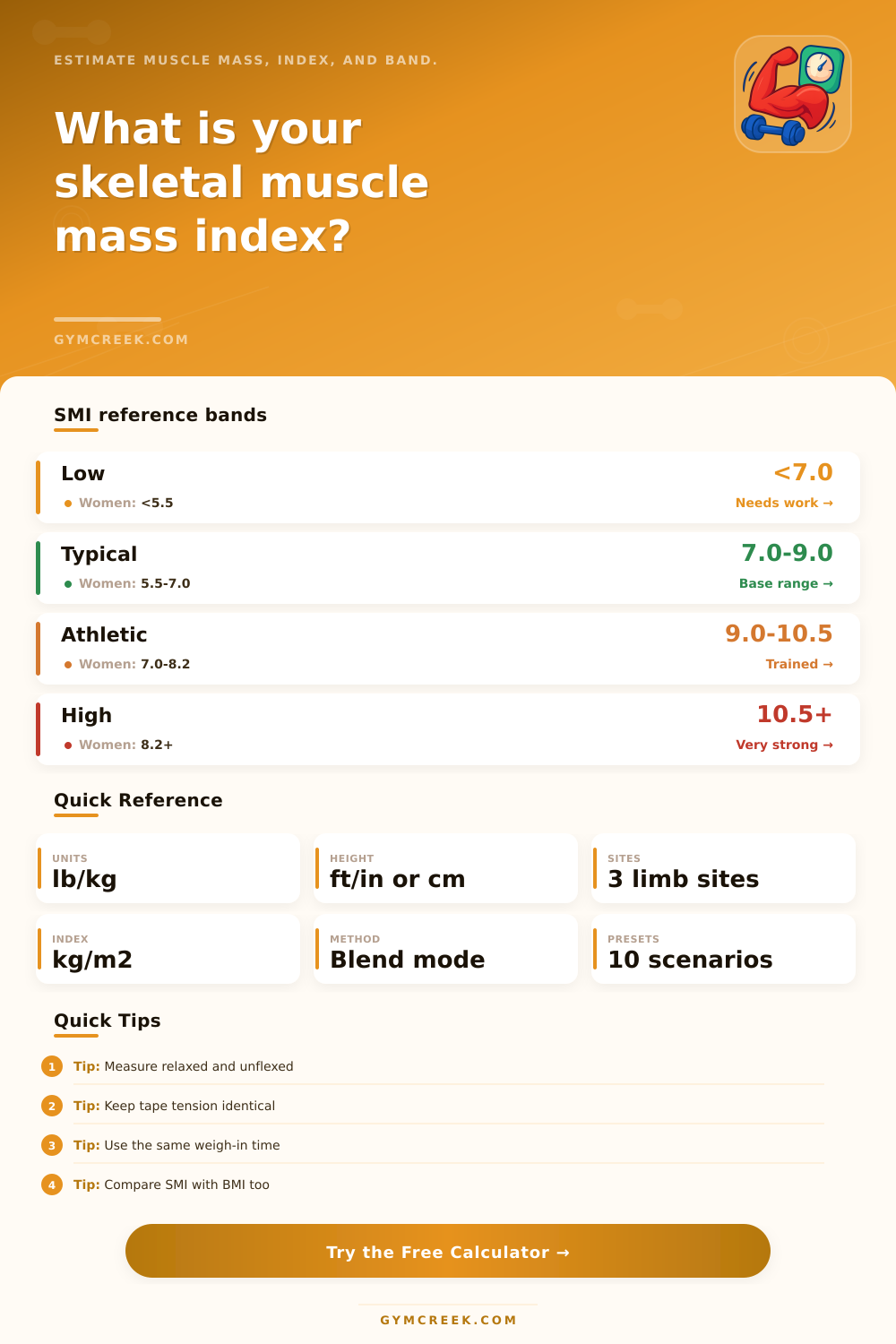
| Band | Men SMI | Women SMI | Interpretation |
|---|---|---|---|
| Low | <8.0 | <6.5 | Worth checking. |
| Typical | 8.0-9.4 | 6.5-7.4 | Normal range. |
| Athletic | 9.5-10.6 | 7.5-8.4 | Strong base. |
| High | 10.7+ | 8.5+ | Very muscular. |
| Site | How to take it | Why it matters | Common error |
|---|---|---|---|
| Arm | Midpoint, relaxed | Upper-limb muscle | Flexing the arm |
| Thigh | Largest or mid | Biggest muscle site | Moving tape angle |
| Calf | Widest point | Lower-limb size | Measuring seated |
| Skinfold | Pinch in mm | Corrects girth | Reading in cm |
| Method | Inputs | Output | Best use |
|---|---|---|---|
| Lee anthropometric | Tape, age, sex | SMM kg | Best with all sites |
| Body-mass shortcut | Weight, height | SMM kg | Fast screening |
| Blended estimate | Both models | Stable SMM | Regular tracking |
| Context layer | Body fat % | Lean share | More context |
| Convert | Factor | Applies to | Note |
|---|---|---|---|
| lb to kg | 0.4536 | Body weight | Imperial input |
| in to cm | 2.54 | Height, tape | Metric output |
| mm to cm | 0.10 | Skinfolds | For correction |
| cm to m | 0.01 | Height | Index formula |
| Days | Profile | Use case | Trend clue |
|---|---|---|---|
| 0-1 | Low volume | Recovery phase | Hold steady |
| 2-3 | Base work | Beginner build | Slow gains |
| 4-5 | Serious train | Strength focus | Nice trend |
| 6+ | High load | Advanced phase | Watch recovery |
Skeletal muscle mass index are a measurement of the amount of skeletal muscle in a persons body. To calculate the skeletal muscle mass index for an individual, someone will divide an individual’s total skeletal muscle mass by the individual’s height, squared. Because muscle mass is measured in kilogram and an individuals height is measured in meters, skeletal muscle mass index is reported in the unit of measurement of kilograms per meter squared (kg/m²).
To determine the amount of skeletal muscle in the body, an individual may use a body scale to determine there body weight. However, body scales does not differentiate between body fat and muscle mass. An individual may use the Body Mass Index (BMI) to determine the amount of body fat and muscle mass in they’re body.
What is skeletal muscle mass index?
However, BMI does not differentiate between the amount of muscle and fat in the body. Therefore, skeletal muscle mass index is a measurement that allow for individuals to spesifically measure the amount of skeletal muscle in their body. Skeletal muscle mass index can be calculated using tape measurement and skinfold measurements of an individual.
Using a tape measure, an individual can measure the circumference of the upper arm, thigh, and calf. The upper arm measurements can reflect the size of the biceps and triceps muscle. The circumference of the thigh reflect the size of the quadriceps muscles.
The circumference of the calf indicates the size of the lower leg muscle. Because the tape measurements reflect the thickness of the muscles plus the thickness of the fat that lies on top of the muscles, skinfold measurement are taken to measure the thickness of the subcutaneous fat. The person will subtract the thickness of the subcutaneous fat from the tape measurement to determine the size of the muscles.
If the thickness of the subcutaneous fat is not subtracted from the tape measurement, the amount of muscle of an individual will be overestimated. Skeletal muscle mass index is calculated by dividing the total skeletal muscle mass by the height, squared. Several factor influence an individual’s skeletal muscle mass index.
For instance, an individual’s age may influence skeletal muscle mass index because the density of muscle mass may decline with age. An individual’s sex can influence the measurement of skeletal muscle mass index because men typically have more muscle mass then women. An individual’s ethnicity may also influence skeletal muscle mass index.
For example, individuals of African descent may have more muscle mass than individuals of Asian descent. The time of day that an individual’s skeletal muscle mass is measured can also influence the measurement of skeletal muscle mass index. For example, person should take muscle mass measurements at the same time of day, and after fasting for an extended period of time.
This is because the carbohydrate in the body may cause the skeletal muscle mass to swell temporary. Based off the calculated skeletal muscle mass index of an individual, ranges of muscle mass can be established for different individuals. For instance, for men, a skeletal muscle mass index of below 8.0 kg/m² is considered low, an index between 8.0 and 9.4 kg/m² is considered typical for active men, between 9.5 and 10.6 kg/m² is considered an athletic range, and any index higher than 10.7 kg/m² is considered very muscular.
For women, a skeletal muscle mass index below 6.5 kg/m² is considered low, and any index higher than 8.5 kg/m² is considered high. These ranges allow an individual to understand their skeletal muscle mass in comparison to others, and to determine if their muscle mass is increasing or decreasing over time. To accurately calculate an individual’s skeletal muscle mass index, there are steps that should be taken to ensure the accuracy of the measurement.
For instance, the muscles should not be flexed when measuring the circumference of the limb. Flexing the muscles will make the circumference of the limbs appear larger then they are when the individual is relaxed. An individual’s calves should not be measured while they are sitting down.
Sitting may compress the calves and make the calf circumference appear more smaller. The amount of tension with which an individual pulls the tape measure should also be the same each time the skeletal muscle mass index is calculated. Using a different amount of tension may create changes in the muscle mass index that dont reflect the true skeletal muscle mass index of the individual.
For an individual to understand the impact of their physical activity on skeletal muscle mass, it is more important to calculate the trends in their skeletal muscle mass index than to look at the measurement of their skeletal muscle mass index alone. For instance, if an individual’s skeletal muscle mass index increases from 8.8 kg/m² to 10.1 kg/m² over a six-month period, the individual is gaining skeletal muscle mass. If an individual’s skeletal muscle mass index remains the same over time, they is maintaining their skeletal muscle mass.
An individual’s skeletal muscle mass index can be used to establish goals for muscle mass. For instance, an individual that is new to strength training may aim to reach the typical range of skeletal muscle mass index for an active man. An intermediate individual may aim for the athletic range.
An older individual can use the skeletal muscle mass index to avoid muscle loss that may occur with the natural aging process.