Body Fat Muscle Mass Water Weight Calculator
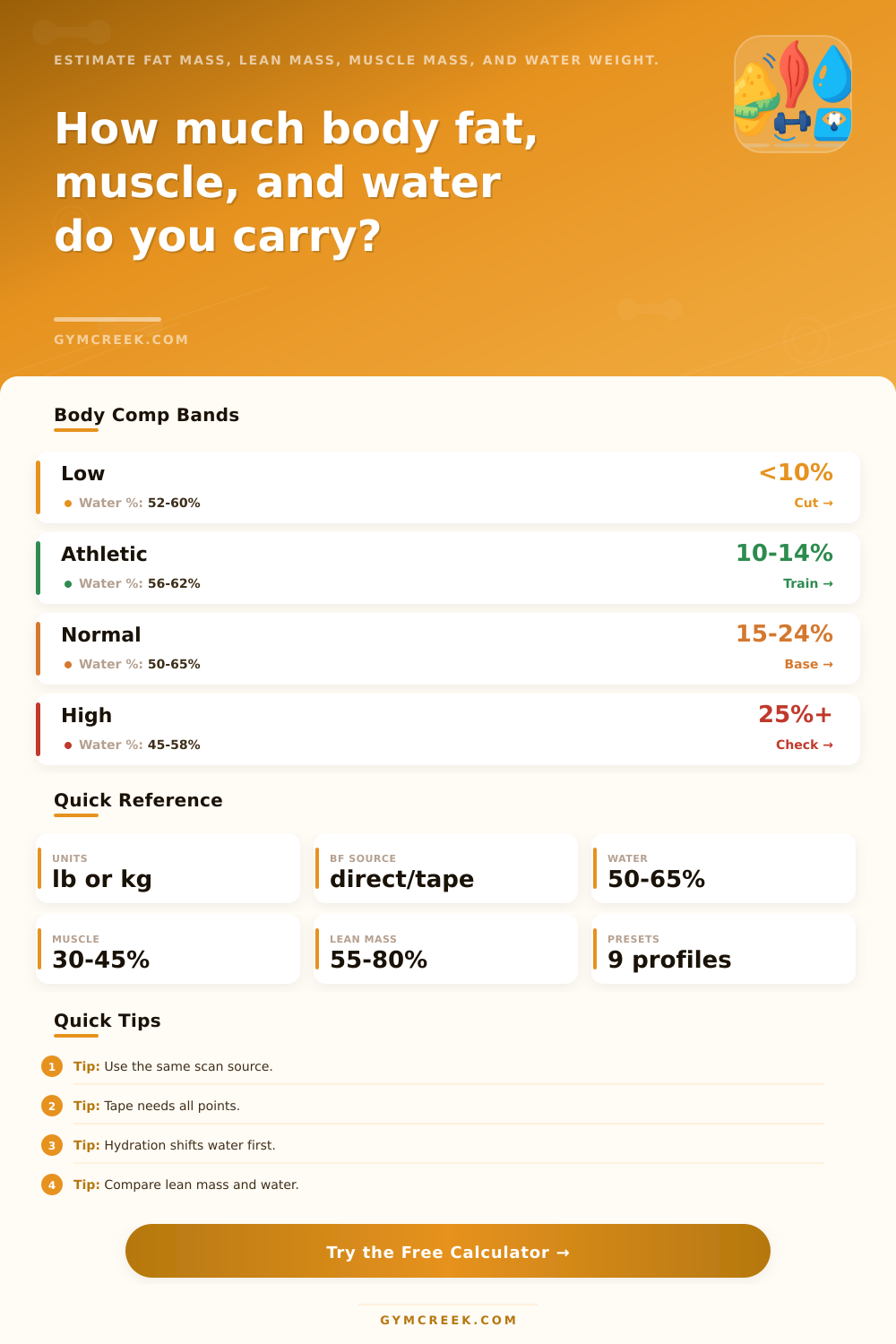
Estimate body fat, fat mass, lean mass, skeletal muscle mass, and total body water with one clean body-composition snapshot.
📌Presets
Each preset loads a realistic body-comp profile and recalculates the numbers immediately.
⚙Calculator
Body composition snapshot
Enter your measurements and the calculator will estimate body fat, muscle mass, and water weight in one view.
📊Body Comp Metrics Grid
📑Reference Tables
| Band | Men | Women | Read |
|---|---|---|---|
| Essential | 2-5% | 10-13% | Vital fat |
| Athletic | 6-13% | 14-20% | Sport lean |
| Average | 14-17% | 21-28% | Typical |
| High | 18%+ | 29%+ | More fat |
| Band | Share | Feel | Use |
|---|---|---|---|
| Low | 45-50% | Dry | Cut check |
| Normal | 50-65% | Stable | Base line |
| High | 66-70% | Full | Bulk view |
| Very high | 70%+ | Soft | Review |
| Band | Ratio | Look | Use |
|---|---|---|---|
| Base | 30-35% | Lean | Start |
| Fit | 36-40% | Tight | Maintain |
| Strong | 41-45% | Dense | Build |
| Huge | 46%+ | Very full | Upper end |
| Formula | Inputs | Output | Use |
|---|---|---|---|
| Fat mass | Wt, BF% | Kg fat | Main result |
| Lean mass | Wt, BF% | Kg lean | Core base |
| Muscle | Lean, ratio | Kg muscle | Share view |
| Water | Age, size | Kg water | Hydration |
💡Tips
Body composition is another method of measuring the different part of a persons body. Body composition is more useful than total body weight because total body weight dont differentiate between the different parts of the body that contribute to a persons total weight. A person’s total weight is only provided for when they stand on a scale.
However, this total weight doesnt provide information for whether a person has gained muscle or whether they are holding more water than before. Body composition breaks down a persons body into the following category: fat mass, lean mass, and water mass. By measuring these category separately for a person, it is possible for that person to understand if they are losing fat mass or if they are building muscle mass.
Body Composition: Fat, Muscle and Water
Fat mass is the total amount of fat contained within a persons body. A person can calculate fat mass by multiplying a persons body fat percentage by the total weight of that individual. Lean mass is the total weight of all of the parts of the body that are not compose of fat.
Lean mass include muscle mass, bone mass, organ mass, and water mass. Muscle mass is a component of lean mass. A variety of factor can influence muscle mass including the number of times a person trains there muscles, the size of a persons frame, and the activity level of that individual.
Thus, muscle mass will have an impact upon the bodys lean mass; an increase in muscle mass will lead to an increase in lean mass. Water weight is one of the component of lean mass. A variety of factors can affect water weight, including the hydration of a persons body, their sodium intake, their carbohydrate intake, and the weather.
Water weight make up a significant portion of lean mass. For instance, if a person is dehydrating, their water weight will decrease. In this case, the individual will weigh less on the scale.
Conversely, if a person consumes foods that are highly in sodium, their water weight will increase; their total weight on the scale will also increase. Thus, it is important for individuals to account for water weight when they are tracking there body composition; water weight can fluctuate significant between days. There are various method to measure body composition.
For instance, tape measurements measure the circumference of the waist, neck, and hips of an individual. This method is considered to be a quick way of estimating the body fat of an individual. More direct scan of the body, such as DEXA scans, are considered to be the most accurate in measuring body composition.
Many individuals choose to blend the methods of measuring body composition. Blending body composition methods allow individuals to use the strengths of both tape measurements and direct scans to find the average body composition of an individual. Averaging body composition measurements allows individuals to smooth out the error in body weight measurements caused by fluctuations in water weight.
Body composition should be measured under specific condition in order to ensure the accuracy of the body composition measurements. For example, an individual should measure body composition when an individual is in a fasted state. Additionally, body composition should be measured at the same time of day every day.
This ensures that an individual does not have a high carbohydrate intake before the composition measurement; high carbohydrates will lead to an increase in water weight. Additionally, an individual should not measure body composition immediately after an individual perform physical exercise. After exercise, the blood flow to the muscles is increased.
Therefore, lean mass will be higher than normal immediately after an individual performs exercise. Finally, if an individual uses different method for measuring body composition, such as using an InBody scale one day and measuring body composition with a tape measure on another day, the body composition measurements will jump from high to low and vice versa; it is important for an individual to use the same method for measuring composition in order to provide valuable information to the individual. An individual’s body composition can change over time.
For example, body composition measurements should be tracked on a weekly basis. If fat mass is decreasing and lean mass is remaining the same or increasing, then the individual is losing body fat but gaining lean mass. If lean mass is increasing but fat mass is remaining the same, then the individual is increasing muscle mass.
If lean mass and fat mass is decreasing, the individual is likely losing lean mass or muscle mass. Additionally, it is also important to track dry lean mass; dry lean mass is lean mass minus water weight. If dry lean mass is increasing, then an individual is likely increasing lean mass and bone density.
Based off the body composition number of an individual, there are various goal that can be set. For instance, if an individuals goal is to lose fat mass, that individual should focus upon decreasing fat mass while attempting to preserve lean mass. If an individuals goal is to gain lean mass, they should focus upon increasing there lean mass, which will also lead to an increase in total body weight and water weight.
Finally, if an individuals goal is to stabilize there body composition, they should focus upon maintaining there current body fat, lean, and water mass. Thus, if an individual understands there fat mass, lean mass, and water mass, they can go beyond there total weight on the scale and understand there body composition.