Max Muscle Mass Calculator
Estimate your lean-mass ceiling, current FFMI, and the scale weight you can carry at a chosen body-fat level.
📌Presets
Each preset loads a realistic muscle-building profile, updates the unit labels, and recalculates the ceiling immediately.
⚙Calculator
Muscle ceiling snapshot
Enter your stats and the calculator will estimate the lean-mass ceiling, scale-weight ceiling, and current gap.
📊Muscle Metrics Grid
📑Reference Tables
| FFMI | Band | Lean | Note |
|---|---|---|---|
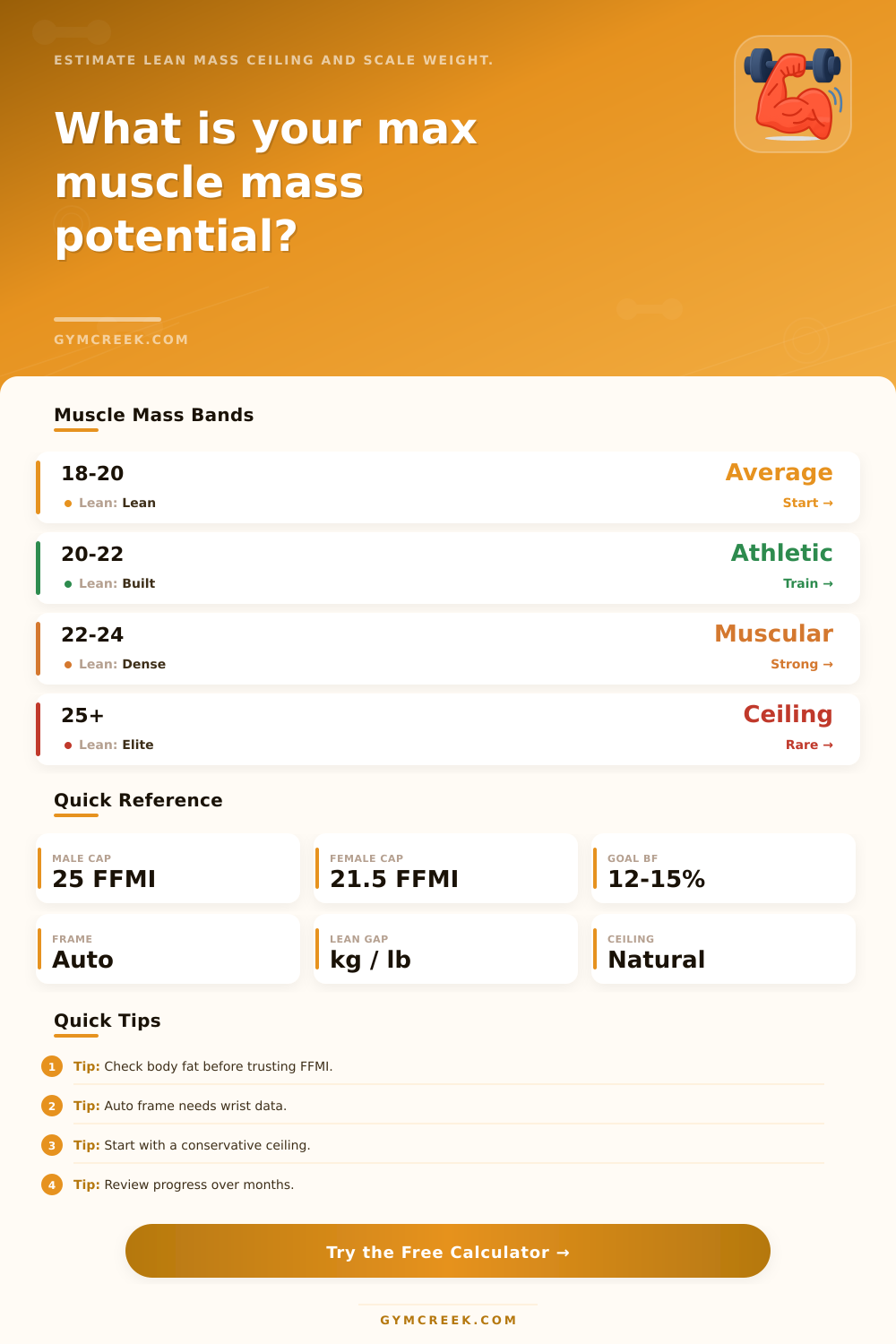
| 18-20 | Average | Lean | Start |
| 20-22 | Athletic | Built | Train |
| 22-24 | Muscular | Dense | Strong |
| 25+ | Ceiling | Elite | Rare |
| Ratio | Frame | Adj | Use |
|---|---|---|---|
| <0.104 | Small | -0.7 | Fine |
| 0.104-0.112 | Medium | 0.0 | Base |
| 0.112-0.120 | Large | +0.7 | Broad |
| 0.120+ | XL | +1.0 | Heavy |
| BF% | Look | Use | Notes |
|---|---|---|---|
| 6-8% | Stage | Show | Dry |
| 8-12% | Lean | Sharp | Photo |
| 12-15% | Fit | Solid | Offseason |
| 15-18% | Full | Bulk | Safer |
| Scenario | Profile | Target | Outcome |
|---|---|---|---|
| Desk lifter | 176 lb, 16% | 12% | Lean build |
| Hybrid runner | 154 lb, 13% | 10% | Small frame |
| Mass block | 202 lb, 19% | 15% | Large frame |
| Master lifter | 174 lb, 17% | 12% | Slow gain |
| Formula | Inputs | Output | Use |
|---|---|---|---|
| FFMI | Lean / h2 | Index | Mass ceiling |
| Lean mass | Wt x (1-BF) | kg / lb | Current base |
| Frame | Wrist / ht | Adj | Size bias |
| Scale wt | Lean / (1-BF) | Goal wt | Chosen BF |
💡Tips
Maximum muscle mass potential are determined by several factor. Understanding the maximum muscle mass potential allow an individual to set realistic goals for themself. The maximum muscle mass potential for an individual isnt a mystery; they bone structure, their training experience, and their body fat percentage determine it.
By understanding an individual’s maximum muscle mass potential, they can train for their maximum potential rather than becoming frustrate when they dont see new result in their training. Many individuals who attempt to gain muscle for themself consume large amount of food over a long period of time. In many instances, though, those who follow this method find that they are gaining body fat rather than muscle mass.
Find Your Maximum Muscle Mass
One way to measure an individual’s muscle mass is through the Fat-Free Mass Index, or an FFMI. FFMI is a measurement of an individual’s lean body mass divided by their height in meter and then squared. This measurement allow for individuals of different heights to have their muscle mass compared to others with different heights.
An FFMI between 18 and 20 is considered average for an individual who has completed their training. An FFMI between 20 and 22 is considered to be the measurement of an athletic individual. An FFMI between 22 and 24 is considered to be highly muscular.
For man, an FFMI of 25 or higher is considered to be an elite level of muscularity. For women, an FFMI of 21.5 or higher is considered to be an elite level of muscularity. Several factor determine an individual’s maximum muscle mass potential.
The frame size of an individual is one of the factor. Their bone structure determines an individual’s frame size; thick wrist, for example, indicate a larger frame size. The training experience of an individual is another determining factor.
Beginners will often gain muscle at a faster rate than individuals with more experience in the gym. An individual’s age is another potential determining factor for their maximum muscle mass. The rate at which an individual muscles recover from muscular exertion decrease after the age of 30.
The last factor is the body fat percentage of an individual. To accurately measure body fat percentage, a person can use tool like calipers or a DEXA scan. Scales will provide an incorrect body fat percentage because their weight include both muscle and body fat mass.
An individual can use the FFMI to calculate the amount of muscle an individual has left to gain. For instance, an individual with an FFMI of 19 can compare that to the FFMI of 23 that is calculate as their muscle mass ceiling. That individual will know that they have some room to grow.
Using this calculation, an individual will realize that they cant gain muscle mass beyond their ceiling. Their frame size determines the ceiling of an individual. An individual with a smaller frame will have a lower ceiling for their muscle mass than an individual with a larger frame size.
In addition to calculating an individual’s FFMI and knowing their maximum muscle mass potential, there are additional factor that must be considered for gaining muscle mass. An individual must incorporate specific training and nutritional habit to maximize their muscle gain. An individual who is looking to gain muscle must incorporate the concept of progressive overload.
Progressive overload is a training concept that suggests that an individual must gradually increase their repetition, sets, or the amount of weight that they lift. An individual also need sleep to gain muscle. If an individual does not get enough sleep, their potential for gaining muscle decrease.
An individual must consume enough protein to support their growing muscle. A common recommendation is for an individual to consume 2 gram of protein per kilogram of body weight. Additionally, an individual should consume enough carbohydrate for energy and enough fats for hormonal health.
Finally, an individual should track their muscle mass using the average measurement each individual gains each month. Daily measurement will fluctuate from individual to individual. By measuring the average monthly muscle mass, an individual will be able to see whether or not their muscle mass is increasing.
By knowing an individual’s maximum muscle mass potential, they can focus their effort to reach their realistic goal. By knowing their maximum muscle mass potential, an individual ensure that they are not wasting their time and effort to achieve goal that are impossible to achieve.