🩸 Creatinine Clearance Calculator — Ideal Body Weight
Cockcroft-Gault CrCl using Devine IBW or Adjusted Body Weight for obese patients. Includes kidney function staging.
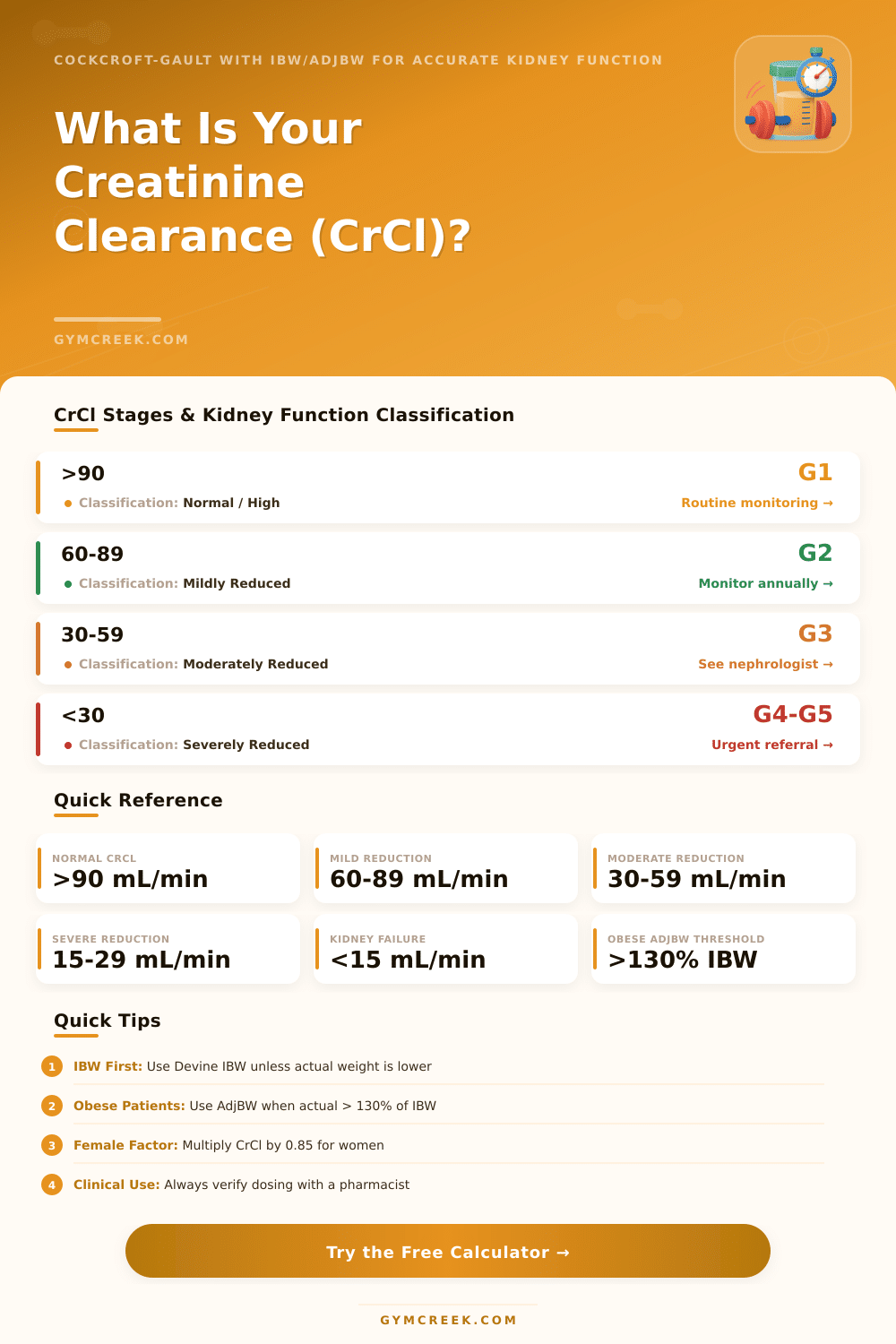
| CrCl (mL/min) | Stage | Classification | Recommended Action |
|---|---|---|---|
| >90 | G1 | Normal or High | Routine monitoring |
| 60–89 | G2 | Mildly Reduced | Annual monitoring |
| 45–59 | G3a | Mildly-Moderately Reduced | See specialist |
| 30–44 | G3b | Moderately-Severely Reduced | Nephrology referral |
| 15–29 | G4 | Severely Reduced | Urgent nephrology |
| <15 | G5 | Kidney Failure | Dialysis evaluation |
| Situation | Weight to Use | Threshold |
|---|---|---|
| Actual weight ≤ IBW | Actual Body Weight | Actual ≤ IBW |
| Slightly overweight | Ideal Body Weight (IBW) | Actual ≤ 130% of IBW |
| Obese (>130% IBW) | Adjusted Body Weight (AdjBW) | Actual > 130% of IBW |
| AdjBW Formula | IBW + 0.4 × (Actual – IBW) | — |
creatinine clearance estimates how many creatinine your kidneys remove from the blood plasma during a set time. That method is an easy and cheap way to check kidney function, without big costs. The testing happens by comparing the creatinine amount in the urine with that in the blood.
If the kidneys do not work well the creatinine starts to build up in the blood, because less of it passes in the urine.
How Creatinine Clearance Checks Kidney Function
Creatinine comes from the breakdown of creatine in the muscles of your body. After production, the kidneys filter it and almost everything exits through the urine. The production stays fairly steady and depends mainly on the muscle mass, weight and height of the body.
One reports the clearance in milliliters per minute or milliliters per second, depending on the used laboratory.
For men normal creatinine clearance falls between 97 and 137 mL/min. For women it usually reaches from 88 to 128 mL/min. If the results sink to 30, 59 mL/min, that shows mildly reduced kidney function.
The doctor must estimate your exact value according to context, age, general helath and other factors play a big role.
There is a clear tie between creatinine clearance and GFR (glomerular filtration rate), but hear the main point: they are not the same thing. The creatinine clearance result is a bit higher than the real GFR, because the creatinine not only filters in the glomerulus, but also gets released from the nearby tubule. This extra release in the nephron causes the different numbers.
The Cockcroft-Gault formula is the most commonly used way to estimate creatinine clearance. It counts the clearance according to the level of creatinine in the serum. The equation ties age, weight and values of serum creatinine.
Scientists created it in 1973 using data from 249 men. The quirk is that it does not consider the body surface area. That is the point of the calculation, serum creatinine value alone can not show your clearance.
Muscle mass drives all of this. Bigger muscle produces more creatinine, because it is a natural product of metabolism. Worth noting: hard exercise periods raise the serum creatinine, because the muscles release more of it in the blood, but that does not touch the real GFR.
The Cockcroft-Gault formula commonly underestimates the clearance in people with high muscle mass and higher baseline of creatinine production. Also, muscle naturally drops with the years, so older men commonly have lower serum creatinine levels.
If one builds an eGFR formula from data of thousands of average folks, some with much less muscle than the standard could get a wrong result. One can estimate creatinine clearance directly using serum creatinine, urinary creatinine and the volume of urine together. The 24-hour urine collection method is seen as the older approach, and with good reason, because exact collection of urine during a wholeday is truly very hard and prone to mistakes.