🏋 Bench Press Percentage Calculator
Find your training weights at any percentage of your 1RM bench press
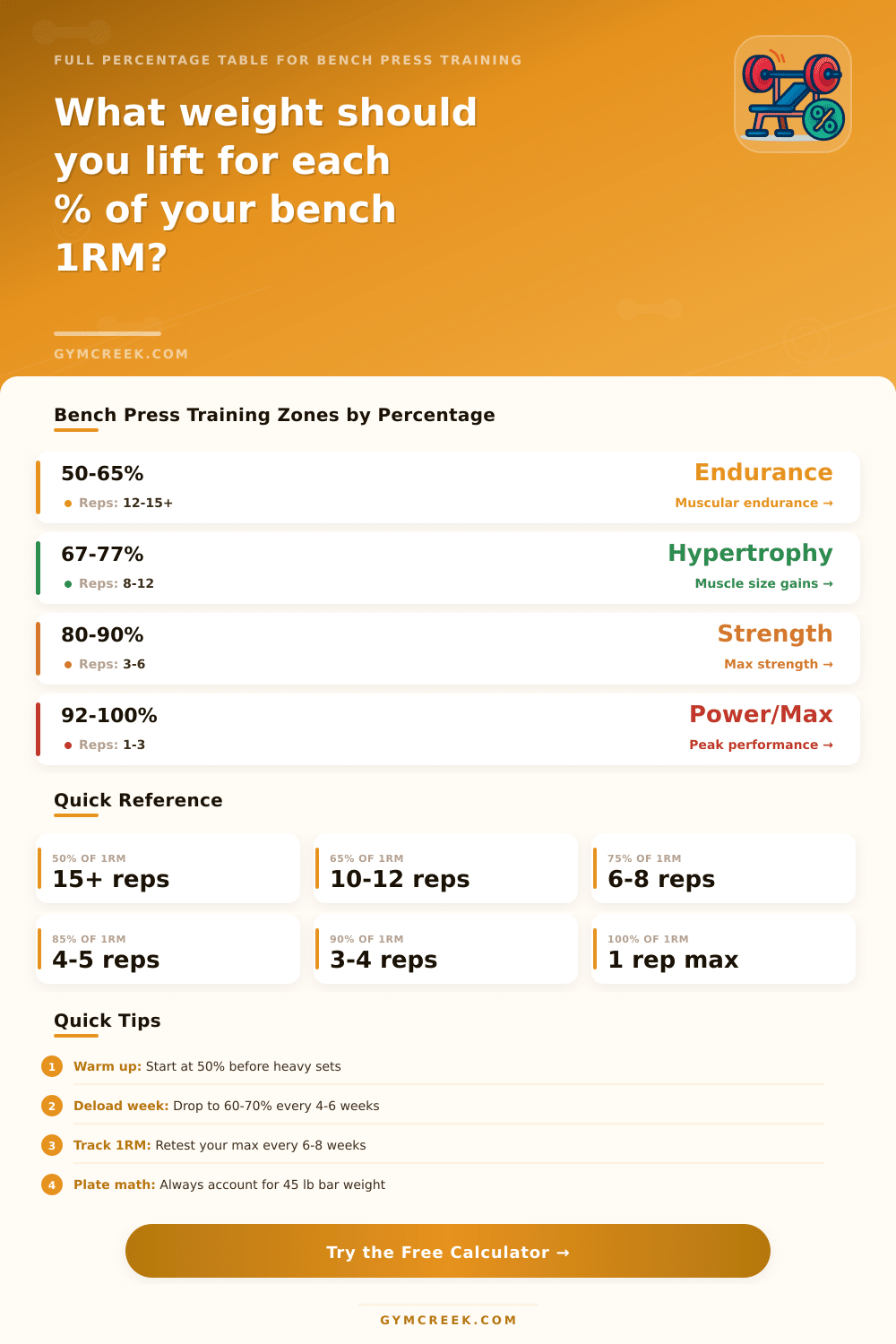
| % 1RM | Weight (lbs) | Weight (kg) | Rep Range | Training Zone |
|---|---|---|---|---|
| 50% | — | — | 15+ | Endurance |
| 55% | — | — | 12-15 | Endurance |
| 60% | — | — | 10-12 | Endurance |
| 65% | — | — | 10 | Endurance |
| 70% | — | — | 8-10 | Hypertrophy |
| 75% | — | — | 6-8 | Hypertrophy |
| 80% | — | — | 5-6 | Strength |
| 85% | — | — | 4-5 | Strength |
| 90% | — | — | 3-4 | Strength |
| 95% | — | — | 2-3 | Power/Max |
| 100% | — | — | 1 | Power/Max |
| Zone | % Range | Rep Range | Rest Between Sets |
|---|---|---|---|
| Endurance | 50–65% | 12–15+ | 30–60 sec |
| Hypertrophy | 67–77% | 8–12 | 60–90 sec |
| Strength | 80–90% | 3–6 | 2–4 min |
| Power / Max | 92–100% | 1–3 | 4–5 min |
| Total Weight (lbs) | Per Side (lbs) | Plates per Side | Zone |
|---|---|---|---|
| 95 | 25 | 1×25 | Beginner |
| 115 | 35 | 1×25 + 1×10 | Beginner |
| 135 | 45 | 1×45 | Intermediate |
| 155 | 55 | 1×45 + 1×10 | Intermediate |
| 185 | 70 | 1×45 + 1×25 | Intermediate |
| 205 | 80 | 1×45 + 1×35 | Advanced |
| 225 | 90 | 2×45 | Advanced |
| 245 | 100 | 2×45 + 1×10 | Advanced |
| 275 | 115 | 2×45 + 1×25 | Strong |
| 315 | 135 | 3×45 | Elite |
The Bench Press is an exercise for strength where a person pushes weight upward, while lying on a bench for weight training. One lowers the weight until the chest and later pushes it upward while straining the arms. For this move one can use a barbell or a pair of dumbbells.
It is a compound exercise, so it uses several muscles together. Main muscles that it uses are the pectoralis major, the front deltoids and the triceps. Also the core works during the whole move.
How to Do the Bench Press
The Bench Press ranks between the most useful exercises for building muscles and strength in the upper part of the body. It is that upper-body move, by means of which one can raise the biggest weight. It involves more upper-body muscle mass than any other exercise for the upper body.
Good technique is important. Before removing the barbell the position already should be ready. The back should be flat, the shoulders drawn together and the feet flat on the floor.
A closed base helps to push strongly. The legs can press against the bench to help the move upward. Think about bending the barbell in U-shape by means of the hands, which helps to bend the elbows naturally and use the lats, while protecting the shoulders.
Take a deep breath and keep it to strain the abdomen before lowering the barbell. That breath keep until passing the most difficult part of the press, later breathe out strongly while pushing upward.
Failing in the middle of the press commonly shows weak deltoids. Failing beside the chest usually points to weak pectorals or lats. Bench Press with dumbbells and heavier sets can help beat such problems.
Close-grip Bench Press and dips serve as helpful exercises. Skull-crushers and JM-presses more well help the Bench Press then tricep pushdowns.
Training the Bench Press three times weekly with different sets of reps and high volume is a good method. Frequency is key for progress in this move. Work in the heavy range of eight to twelve reps and in the endurance range of fifteen to thirty reps during four to six weeks helps to beat plateaus.
Changing the program by means of various sets, reps and weights is a good way tosurprise the body and escape stalling.
Dumbbells well replace the barbell, but one usually can raise less weight because of a more unstable position. Combining flat Bench Press with incline and decline versions hits the chest from various directions and stimulates the upper, middle and bottom parts of the pectorals. Incline Bench Press widely requires less weight than flat or decline versions, and that is entirely normal.
A stronger chest and triceps from Bench Press can improve results in push-ups, handstand push-ups and muscle-ups. Controlled reps with good form always beat hoisting of heavy weight with bad technique.