Critical Swim Speed Calculator
Use two hard pool trials to estimate critical swim speed, then map that pace into repeat targets, zone splits, and send-offs that fit a real pace clock instead of guesswork.
📌Lane Presets
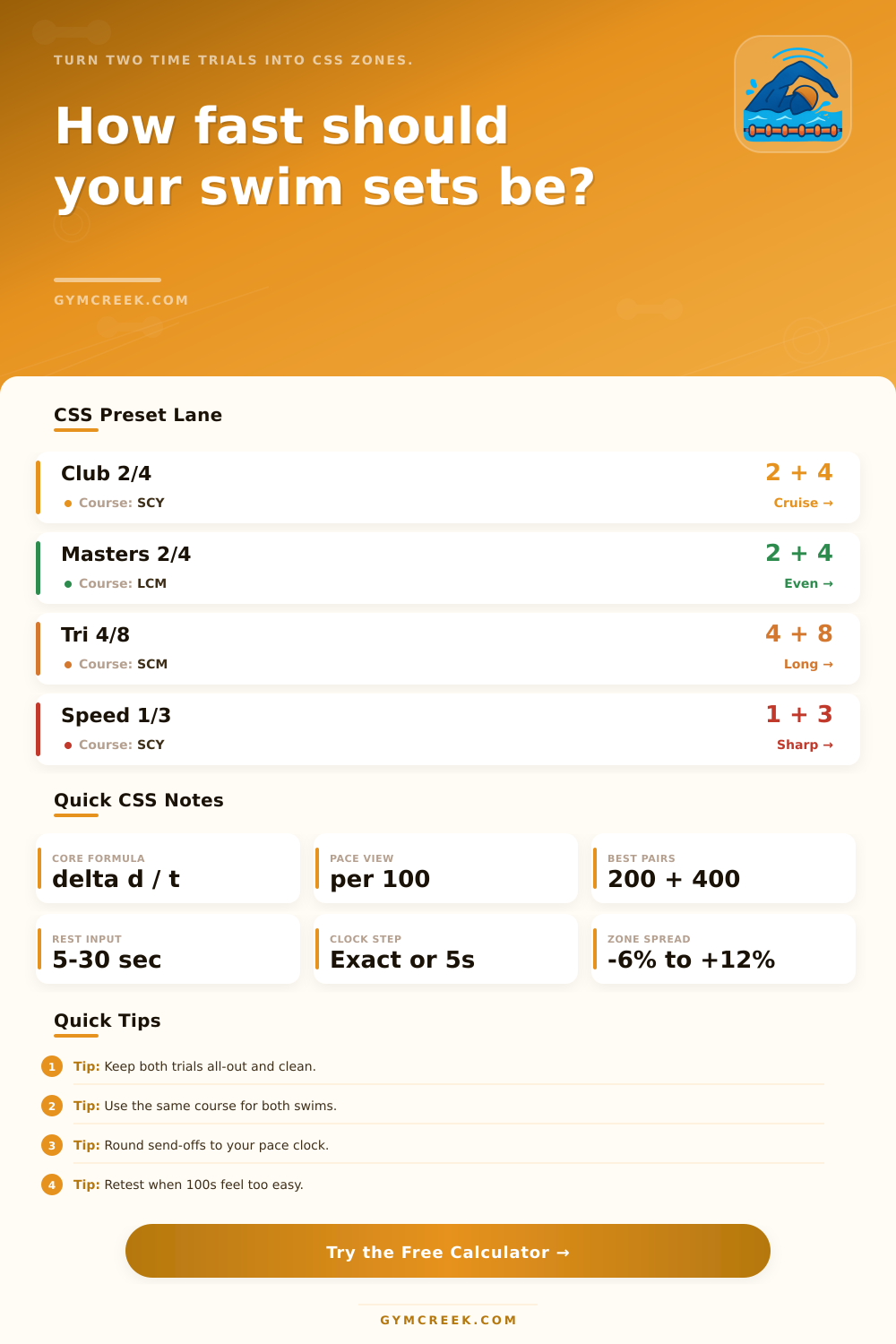
These nine presets cover sprint-biased pairs, traditional 200 and 400 CSS tests, distance builds, and longer triathlon checks so you can compare how trial choice changes pace targets and send-off spacing.
⚙CSS Inputs
Critical swim speed snapshot
Enter two valid swim trials to calculate CSS pace, zone targets, and pace-clock send-offs.
📊Pool Metrics Grid
📑Reference Tables
| Line | Distance | Time | Pace / 100 |
|---|---|---|---|
| Short | -- | -- | -- |
| Long | -- | -- | -- |
| Delta | -- | -- | -- |
| Zone | Pace / 100 | 50 split | 200 split |
|---|---|---|---|
| Recovery | -- | -- | -- |
| Aerobic | -- | -- | -- |
| CSS | -- | -- | -- |
| Threshold | -- | -- | -- |
| Race touch | -- | -- | -- |
| Rep | CSS swim | Exact off | Clock off |
|---|---|---|---|
| 50 | -- | -- | -- |
| 100 | -- | -- | -- |
| 150 | -- | -- | -- |
| 200 | -- | -- | -- |
| Lever | Rule | Effect | Use |
|---|---|---|---|
| CSS core | distance delta / time delta | Builds pace per 1 unit | Any two hard trials |
| Per 100 pace | 100 / CSS speed | Turns CSS into a repeat target | Main aerobic sets |
| Lens spread | Recovery to race pace bands | Moves zone targets wider or tighter | Build or taper weeks |
| Send-off | Swim time + rest, then round up | Fits the pace clock cleanly | Lane sharing and interval sets |
💡Deck Tips
Pick trials that are hard but controlled. A messy first 100 or a missed turn skews CSS more than most swimmers expect, especially on short test pairs like 100 and 300.
Match send-off rounding to your actual clock habits. If your lane leaves on ':05' marks, a neat rounded send-off is more useful than an exact pace nobody can hit consistently.
Critical Swim Speed, or CSS for short, is the rate at which a person can perform aerobic exercise for an extended period. Critical Swim Speed is a scientific measurement of the rate at which a swimmer can swim for a long period of time without feeling tired. CSS are used to determine training zones for swim athlete because CSS determines the baseline rate at which a swimmer can perform aerobic exercise.
By calculating Critical Swim Speed, an individual can determine the pace at which an individual should swim during training to maximize benefit and avoid exhaustion. However, if an individual calculates Critical Swim Speed incorretly, they may find themself either swimming too fast and eventually becoming too tired after long period of swimming, or swimming too slow and failing to provide the benefits that they needed from there training. To find Critical Swim Speed, two time trials are performed in a swimming pool.
Critical Swim Speed: What It Is and How to Find It
One of the time trials is to swim a short distance in the pool as fast as the swimmer can swim. The other time trial is to swim a long distance in the pool as fast as the swimmer can swim. The same pool should be used for both time trials.
Subtract the distance covered in the short trial from the distance covered in the long trial. This creates a delta, which is used to calculate the Critical Swim Speed of the swimmer in units of 100 meter or 100 yards. Swimming intervals of both short and long distances is a more accurate means of finding a swimmers Critical Swim Speed than swimming only during one time trial.
This is due to the chance of errors during only one trial, such as only being able to find the swimmers peak performance for a short distance, or the swimmers endurance for a long distance. Based off the Critical Swim Speed of an individual, zones can be established for training. The aerobic zone for training is slightly slower than the swimmers Critical Swim Speed.
This zone is used for training that involves steady swimming. The threshold zone is slightly faster than the swimmers Critical Swim Speed. This zone is used for high-intensity swimming training.
The recovery zone for swimming is much slower than the swimmers Critical Swim Speed. This zone is used to allow the muscles to recover after long periods of swimming. The race pace zone for swimming is faster than the swimmers Critical Swim Speed.
Swimmers use this zone as a means of training for competition. These training zones can be adjusted according to what a swimmer wishes to train there body to do, whether that be improve their aerobic endurance, or improve their ability to swim fast for races. Critical Swim Speed can be used to determine the send-offs for intervals within a swim set.
The send-off is the amount of time between each interval. Rest periods can be included between each interval, although the length of the rest periods can last between 5 and 30 second. The send-offs should be rounded to the nearest interval on the swimmers training clock.
For instance, if a swimmer swims a 100-meter interval at their Critical Swim Speed, they might want to allow 15 second for each interval to rest between each interval. By using Critical Swim Speed to calculate the send-offs, the swimmer ensures that the intervals during their training are not random. By using Critical Swim Speed for determining the send-offs for each interval, the swimmer ensures that each interval is based upon the bodys ability to sustain that interval.
However, there are some mistake that should of been avoided when performing the test to find Critical Swim Speed. The swimmer must ensure that their technique while swimming is clean and correct. If the swimmer uses excessive power when performing a push-off from the pools starting line, the short trial might produce a faster rate than the swimmers Critical Swim Speed.
In this case, the swimmers Critical Swim Speed will appear to be too fast. Retesting of Critical Swim Speed can be performed every few months to monitor the swimmers improvement or decline in fitness. A swimmer can also track a specific metric called pace drift.
This metric measures the difference between the pace during the short trial and the pace during the long trial. If a swimmer experiences a significant slowing of pace during the long trial compared to the short trial, this indicates that the swimmer might need to improve their endurance or technique in the pool.