Running Stride Length Calculator
Estimate running stride length from cadence, pace, speed, height, inseam, uphill grade, and a measured route so you can compare body-based math against what actually happened on the ground.
📌Preset Run Profiles
The nine presets preload realistic running data so you can compare easy mileage, structured workouts, uphill sessions, treadmill efforts, and route-based cross-checks without rebuilding the form each time.
⚙Running Inputs
Steady stride snapshot
Use cadence, pace, speed, and a known route to compare your modeled stride from more than one angle.
📊Metrics Grid
📑Reference Tables
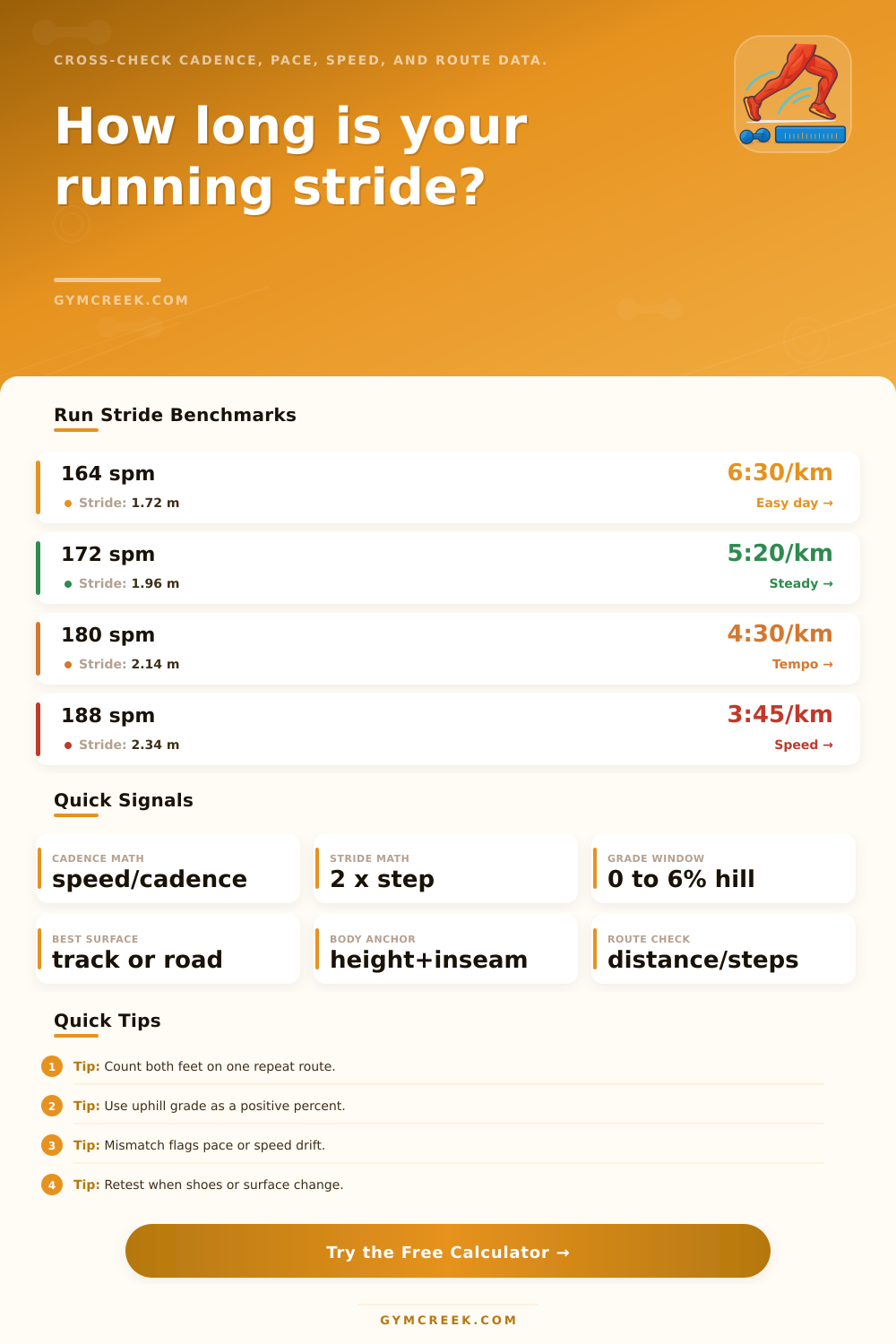
| Profile | Cadence ref | Pace ref | Step aim |
|---|---|---|---|
| Recovery easy | 164 spm | 6:30 / km | 0.86 m |
| Steady aerobic | 172 spm | 5:20 / km | 0.98 m |
| Tempo | 178 spm | 4:30 / km | 1.07 m |
| Interval | 188 spm | 3:25 / km | 1.18 m |
| Grade | Stride shift | Best use | Cue |
|---|---|---|---|
| -3% to -1% | Slightly up | Controlled descents | Do not overstride |
| 0% to 1% | Neutral | Track or flat road | Best comparison zone |
| 2% to 4% | Shorter | Bridge ramps | Cadence often rises |
| 5% to 8% | Much shorter | Hill repeats | Use route cross-check |
| Route | Why it helps | Best for | Watch for |
|---|---|---|---|
| 200 m straight | Quick recounts | Easy form checks | Small count errors |
| 400 m lap | Known distance | Track workouts | Lane choice drift |
| 1 km split | Steady load | Base or tempo runs | GPS smoothing |
| Treadmill block | Repeatable speed | Indoor tests | Belt calibration |
| Step length | Stride length | Steps per km | Read |
|---|---|---|---|
| 0.85 m | 1.70 m | 1176 | Easy turnover |
| 0.98 m | 1.96 m | 1020 | Steady rhythm |
| 1.08 m | 2.16 m | 926 | Tempo range |
| 1.18 m | 2.36 m | 847 | Fast repeat |
💡Practical Tips
Use the same route, shoe, and watch mode every time you retest. Consistency matters more than chasing a single perfect stride number.
If pace and speed disagree by more than a few percent, trust the cleaner source first, then use the cross-check distance to settle the final stride.
Stride length are the distance covered from one foot strike to the next foot strike. Stride length is an essential element of running as stride length will determine how efficient a runner can cover the distance. While many runners may focus on there target pace or distance goal, stride length is one of the primary component of efficiency in running.
If an individual runner dont manage their stride length correctly, they will waste energy during their run. In order to understand stride length, one must understand the relationship between speed, stride length, and cadence. Cadence is the number of steps taken per minute.
How Stride Length Affects Running
An individual can calculate stride length by taking an individual’s speed divided by their cadence. Stride length and speed are calculated in relation to cadence, meaning that each of these can not be measured without the other two variable. An individual’s terrain will also affect their stride length.
For instance, when an individual is running uphill they will take short strides compared to when they are running on even terrain. An individual’s body dimension will also play a role in their stride length. An individual’s height and inseam length will ultimately determine the limit of how far their legs can extend while running.
In other words, the taller an individual is the more longer their stride will be, but their inseam length will dictate how far their leg can extend with each stride. Many runners aim for a cadence of 180 step per minute. However, 180 steps per minute may not be the best cadence for all types of run.
For instance, during a recovery run an individual may have a cadence of 165 steps per minute, which allow for longer strides. In tempo runs, with a higher target speed, the individual will have a higher cadence with potentially change stride length due to fatigue. An individual can calculate their stride length by measuring their speed, cadence and body measurement.
The individual can then cross-check the calculated stride length with the number of steps taken over a known route. If the calculated stride length do not match the measured stride length, then there is an error in the data collected from the GPS tracker. Data can become wobbly when GPS trackers measure stride length due to wind affecting an individual’s pace.
If the calculated and measured stride lengths match, then an individual can have more confidence in the data collected from the GPS tracker. The grade and incline at which an individual is running will change how stride length work. When individuals incorporate inclines into their run, the muscles have to work against the force of gravity to move the individual forward.
As a result, the strides will be shorter with a higher cadence when individuals are running uphill. When running down hills, individuals may tend to take longer strides which put more force on the quadriceps muscles. On the other hand, on flat ground with no incline or declines, individuals will have the best stride length for measurement.
Depending on the type of run an individual takes, they will have a different stride length. When performing recovery runs, individuals will take shorter strides with a higher turnover rate for the body to recover. For tempo runs to increase an individual’s speed, they will have a longer stride length with a higher cadence.
These stride length profiles can be used to test how stride length change during different types of workouts. An individual’s shoes and the surface on which they run will also affect their stride length. For instance, minimalist shoes will allow an individual to take their natural stride length.
Maximal cushioning shoes are for absorb the impact on an individual’s body during long runs. For individuals who run on sand or wet roads, they will have to take shorter and more quickly strides to maintain there grip on the ground. When an individual is fatigued during a long run, their form may change which will result in a decay of their stride length.
An individual should avoid force their stride length to be longer to increase their running speed. Forced stride lengths can put more stress on an individual’s body which can result in more injury. An individual should find a balance between their stride length and cadence to their running speed to improve efficiency.
Short strides should be used when running on hills or when an individual is fatigued. For flat ground, an individual should use a longer stride to maintain their running speed. By measuring an individual’s stride length, cadence, speed, and grade, an individual can make better decision regarding how to run their races.