Incline Bench to Flat Bench Calculator
Estimate what an incline bench set may mean for flat bench strength by blending angle share, rep math, source setup, grip, pause style, and bench-specific transfer skill.
📌Incline Transfer Presets
These nine presets cover common 30 degree work, lower-angle pressing, dumbbells, Smith machine carryover, return-to-bench phases, and more competition-style flat bench transfers.
⚙Incline Bench Inputs
Estimated flat bench profile
Enter an incline set to estimate flat-bench strength, same-rep load, and planning numbers.
📊Bench Transfer Metrics
📑Reference Tables
| Angle | Flat share | Typical gap | Read |
|---|---|---|---|
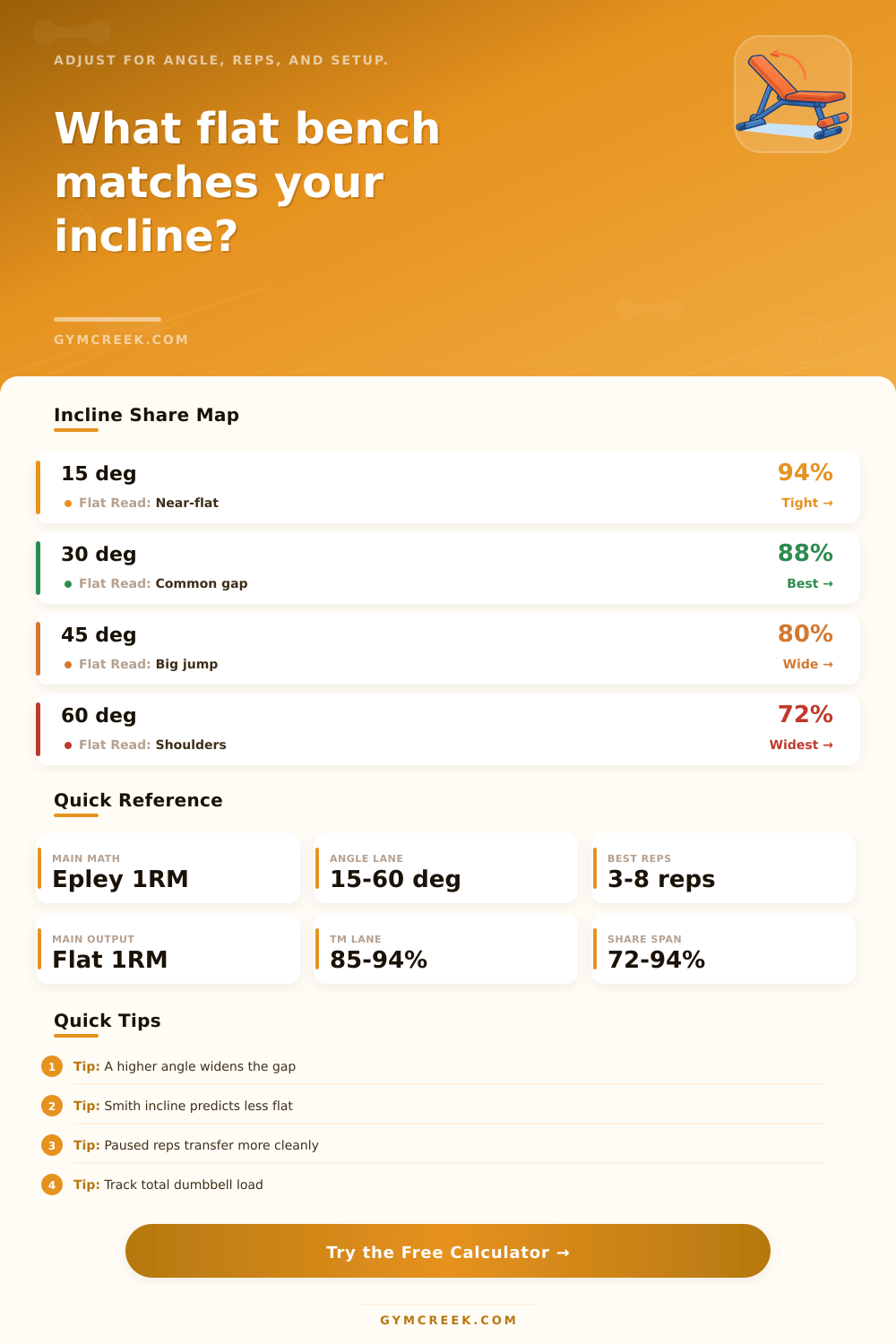
| 15 degrees | 0.94x | 6% gap | Almost a low incline press. |
| 30 degrees | 0.88x | 12% gap | Most common commercial setup. |
| 45 degrees | 0.80x | 20% gap | Upper chest bias widens the jump. |
| 60 degrees | 0.72x | 28% gap | Closer to a seated press line. |
| Choice | Factor | Main effect | Use case |
|---|---|---|---|
| Dumbbells total | 1.03x | Flat barbell is often higher. | DB to barbell transfer |
| Smith machine | 0.93x | Guided path overstates free bench. | Machine-heavy gyms |
| Close grip | 0.97x | More triceps, less max carryover. | Narrow shoulder setups |
| Paused first rep | 1.02x | Cleaner chest start. | Meet-style or strict touch |
| Lane | Men | Women | Read |
|---|---|---|---|
| Base | Under 1.00x | Under 0.70x | Early flat bench base. |
| Solid | 1.00-1.34x | 0.70-0.94x | Good recreational bench. |
| Strong | 1.35-1.69x | 0.95-1.19x | Clear barbell strength. |
| High | 1.70x+ | 1.20x+ | Plan attempts carefully. |
| Snapshot | Incline set | Flat read | Context |
|---|---|---|---|
| Garage lifter | 185 x 6 | 225-235 | 30 degrees, barbell |
| DB presser | 160 x 8 | 205-220 | Total DB load |
| Meet return | 205 x 4 | 250-265 | Paused low incline |
| Smith regular | 225 x 5 | 240-255 | 30 degrees Smith |
💡Bench Tips
Another method for determining an individuals bench press strength is by using an incline bench press. An incline bench press at a 30-degree incline is approximately 88 percent of the strength of an individual’s flat bench press strength. An incline bench press is considered to be weaker than a flat bench press due to the change in the angle of the torso, as well as the difference in the muscle groups that is required to perform the exercises.
Bench pressing exercises in the flat style allow for the body’s gravity to work in the body’s benefit in that it allows for the lower pectoral muscles of the chest, as well as the latissimus dorsi muscles of the back, to engage in the exercise. An incline bench press, however, forces the body into an angle where the shoulders must perform some of the works of the exercise. At different incline angles, the incline bench press strength is thought to be able to translate to the flat bench press strength.
Guess Flat Bench Press Strength from Incline Bench Press
An incline bench press with an incline angle of 15-degree is similar to a flat bench press in that a 15-degree incline bench press may be only about 6 percent weaker than an individuals flat bench press strength. A 30-degree incline is a more common incline angle for bench press exercises, but a 30-degree incline is approximately 12 percent weaker than the strength of an individual’s flat bench press. Bench pressing with angles between 30 and 45 degrees, however, introduces the potential of the exercise to mimic a shoulder press; at 45 degrees, an incline bench press is approximately 20 percent weaker than the flat bench press strength of an individual.
At 60 degrees of incline, the incline bench press is even less effective at estimating the individuals flat bench press strength. In addition to the angle of the incline bench press, the type of equipment that is used can also influence the accuracy of the determination of an individuals bench press strength. A barbell incline bench press will translate to the individuals barbell bench press strength.
A dumbbell incline bench press, however, require more stabilization from the individual, which means that an individual may be able to bench press more weight on a flat dumbbell bench press than with a barbell. The same is true of a Smith machine incline press; an incline bench press on a Smith machine will overstate the strength of an individuals free-weight flat bench press strength. Additionally, the grip width used can influence the strength between incline and flat bench pressing; a close grip bench press use more triceps strength than a flat bench press, while a wide grip bench press is closer to the strength of a flat bench press.
The number of repetitions of an incline bench press can also help to determine the strength of an individuals flat bench press by using a formula like the Epley formula; this formula allows an individuals repetitions to be weighted realistic within the calculation. Sets performed at higher weights between three and five repetitions are more accurate than sets performed at higher volumes but lower weights; sets performed at eight repetitions or more may provide less accurate estimates of strength. Additional factors that could be considered with an estimate for the flat bench press include the body weight, height, and age of the individual.
Individuals that are taller may have a longer range of motion during the exercise than individuals that are shorter in stature; individuals that is shorter have a shorter range of motion for the exercise. An individuals technique during the incline bench press may also impact the accuracy of the estimates of their flat bench press strength. Individuals with poor technique during the incline bench press may find that the techniques that are applied to estimate flat bench press strength are not accurately reflected in their actual bench pressing strength.
An incline bench press allows for an individual to hide from viewers (or poor form) their poor technique because the incline shortens the descent of the weight. An individual should of mastered technique in a flat bench press so that their bar path and hips does not rise during the exercise. Additionally, the use of paused repetition may improve the accuracy of the translation of incline strength to flat bench press strength; paused repetition will ensure that the incline bench press building strength is not reliant upon the movement from one bench press to the next.
An individual can use these estimations as a means of programming their workouts to achieve specific goals for their upper body strength, while also avoiding potential injury. For those who wish to increase the size of their pectoral muscles, for instance, using conservative estimates of the individuals flat bench press strength may be beneficial. Those who wish to compete in powerlifting may be able to use the estimates to their benefit in creating more boldy estimates of their flat bench press strength.
Furthermore, because these estimates are ranges of strength rather than exact measurements of strength, these estimates should include some margin of error for the individuals strength. Additionally, by tracking the strength gains in an incline bench press over a period of months, an individual may be able to determine how well the incline bench press translates to flat bench press strength over time. By accounting for each of these factors, an individual may be able to create a map from incline bench press training to flat bench press strength.