AMRAP Calculator
Project how an AMRAP score should finish by blending your live rounds and reps with round structure, rep speed, station resets, and fatigue so time-cap guesses feel much less random.
📌AMRAP Presets
These nine presets cover short engine pieces, steady bodyweight work, mixed-modal rounds, and longer grinders so you can compare round pace, fatigue drift, and likely scaling without building each test from zero.
⚙Score Inputs
Projected AMRAP finish
Enter your live score and round structure to forecast the cap.
📊AMRAP Metrics
📑Reference Tables
| Time cap | Total reps | Score | Read |
|---|---|---|---|
| 8 min | --- | --- | --- |
| 12 min | --- | --- | --- |
| 16 min | --- | --- | --- |
| 20 min | --- | --- | --- |
| RPM | Round rhythm | Session read | Best fit |
|---|---|---|---|
| Under 5 | Stop-start | Long resets | Heavy hero work |
| 5 to 7.4 | Measured | Manageable | Barbell or mixed |
| 7.5 to 10 | Flowing | Tough but steady | Classic box AMRAP |
| Over 10 | Fast turns | Very dense | Short engine tests |
| Family | Pace mod | Fatigue | Best use |
|---|---|---|---|
| Bodyweight | 1.04x | Low | Cindy-style rounds |
| Mixed modal | 1.00x | Moderate | Box couplets |
| Barbell | 0.94x | High | Cycling and resets |
| Engine chipper | 1.08x | Low | Burpee and box flow |
| Hero grind | 0.90x | Highest | Long loaded tests |
| Call | Rounds / 10 | Suggested move | Coaching read |
|---|---|---|---|
| Deep scale | Below floor | Cut 20 to 30% | Pace is breaking |
| Light scale | Near floor | Trim 10 to 15% | Keep moving |
| Rx lane | Target band | Hold standard | Solid benchmark fit |
| Comp lane | Above target | Add load or reps | Push the ceiling |
💡AMRAP Tips
An AMRAP is a As Many Reps As Possible workout that has a time limit. During an AMRAP, an individual must decide on a pace for performing the workout such that they can perform as many repetitions of the workout as possible prior to the time limit for that AMRAP. Workout pacing can be explained as a mathematical process because determining the pace for an AMRAP require individuals to account for various factors within the workout that may impact their pacing during the AMRAP.
One of the factors that may impact an individual’s pacing during an AMRAP is the structure of the movements within that workout. Workouts that include many repetitions of three different movement may exhibit different pacing recommendations than workouts that include many body weight movements. Individual’s should focus upon finding a sustainable rate of performing the prescribed movements, rather than aiming for a very high rate of performance at the beginning of the workout.
How to Pace an AMRAP Workout
Furthermore, individuals should account for the time required for transitions between different movements during the workout. If the individual incorrectly accounted for these transition times within the individual’s plan for the workout, the individual may unintentionally increase there total time for each round of the workout. An individual can use a blended model for determining there pacing during an AMRAP.
Such a model may include both live data from the scoreboard for the AMRAP, as well as data that models there expected rate of performance during the workout. Data that can be collected live from the scoreboard may include the number of rounds that have been completed, as well as the time that the individual has spent performing those rounds. Furthermore, such live data will help to account for mistakes during the workout, such as no-reps or grip slips.
Data that models an individual’s expected rate of performance may use the number of repetitions that are to be performed during the workout, divided by the total number of movements within the workout. This projection will help an individual to account for the change in there effort during each round of the workout. The output of this model will be a rate of the number of repetitions that can be performed per minute.
This rate will help an individual to understand how many repetitions that remain to be performed during the AMRAP. For classic box workouts, the target rate for performing repetitions is between 7.5 and 10 repetitions per minute. Rates that are less than 5 repetitions per minute suggest that the individual finds the workload to be heavy or stop-start.
Rates that are more higher than 10 repetitions per minute, however, suggest that the individual is performing the workout at a fast pace. Some workouts may include movements that require different rates of performance than other movements within the same AMRAP. Workouts that include body weight movements may allow for individuals to maintain a more even and steady rate of performance than workouts that include barbells.
The fatigue that individuals feel after performing barbell movements may have a greater impact on their pacing in relation to body weight movements. Other types of workouts, such as hero workouts include long and loaded repetitions. In these types of workouts, individuals may experience a more steep drop in there pacing than in other types of workouts.
These different types of movements within a workout can have an impact upon the rate at which individuals set for performing each movement during the AMRAP. One of the most common mistakes during an AMRAP is known as transition creep. Transition creep is when individuals maintain a steady rate of performance in there movements, but they increase the amount of time that they take to transition between performance zones for each movement.
For instance, individuals may take 6 seconds to transition between movements during the first few rounds of a workout, but may increase the time required to transition to 12 seconds during later rounds. Such long resets will decrease the number of rounds that an individual can perform. An individual can monitor there repetitions per minute during the first five minutes of a workout, and compare that rate to the rate at which they can perform repetitions during the last five minutes of that workout.
If an individual spends too much fatigue during the first few rounds of a workout, they will fade quickly during the last few rounds. Effort choice is an individual’s decision as to how to manage there efforts during an AMRAP. For instance, an individual may choose to even output of there effort throughout the workout, this is referred to as a steady race pace.
An individual may increase there effort during the beginning of the workout if they are under-pacing for that workout, but pushing too hard during the beginning of a workout may lead to an individual failing during later rounds of the workout. The blended model will provide more emphasis upon the live repetitions-per-minute than upon the estimated repetitions-per-minute for an individual’s effort, as the live repetitions-per-minute represents the actual truth of an individual’s score on the scoreboard for the AMRAP. Scaling is the process that an individual may use to adjust the requirements of a workout to match an individual’s physical abilities.
Scaling may be based off an individual’s normalized rounds per 10-minute period. Target bands for various types of workouts will differ from one another. For instance, individuals may require a slower rate of completion of rounds for barbell workouts than for engine-based chipper workouts.
Furthermore, if an individual is performing below the target number of repetitions per round, they should reduce the number of repetitions that are to be performed by 20 to 30 percent. If an individual is performing above the target number of repetitions for each round, the individual should increase the load that is to be used during each round of the workout. The additional load that is prescribed to each movement should account for the strength of the individual that is performing the workout.
External factors may impact the accuracy of the model that is used to calculate the rate at which an individual may best perform each round of a workout. Factors outside of the individual’s control may include whether or not strict judging is employed for the workout. Under these types of conditions, individuals may experience long periods of performing no-reps during that workout.
Individuals should count the number of no-reps that are performed during the workout. The rationale behind requiring the counting of the number of no-reps is that the number of no-reps will increase prior to the rate at which the individual performs each repetition decreases. Furthermore, individuals should count the total number of repetitions, as opposed to merely the number of rounds and extra repetitions that are performed during each round.
By counting the total number of repetitions that are performed during a workout, individuals can gain an understanding of the density of the work that is to be performed during that workout. Individuals can use presets to increase the speed with which they can complete a workout. Presets for different types of workouts have been established based upon the number of repetitions of each type of movement that may be required for each workout, as well as the time for each round of the workout, factors that have been determined from thousands of previous scores for those types of workouts.
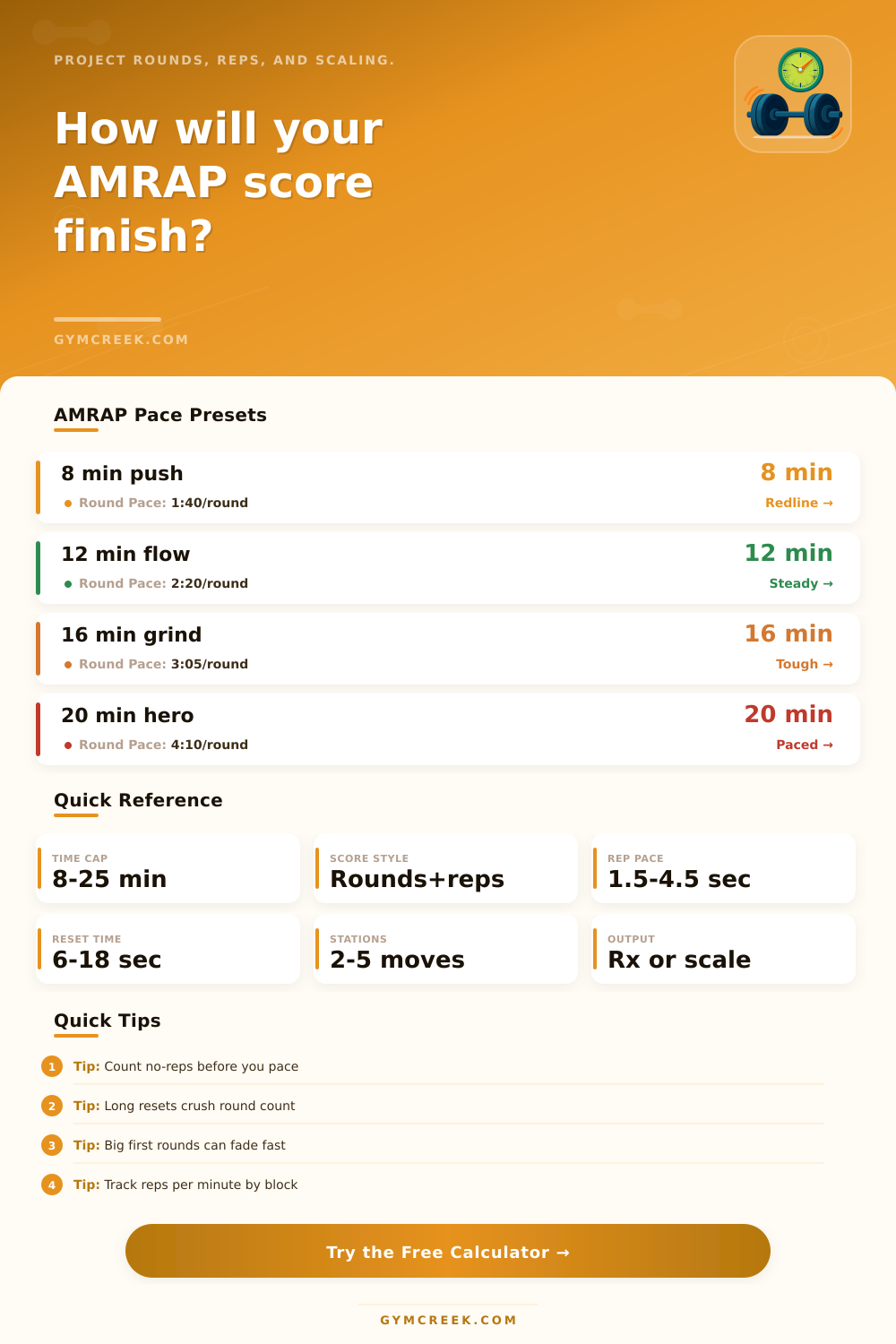
For instance, a preset for a twelve-minute box flow may be 2 minutes and 20 seconds for each round of that workout. The use of presets allows for an individual to compare there performance during a given workout to others who may be performing the same type of workout. Many athletes may make mistakes when they are performing an AMRAP.
One type of mistake that many athletes make is chasing round parity. Chasing round parity is a process in which an athlete may attempt to force identical times for each split of a workout, a feat that is impossible when fatigue impacts an individual’s ability to perform certain movements within a workout. Many athletes also mistakenly overlook the importance of the work share.
The work share is the ratio of the number of seconds that are spent performing repetitions divided by the total time for each round. An individual should aim for a work share of 70 percent or more. Furthermore, an individual should print a breakdown of the clock that is used for the workout, the number of minutes that remain for the workout, and the number of repetitions that can be performed in the remainder of the workout.
During a workout, individuals should glance at both the live score that is displayed during the workout, as well as at the modeled sustainable pace for that workout. Both of these factors will allow for an individual to make an informed decision as to how to complete the remainder of the workout.