Weighted Pull-Up Calculator
Estimate how a weighted pull-up set translates into total system load, bodyweight-relative strength, projected 1RM, and future plate math if your bodyweight rises or drops.
📌Pulling Presets
These nine presets span first weighted sets, heavier triples, neutral-grip volume, rings, chest-high standards, cutting phases, and masters pulling so the bodyweight and system-load math changes in realistic ways.
⚙Pull-Up Inputs
Weighted pull-up strength snapshot
Enter your set details to model system load, ratios, and bodyweight-shift math.
📊Strength Markers
📑Reference Tables
| Lane | Men | Women | Read |
|---|---|---|---|
| Foundation | Under 1.20x | Under 1.05x | Usually first weighted cycles |
| Solid | 1.20x to 1.44x | 1.05x to 1.24x | Good gym strength |
| Strong | 1.45x to 1.64x | 1.25x to 1.44x | Clear weighted skill |
| Advanced | 1.65x to 1.84x | 1.45x to 1.59x | Heavy belt territory |
| Elite | 1.85x+ | 1.60x+ | High-level pulling |
| Reps | Epley x | % of 1RM | Best use |
|---|---|---|---|
| 1 | 1.03x | 97% | Heavy single read |
| 3 | 1.10x | 91% | Best strength lens |
| 5 | 1.17x | 86% | Balanced estimate |
| 8 | 1.27x | 79% | Volume bridge |
| 12 | 1.40x | 71% | Lower confidence |
| Setting | Factor | Main effect | Use case |
|---|---|---|---|
| Pronated strict | 1.00x | Baseline pull-up | Most comparisons |
| Neutral grip | 1.02x | Often strongest groove | Handles or MAG |
| Supinated chin | 1.04x | More elbow flexor help | Chin-up testing |
| Rings strict | 0.98x | More stability demand | Gymnastic rings |
| Chest-to-bar | 1.03x | Longer travel, stricter top | CF or strict skill |
| Light kip | 0.94x | Lower strict transfer | Do not compare directly |
| BW shift | Plate change | System math | Read |
|---|---|---|---|
| -10 lb / -4.5 kg | Plate rises | BW down, plate up | Common after cuts |
| -5 lb / -2.3 kg | Plate rises | Same 1RM load | Small trim, clear gain |
| +5 lb / +2.3 kg | Plate falls | More BW to move | Lean bulk tradeoff |
| +10 lb / +4.5 kg | Plate falls | Plate math tightens | Keep system load honest |
💡Pull-Up Tips
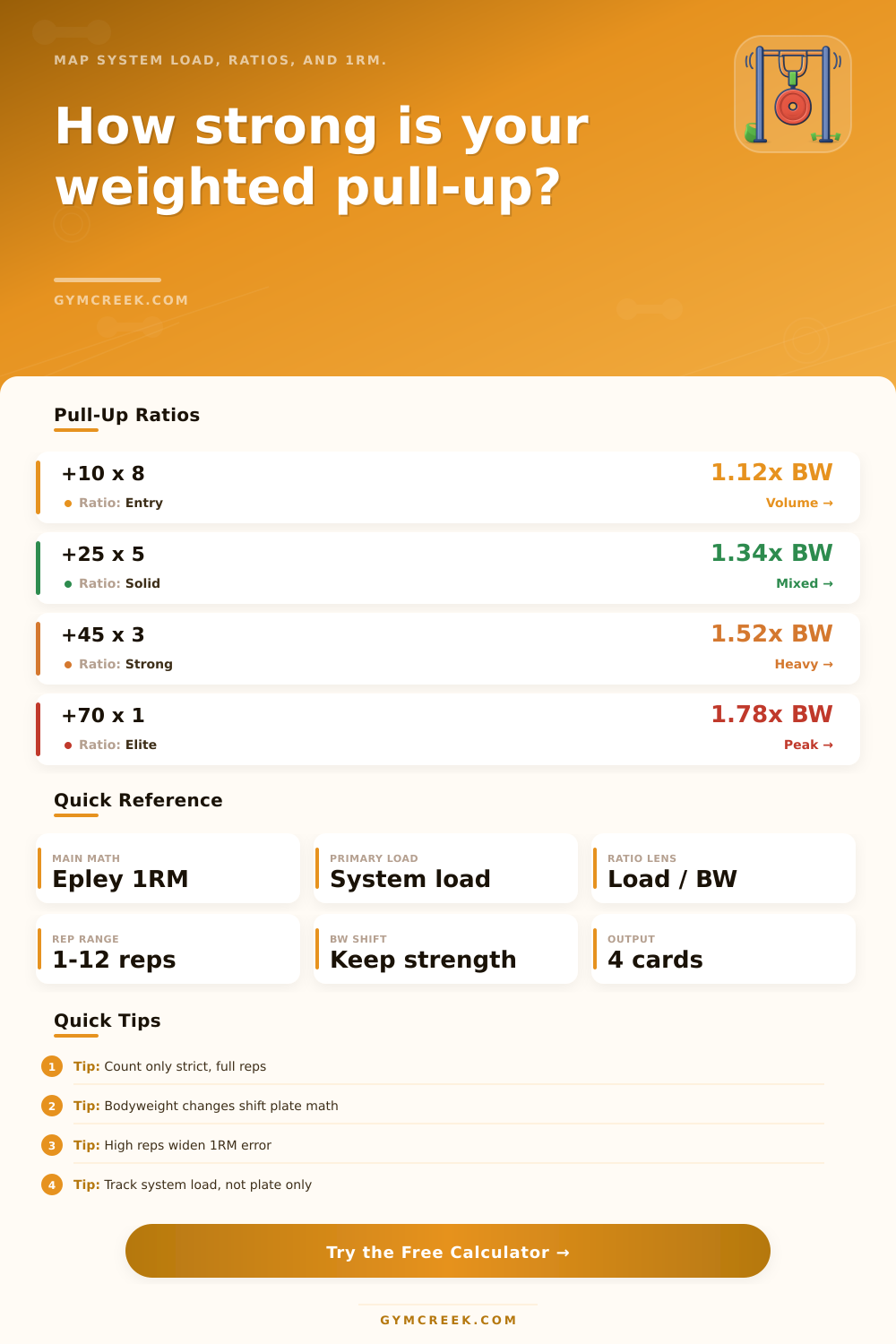
Weighted pull-ups are a form of strength training in which an individual add weight to there body to make the exercise more challenging. To perform a weighted pull-up, an individual must use their body weight plus the weight of the added plate. The total amount of weight moved is known as the system load.
The system load include both the body weight of the individual performing the exercise and the added weight of the plates. The system load can change for an individual due to changes in their body weight. Therefore, using only the weight of the plates to calculate the strength of an individual will lead to inaccurate conclusion.
How to Measure and Build Strength in Weighted Pull-Ups
For these reasons, an individual performing weighted pull-ups should use the ratio of the system load to an individual’s body weight to measure the strength of an individual. The different grip variation for pull-ups alter the performance of the exercise and the muscles used during execution. An individual using a pronated grip should feel the engagement of their lat and scapular muscle.
An individual using a neutral grip will use their biceps in addition to their primary muscles for the exercise. An individual using a supinated grip will also use their biceps for the exercise in addition to their primary muscles. Additionally, using a grip using rings instead of a bar require the use of the shoulder stability muscles.
Therefore, grips and tools alter the difficulty of the exercise, so it is essential to track the type of grip used for strength measurement. An individual’s repetitions for pull-ups will impact how much an individual’s strength is estimated. An individual performing one repetition with a high amount of added weight will estimate the one-rep maximum strength.
However, performing five repetitions of moderate weight will provide an entirely different estimate of strength. If an individual completes many repetition for a set of pull-ups, their estimate of there strength will be less accurate. Additionally, the makeup of an individual’s body will also impact their strength ratio.
An individual who is in a calorie deficit may lose body weight, but they may also lose muscle, making them weak overall. An individual who is in a calorie surplus may gain body weight, increasing there system load. The strength ratio for an individual performing pull-ups can be used to categorize the strength of an individual.
A ratio of 1.2 times the body weight is considered the foundation for performing pull-ups. A ratio of 1.45 times the body weight is considered to be a strong ratio for performing pull-ups, as they can perform multiple repetitions with two plate attached to there belt. An elite ratio for performing pull-ups is 1.85 times the body weight or higher.
To achieve such a ratio will take many years of training. Women will use these ratios to track there performance in pull-ups, just as men will. However, women have on average different leverage and muscle mass than men.
To continue to make progress in performing pull-ups, an individual should avoid some mistake. One mistake to avoid is counting partial repetitions. A partial repetition does not allow the muscles to complete the full range of motion from dead hang to when the chin clears the bar.
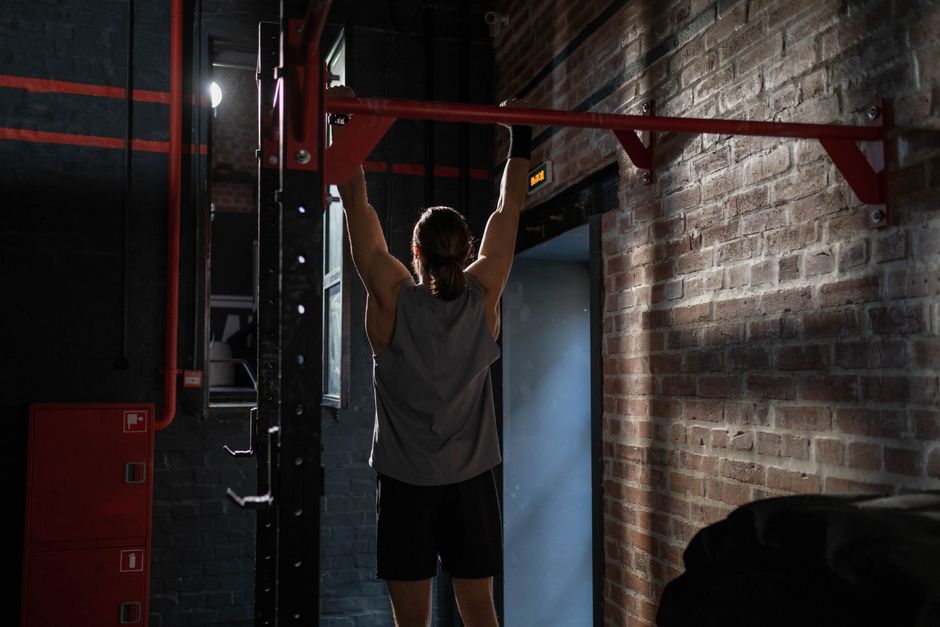
Another mistake to avoid is to neglect the variety of grip. A lack of grip variety can cause muscle imbalance in the body. An individual should also re-calculate their strength ratio if their body weight change.
Not being able to track the change in their ratios will make it impossible for them to see if there relative strength is increasing or decreasing. Finally, another mistake to avoid is not using accessory exercises such as rows or face pulls. These accessory exercises will protect the elbows for heavy weighted pull-up sets.