Smith Machine to Free Weight Calculator
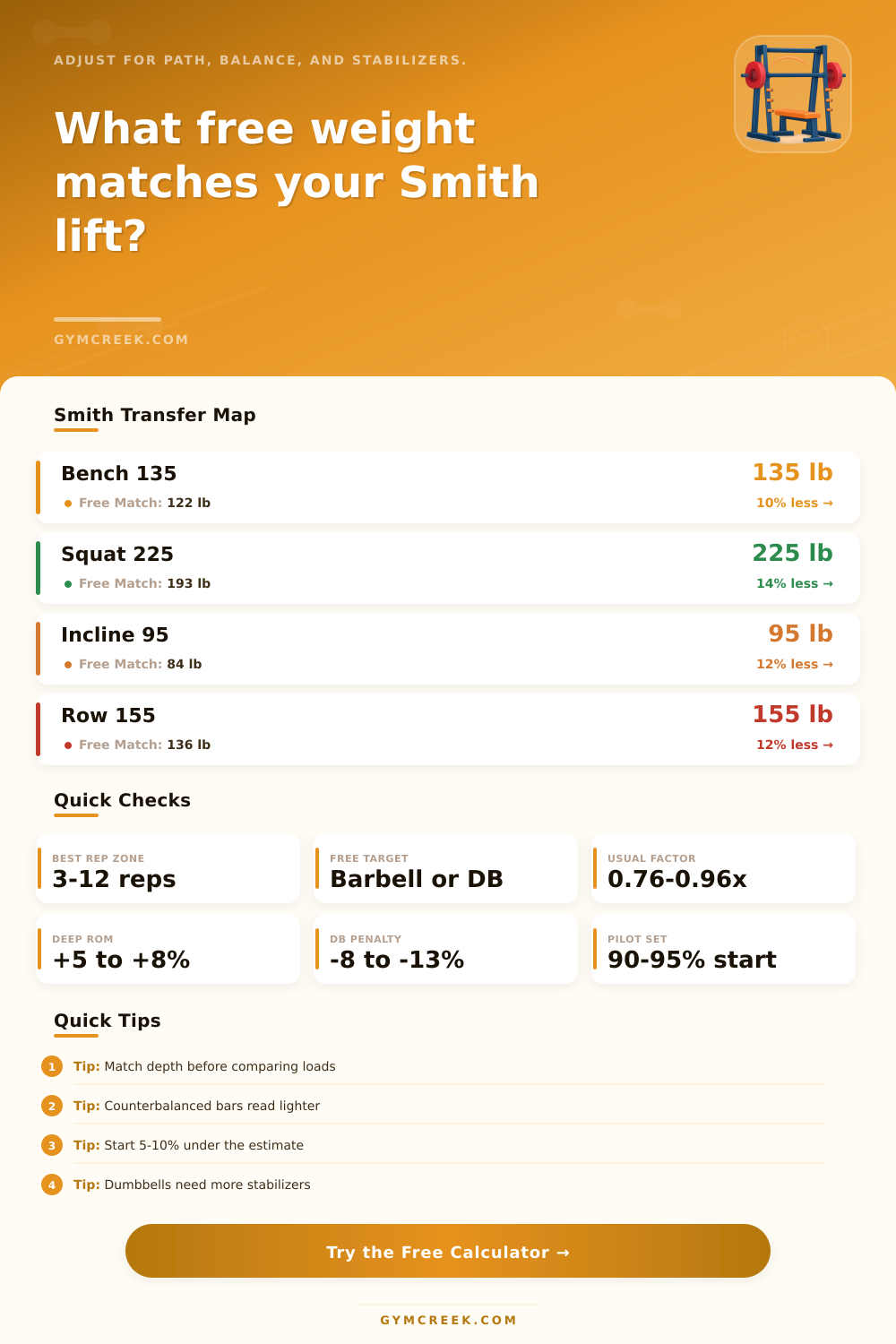
Translate a guided Smith machine load into a more realistic free-weight match by blending movement pattern, rail path, counterbalance feel, stabilizer demand, range of motion, and control style.
📌Transfer Presets
These nine presets span press, squat, row, unilateral, and hip-dominant patterns so you can compare how guide rails, balance demands, and skill transfer change the free-weight match.
⚙Smith Conversion Inputs
Estimated free-weight match
Enter your Smith lift details to model a freer, less-guided version of the same effort.
📊Transfer Metrics
📑Reference Tables
| Pattern | Base factor | Usual gap | Read |
|---|---|---|---|
| Flat press | 0.92x | 8% less | Smith hides some bar path control. |
| Back squat | 0.86x | 14% less | Balance and groove matter more. |
| Front squat | 0.82x | 18% less | Rack position exposes posture leaks. |
| Hip thrust | 0.95x | 5% less | Stable setup transfers more directly. |
| Setting | Factor | Why it changes | When seen |
|---|---|---|---|
| Slight back-angle | 0.99x | Closer to a natural groove. | Better commercial units |
| Strict vertical | 0.96x | Fixed bar path replaces self-balance. | Older straight-rail frames |
| Counterbalanced | 0.90x | Displayed load feels lighter than free. | Assisted Smith bars |
| Sticky friction | 1.04x | Friction raises real work slightly. | Worn guide rods |
| Target | Factor | Typical drop | Use case |
|---|---|---|---|
| Free barbell | 1.00x | Baseline | Closest direct transfer |
| Dumbbells | 0.92x | 8% less | More shoulder and hand control |
| Double kettlebell | 0.89x | 11% less | Front-rack balance challenge |
| Single-side | 0.87x | 13% less | Anti-rotation and offset demand |
| Rep band | Best use | Confidence | Coaching note |
|---|---|---|---|
| 1 to 3 | Peaking check | Moderate | Technique swings matter more. |
| 4 to 8 | Best transfer zone | Best | Strong mix of load and control. |
| 9 to 12 | Hypertrophy bridge | Good | Fatigue widens the landing range. |
| 13+ | Volume estimate | Lower | Use the result as a ceiling, not a demand. |
💡Transfer Tips
A person may find that the weight that is lift on a Smith machine feel different than the same weight that is lift on a free barbell. The difference between the two weights are caused by the fact that Smith machines use rails to provide stability for the barbell, while free barbell dont provide that same stability for the barbell. As a result, the muscle that provide that stability for the barbell have to work harder when using a free barbell, making it feel like the weight of the barbell is more.
However, the primary muscle that perform the exercise still work the same on each type of exercise. The Smith machine may affect the way that a person feel the weight of the barbell due to the counterbalance of many Smith machines. When a Smith machine is counterbalanced, the weight of the metal plate that are used on the Smith machine may feel lighter to the individual because the counterbalance of the Smith machine assist in moving the barbell upward.
Why the Same Weight Feels Different on a Smith Machine and a Free Barbell
Furthermore, the angle of the Smith machines rails may also affect how the individual feels the weight of the barbell. For instance, the path of the rail may be more different than the natural movement of the human bodys limb. Thus, squats on a Smith machine may be easier than squats on a free barbell.
A person can calculate the difference between the weight of a Smith machine and a free weight. The type of movement that is to be performed can be one of the factor that is considered in the calculation. For instance, movements like a bench press may be easier to transition from a Smith machine to a free barbell than movements like a back squat due to the need for balance in perform a bench press.
Repetitions can also be factored into the calculation. For instance, if an individual is performing low repetitions with the weight, the muscles involved will be performing more repetitions on each lift so they can perform the required repetitions; thus, an individual should of use mid-range repetitions (between four and eight reps) when calculating the weights. Additionally, if an individual is performing high repetitions with the weights, the fatigue of the muscles will make a difference between Smith and free barbell weights.
A Smith machine may allow for an individual to lift less weight than on a free barbell. For instance, individuals may find that they need to use between 5 and 18 percent less weight on a free barbell compared to a Smith machine. This percentage may be higher for individuals that are relatively new to weight training due to the need for better balance when using a free barbell.
In contrast, a percentage may be lower for individuals that are more experienced and have better control of the barbell. When an individual transition from a Smith machine to a free barbell, the individual should start with a lower weight. For instance, the individual should unrack the barbell to allow the individual to feel the way that the barbell settle when it is no longer on the Smith machine.
In addition, the individual should pay attention to there posture to ensure that they are not making mistake like knee cave or elbow flare when squatting or performing other strength exercises on the Smith machine. Finally, an individual should avoid comparing the performance of partial repetitions on a Smith machine to the performance of full repetitions on a free barbell. A Smith machine’s data regarding the weight and repetitions performed on a Smith machine can be tracked in a training log.
By logging each Smith machine training session, an individual can note the weights used, the number of repetitions performed, and how the exercise felt during that session. By noting these reasons during training sessions, an individual can adjust the weight used on free barbells during following training sessions. Over time, by logging these sessions, an individual will have developed a personal factor that can be used to determine the weight that should be use on Smith and free barbells.
By using this system and keeping data regarding Smith machine training, an individual can transform the lifting of weight from a process of guesswork to one of certainty.