Weighted Vest Calorie Calculator
Estimate how many calories a weighted vest adds during walks, hikes, jogs, and loaded marches by combining body size, vest load, pace, terrain, grade, and session length.
📌Vest Session Presets
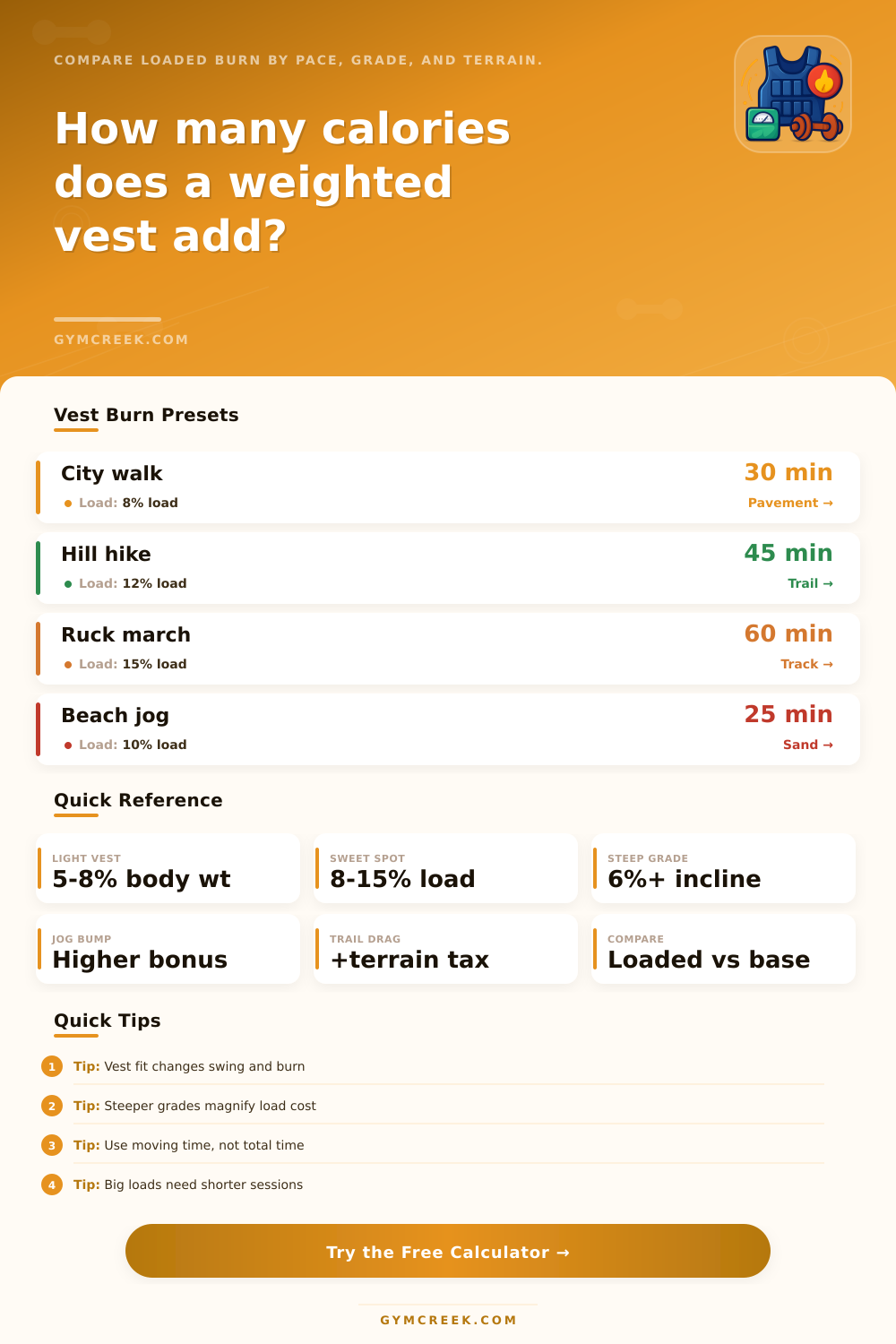
These nine presets cover realistic vest sessions, from easy neighborhood carries to trail rucks and short jogs, so you can compare how load ratio changes the burn instead of starting blank.
⚙Load Inputs
Weighted vest calorie snapshot
Enter your vest session details to compare loaded and unloaded calorie burn.
📊Load Metrics
📑Reference Tables
| Load % | Read | Session feel | Typical use |
|---|---|---|---|
| Under 5% | Light | Small calorie bump | Warm walks |
| 5 to 8% | Noticeable | Steady added drag | Daily conditioning |
| 8 to 15% | Sweet spot | Clear work gain | Fat loss or ruck prep |
| 15 to 20% | Heavy | Harder posture demand | Short marches |
| 20%+ | Very heavy | Technique fades sooner | Advanced blocks |
| Setting | Typical grade | Load effect | Why it climbs |
|---|---|---|---|
| Track | 0 to 1% | Lowest penalty | Stable ground |
| Pavement | 0 to 3% | Baseline | Consistent pace |
| Mixed trail | 2 to 6% | Higher bonus | Micro climbs |
| Rocky hill | 4 to 10% | Strong bonus | Balance plus grade |
| Sand | 0 to 5% | Big tax | Energy leaks |
| Modality | Main formula | Best pace band | Vest cue |
|---|---|---|---|
| Urban walk | Walking ACSM | 2.5 to 4.0 mph | Great for steady burn |
| Incline walk | Walking ACSM | 2.8 to 4.2 mph | Grade lifts bonus fast |
| Trail hike | Walking ACSM | 2.0 to 3.8 mph | Terrain taxes posture |
| Ruck march | Walking ACSM | 3.0 to 4.3 mph | Sweet spot for load |
| Jog or run | Running ACSM | 4.5 mph and up | Shorter, sharper blocks |
| Output | Formula | Uses | Purpose |
|---|---|---|---|
| BMR | Mifflin-St Jeor | Sex, age, wt, ht | Resting session share |
| Base MET | ACSM walk or run | Pace plus grade | Unloaded burn |
| Vest bonus | Load x pace x terrain | Load ratio stack | Extra loaded cost |
| TDEE share | Session / upkeep | Daily maintenance | Perspective check |
💡Weighted Vest Tips
A weighted vest are an appliance that adds to the weight of you body. When you wear a weighted vest, your body has to work harder to move. The additional weight of the weighted vest causes your body to burn more calories then it would if you were not wearing a weighted vest.
The weighted vest alter the function of your muscle. The weighted vest force the muscles that control your core and your posture to work more. The weight of the weighted vest is a critical component of the effectiveness of the weighted vest.
How a weighted vest helps you burn more calories
A weighted vest that weigh five to eight percent of your body weight will allow you to strengthen your body in a way that will not damage your physical form. A weighted vest that weighs eight to fifteen percent of your body weights will burn more calories because it will require you to work your hip and shoulders more. You should avoid use a weighted vest that weighs too much for too long.
Using a very heavy weighted vest will alter the way that you use exercise techniques with the weighted vest and will require more time for your body to recover from the added exertion. The speed at which you walk and the terrain that you walk on will affect the way that your body reacts to the weighted vest. If you walk at three to four miles per hour with a weighted vest, you will burn more calories without having to run.
If you walk at a pace faster than four and a half miles per hour with a weighted vest, you will find it more difficultly to run with the weighted vest. However, if you do choose to run with the weighted vest, you will eventualy experience burnout. Walking on pavement is more efficient than walking on trails, which require more balance.
Walking on sand will require more energy than pavement because sand are unstable. Walking on an incline will force your body to work harder with the weighted vest, as it will test your posture. Due to the added weight of the vest, you will burn more calories than you would with just your standard exercise routine.
With no weighted vest you burn calories at a rate that your walking speed and slope determine. With a weighted vest you can burn ten to thirty percent more calories. The ratio of the weight of the weighted vest to your body weight is called an load ratio.
This load ratio will determine how much exertion you will experience from using the weighted vest. To get the most out of your weighted vest, make sure that it fits properly on your body. A weighted vest that bounce against your body can cause you to alter the way that you walk, which might lead to an injuries.
Ensure that the weighted vest is snugly fitted to your body. Focus on the time that you are moving with the weighted vest, not the total amount of time that you spend with the weighted vest. If the load that you are using with the weighted vest is very heavy, limit your sessions to sixty minute with the weighted vest.
The weighted vest calorie calculator use mathematical equations to determine the benefits of using the weighted vest. Your age, gender, height, and weight will help to determine your basal needs. Your needs plus the bonus from using the weighted vest will determine your net active calories.
Using this calculator, you can see your loaded METs and your cadence. The reference tables will allow you to see how many calories you will burn on different terrains with different ratios of the load of the weighted vest to your body weight. When you begin using the weighted vest, use a progression model.
This model will allow you to begin using a light weighted vest and gradually increase the weight as you increase your fitness level. Use the calorie bonus calculator each week to track your progress. After you use a weighted vest, you should of eat enough protein because the weighted vest hits the muscles in your body harder than by cardio exercise alone.
Finally, continue to use the weighted vest because using the weighted vest consistently will allow you to maintain a calorie deficit over time.