
Running pace change as a person ages, and there are a few reason for these changes in running pace. Many people notice that their running pace slow as they age. Part of the design of the human body as it ages is to encourage efficiency over speed.
Benchmarks for running help to set goal for distance and time, and they will help to avoid setting goal that are too difficult for you age. The average running pace of an individual slow by approximately one minute per mile for every decade that pass for recreational runners. The reason for this decrease in pace is that younger runners use their fast twitch muscle fibers more often than older runners, who rely more on their ability to run for endurance.
How Running Pace Changes with Age
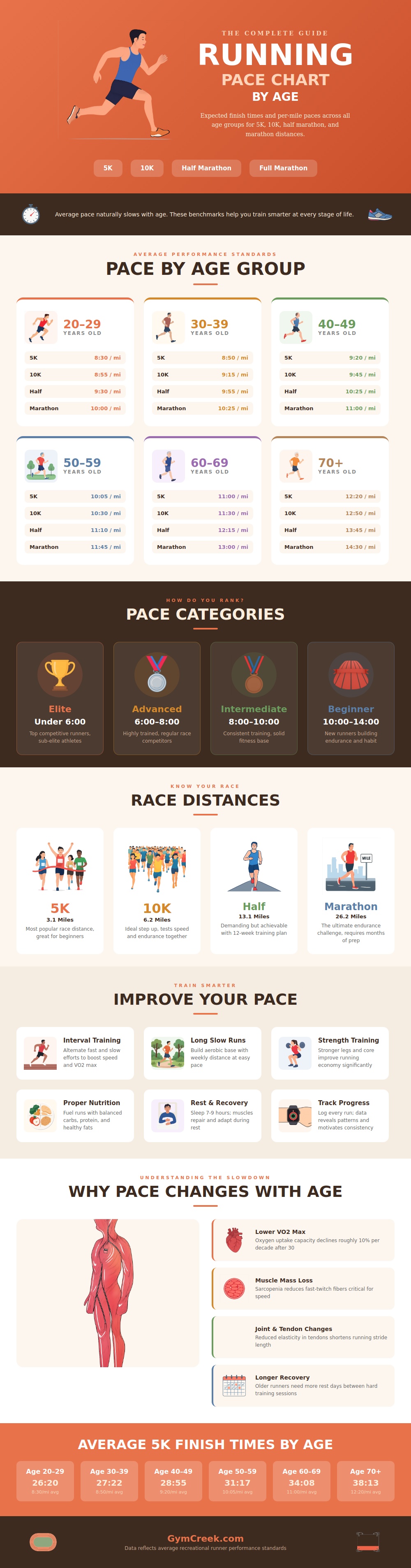
The chart below provide information regarding the expected running paces for people in various age groups, depending on the distance of the race. With this chart, individuals can compare their own running pace with that of the average running pace for their age group. For instance, individuals in their twenties may have an expected pace for half marathons of 9:00 minutes per mile, while individuals in their sixties may have a pace for half marathons of 12:00 minutes per mile.
An individual’s goal for running should change with age to prevent injury to the body. For instance, individuals in their twenties and thirties may have goals of increase their peak speeds and decrease their time for intermediate distances. However, individuals in their forties may have joint issue and muscle recovery problems, so their goal should change to accommodate these age related issues.
For instance, an individual in their forties aiming for a 10K race with a target pace of 9:45 minutes per mile is setting a realistic goal, and that individual should not feel bad if they are unable to accomplish such a goal. Different distance for races require different amount of effort from runners. For instance, 5K races require runners to have good speeds for short distances, while 10K races require more endurance.
Half marathons and marathons require even more endurance over longer distances. The longer the distance of a race, the more months of long distance running is required to build up the necessary mile for the race. The chart provided categorize average running paces for various distances of races.
Most runners fall into the beginner or intermediate runner category. Few runners should ever aim for the pace of elite runners. Elite runners have running paces of 6:00 minutes per mile or less for short distances, while intermediate runners can reach paces of 6:00-8:00 minutes per mile for short distances.
Track your running paces every week, and ensure that you are logging your mile and there paces to monitor your improvement in pace. Data will allow you to see how your mileage and paces compare over time. There are a few different method of increasing your running pace.
Interval training will allow you to increase your VO2 max, as will long, slow distance runs. Additionally, performing exercise of strength will improve your ability to support your body with your core muscle rather than losing energy to unused muscle. Include both carbohydrate and protein in your diet to provide energy and the nutrient required to allow your muscle to recover after running.
Finally, allow your body time to rest to recover from the physical demand of runners, especially as you age. Getting enough rest will allow runners of all age to improve their pace, but older individuals require more time to rest compared to younger runners. Many runners of all age make the mistake of trying to maintain the same pace as runners of much younger age.
For instance, it is unlikely that runners of the age of fifty will be able to accomplish the same number of mile as runners of the age of twenty with the same amount of effort. Because an individual’s VO2 max drop by 10% per decade after the age of thirty, runners need to change their training method to include more easy mile and fewer mile at maximum running effort. Womens running trend are similar to those of men, although their average running pace may be slightly slow due to physiological differences.
While the number provided may be helpful to runners in establishing goals for distance and time, individual goal should always be adjusted to fit the individual’s physical capability. Additionally, outside factor will have an impact on running pace, so focus on long term trend rather than one race result.
