
Pace is a specific measurement of a runners performance in relation to distance and time. However, pace is not the same as speed. Speed is a measurement of the distance covered in a specific amount of time.
Conversely, pace is the amount of time it takes for a person to cover a specific distance. For example, pace is often expressed in units of minutes per mile or minutes per kilometer. The fewer minutes that it takes for a runner to complete a distance, the more faster that runner is able to maintain there speed.
What Is Running Pace and How to Use It
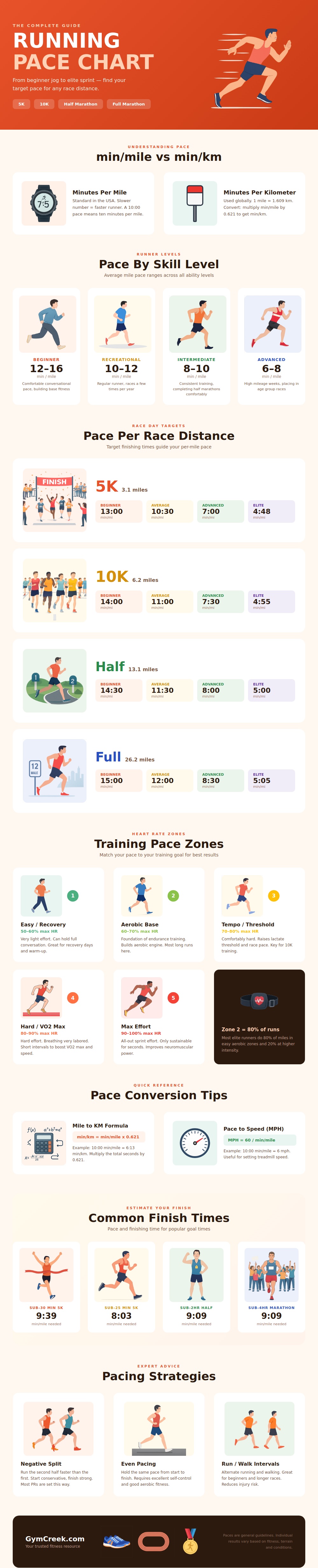
Many people in the U.S. Prefer to use minutes per mile as a means of expressing their running pace. However, many individuals in the remainder of the world use the unit of minutes per kilometer for their pace. The two units are similar in that one mile is equal to approximately 1.6 kilometers; thus, to convert a runners pace from miles to kilometers, you can multiply the number of minutes per mile by 0.621.
Using such a unit of measurement for pace enables a runner to easily track their improvements in pace, as well as to maintain a steady and even running rhythm. Runners of different experience level often exhibit different distances covered per unit of time, or in other words, exhibit different rates of pace. New runners typicaly cover distances at rates of between 12 and 16 minutes per mile.
Runners refer to such a rate as a conversational pace, as runners are able to speak to others in full sentences while running at such a rate. Recreational runners often cover distances at rates of between 10 and 12 minutes per mile, which enables them to compete in various weekly races. Intermediate runners can maintain rates of between 8 and 10 minutes per mile, and can often complete half marathons at those rates.
Finally, advanced runners can maintain rates of less than 8 minutes per mile, and are able to compete against others for high rankings within their age groups. These various classifications of runners of different experience levels isnt exact categories that all runners should fall within, but provide a general indication of the pace that runners of each type can expect to exhibit. The distance that is to be covered during a race will impact the pace at which a runner can maintain during that race.
For instance, 5K races are only 3.1 mile in length. As such, runners are able to maintain faster rates of pace during these races. For instance, beginners may race at rates of 13 minutes per mile for a 5K distance, but an elite runner may cover the same distance in a pace of 5 minutes per mile.
Similarly, 10K races are 6.2 miles in length. Thus, a beginner might have a pace for 10K races of 14 minutes per mile, but an elite runner will easily have a much more faster pace for these distances. However, as the distances to be covered lengthens to distances like half marathons and full marathons, the pace of runners will drop to slower rates of time per mile.
To calculate the target pace that a runner may want to achieve during a race, the runner can divide the time that is targeted for the race by the total number of miles in the race. This rate will provide the runner with the target pace for the race. Depending upon the purpose for which an individual is training their running speed, that runner will have different pacing requirements for those training sessions.
For instance, professional runners may train their runs at 80% of their maximum running pace for most of their runs. This type of running maintains the runners endurance. Recovery runs will take place at much slower rates of pace for runners, as the purpose for recovery runs is for the body to recover from the more intense training.
Runners may perform tempo runs at a “comfortably hard” pace, or at a rate that runners feel comfortable in while also challenging their bodies to increase their lactate threshold. Interval training can be used to increase the runners maximum oxygen consumption, or VO2 max, and requires runners to perform at very fast rates of pace for short distances. However, if an individual performs all of their runs at such high rates of pace, they may become injured; a balance between easy-paced runs and high-paced runs should be incorporated into an individuals training schedule.
Runners can use various pacing strategies during a race. For instance, using a negative split will allow runners to complete the second half of the race at a faster rate than their first half of the race. This pacing strategy can allow runners to beat their personal records for the race.
Even pacing suggests that runners of any distance will maintain the same rate of pace for their entire race. Even pacing requires a great deal of discipline from runners, however. Some runners will use run-walk intervals for races of long distances; walking intervals will help to conserve their energy for the race and reduce the chance of injury.
These various pacing strategies should be practiced during training. By doing so, runners will be more successful in utilizing those strategies during race day. However, in addition to using a timing device to monitor their pace during a race, runners should also pay attention to their bodies and adjust their pace in accordance with their bodys need.
