
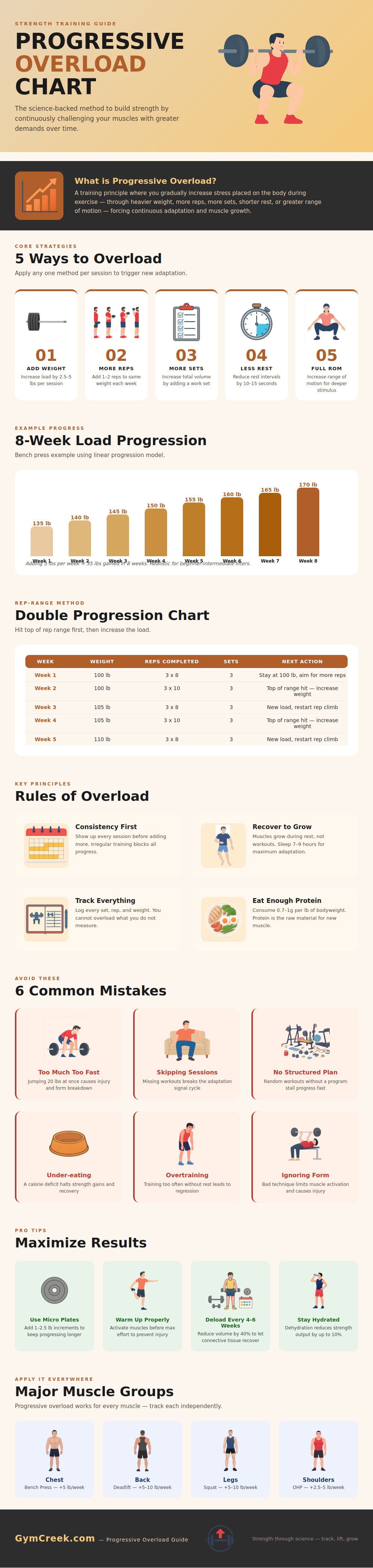
Progressive overload are a training method that involves the increase in the physical demands placed upon the body. The use of progressive overload is necessary for muscles to become stronger, as the muscles only adapt to new demands placed upon them. If the individual performs the same exercises with the same weights and reps, there muscles will not adapt to the demands.
Thus, using progressive overload will ensure that the muscles of an individual continue to develop. There are several methods for achieving progressive overload for an individuals exercise routine, such as increasing the weight that an individual uses in the exercise, increasing the number of repetitions of the exercise, increasing the number of sets performed, decreasing the length periods between sets of exercise, or increasing the range of motion that is performed in the exercise. One method of increasing progressive overload is to increase the weight that is used in the exercise.
Build Muscle with Progressive Overload
Increasing the number of repetitions that an individual performs with a given weight are another method of increasing progressive overload. Increasing the number of sets of exercises that are performed is another method of increasing progressive overload. Decreasing the length of breaks between sets is another method of increasing progressive overload.
Finally, increasing the range of motion that is performing in an exercise is one method of increasing progressive overload. Another method of increasing progressive overload is through the use of a technique known as double progression. Double progression is a technique in which an individual reaches the highest number of repetitions with a given weight before increasing the weight that is used in the exercise.
For instance, if the target number of repetitions for an exercise is between 8 and 12, an individual would perform twelve repetitions with a specific weight for all sets of exercises before increasing the weight. After the person increases the weight, the number of repetitions will likely drop to the bottom of the target range; therefore, the individual will have to increase the number of repetitions to which they can perform with the new weight. Using this technique helps to manage the amount of weight that an individual must lift and prevents injuries that may result from excessively increasing the weight of the exercises performed.
In order to effectively use progressive overload, an individual must be consistent in their use of the technique. Additionally, an individual must ensure that they are recovering from the excessive use of strength. An individuals muscles grow during periods of rest rather than while lifting weights.
Therefore, to ensure that muscles continue to grow in strength, an individual must consume enough protein to provide the muscles with the building blocks they need to grow, and take enough rest periods to allow their muscles to rest after lifting weights. Thus, keeping track of the number of lifts that an individual performed is another requirement for maintaining progressive overload; tracking the number of lifts performed will allow the individual to track their progressive overload. There are some mistakes that may be made in the attempt to utilize progressive overload for an individuals strength and muscular endurance.
For example, an individual may increase the weight of the exercises that they perform to quickly. If the individual increases the weight with which they lift too quickly, they may not be able to utilize proper technique, which can lead to injuries to the muscles groups that are performing the exercises. Another mistake is skipping rest days.
If an individual skips rest days, their muscles will not have time to recover and grow. An individual may also sacrifice proper technique in order to lift heavier weights. However, sacrificing proper technique is a mistake because proper technique will ensure that the muscles are properly loaded with the required tension to perform the exercise.
Finally, another mistake are failing to follow a structured exercise plan; therefore, it is impossible to measure the progressive overload of the muscles developed through an exercise routine. In order to manage the use of progressive overload effectively for an individuals exercise routine, that individual may use several strategies. One strategy is the use of micro plates to increase the weight that must be lifted; this will ensure that the increased weights that are placed upon an individuals muscles are manageable to the body.
Additionally, an individual may use a deload week every four to six weeks to allow their joints to recover from the physical demands of their exercise routine. An individual must also pay attention to their hydration because dehydration will decrease the physical output of the individuals body. Finally, if an individual can apply these principles to all of the exercises performed with each of the major muscle groups of their body, that individual will see improvements in their muscular strength and size over time.
