Stair Climber Calorie Calculator
Estimate stair climber calories with a blended model built from body weight, step rate, resistance, step height, work to easy pacing, and machine-specific climb assumptions.
📌Preset Sessions
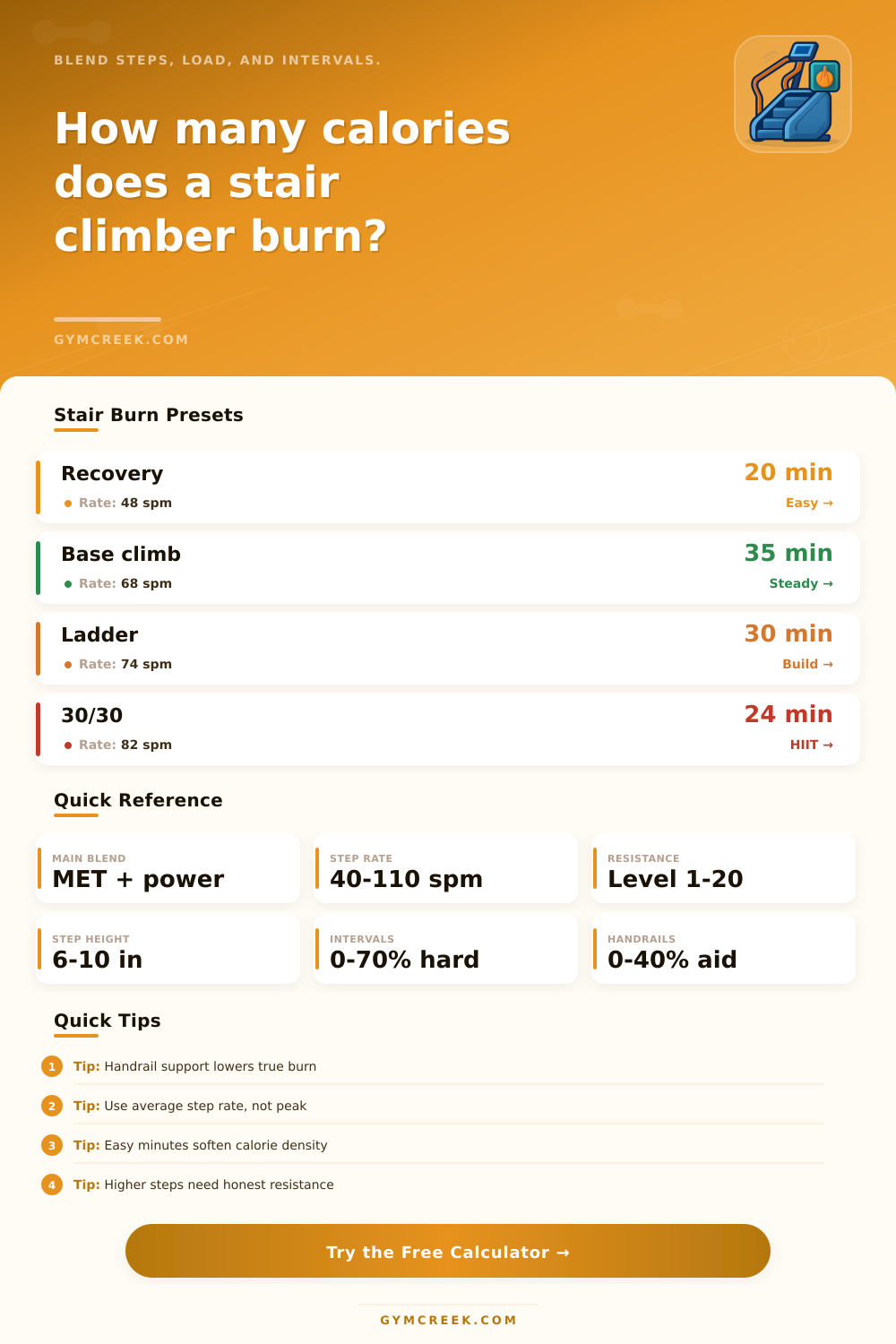
Each preset loads a believable stair session so you can compare steady climbs, ladder builds, and interval-heavy stepmill work without rewriting every field.
⚙Climb Inputs
Stair climber calorie snapshot
Enter your climb details to blend the MET model with vertical-work assumptions.
📊Climb Metrics
📑Reference Tables
| Duration | Total kcal | Floors | Read |
|---|---|---|---|
| 15 min | --- | --- | Quick |
| 30 min | --- | --- | Base |
| 45 min | --- | --- | Long |
| 60 min | --- | --- | Full |
| Pattern | Base MET | Bonus rate | Best fit |
|---|---|---|---|
| Steady | 5.8 | 1.2% | Base climbing |
| Ladder | 7.1 | 2.8% | Rising effort sets |
| Pyramid | 8.0 | 4.0% | Wave sessions |
| 30/30 | 9.1 | 5.8% | Short repeats |
| 60/120 | 8.4 | 4.5% | Longer recoveries |
| Hills | 8.8 | 5.0% | Climb surges |
| Step rate | Pace read | Likely MET | Common use |
|---|---|---|---|
| 40-54 spm | Easy | 4.0-5.2 | Warmup or flush |
| 55-69 spm | Steady | 5.5-7.0 | Base conditioning |
| 70-84 spm | Firm | 7.2-8.8 | Tempo climbing |
| 85-110 spm | Hard | 8.9-11.5 | Intervals or tests |
| Level | Load cue | Handrail note | Typical use |
|---|---|---|---|
| 1-5 | Light | Keep aid near zero | Warmup minutes |
| 6-10 | Moderate | Touch only if needed | Most steady climbs |
| 11-15 | Challenging | Support changes burn fast | Strength or tempo work |
| 16-20 | Very hard | Rails can mask effort | Short surges and tests |
💡Practical Tips
A stair climber is exercise equipment that allows a person to exercise and move vertically. When a person is using a stair climber, there is a calorie readout on the stair climber. This calorie value represents the numbers of calories a person has burned while using the stair climber.
The readout on most stair climbers can display a highly value of calories burned. This might be due to the fact that the stair climber does not account for the specific way in which a person may be using the stair climber. The number of calories that can be burned on the stair climber is based off a variety of factor.
Why Stair Climber Calorie Counts Are Often Wrong
The stair climber requires the use of several large muscles of the body, such as the glutes and the quadriceps. The stair climber mimics the action of an individual who is climbing stairs. However, rather than using stairs, an individual use the stair climber to exercise.
The stair climber calculates the number of calories burned based upon an individual’s body weight, the intensity of their exercise, and the length of time that they are using the stair climber. However, the stair climber does not possess the ability to accurately measure an individual’s intensity while they are using the exercise equipment. For instance, if an individual leans on the handrails of the stair climber while they are exercising, the individual is using those handrails to support there body weight.
By using the handrails, the individual is reducing the amount of work that is required of the muscles of the body. Because of this reduced work of the muscles, the stair climber will overestimate the number of calories that an individual who is leaning on the handrails burns. Another factor that influences the way in which an individual may use the stair climber is the rate at which they step on the stair climber.
If an individual sets the rate of steps per minute to 48, they are expected to perform at a low rate of intensity with the stair climber. Low rates of intensity are typically used by individuals as a way of performing recovery exercises. However, if the individual steps at a rate of 82 steps per minute, they are performing at a high intensity with the stair climber.
High rates of exercise increase the heart rate of an individual that is using the stair climber. In addition to the rate at which an individual steps on the stair climber, the resistance levels that are used also impact the amount of work that is performed with the stair climber. If the resistance levels are low, the individual may feel as if they are performing a warm-up exercise on the stair climber.
However, if an individual increases the resistance levels, their muscles has to work harder to exercise with the stair climber. An additional factor that can influence the amount of work that an individual performs with a stair climber is the bodys use of interval training. By using intervals with the stair climber, such as performing 30 seconds of intense exercise followed by 30 seconds of less intense exercise, the stair climber can increase the metabolic rate of an individual.
In addition to performing intervals of exercise with the stair climber, an individual can utilize other types of intervals. For instance, ladder intervals or pyramid intervals allow individuals to gradually increase their rate of effort or decrease the effort that they use with the stair climber. Additionally, the amount of time that an individual spends performing hard exercise with the stair climber will increase the amount of work that they perform.
However, the amount of easy time that they spend during their exercise session will have the effect of decreasing the average rate of intensity with which they exercise on the stair climber. There are also differences in the types of stair climbers. For instance, full-size stepmills have larger step heights than compact stair climbers.
Because an individual has to climb larger steps on the stepmill than on a compact stair climber, the individual has to work their leg muscles harder with the stepmill. In addition to the types of stair climbers that are available, there are also various factors other than the stair climber manufacturing company that an individual who is calculating the amount of work that they have performed on the stair climber should consider. Instead of using the calorie count that is displayed on the stair climber, an individual can calculate the number of calories burned with the stair climber by measuring the mechanical work that they performed with their body and the metabolic work that their body performed while using the stair climber.
For instance, an individual can calculate the mechanical work by measuring the vertical meters that an individual climbed with the stair climber and the metabolic work can be calculated by measuring the number of MET values that the individual set for their stair climb. Additionally, another measurement of the amount of work that an individual performed on the stair climber is the measurement of the power output of the individual. The power output of an individual can be measured in the unit of watt.
The number of watts that an individual outputs while using the stair climber can be calculated by multiplying the height of the steps that the individual takes, the rate at which the individual sets for stepping on the stair climber, and the body weight of the individual. Finally, there are a variety of mistake that may be made when utilizing the stair climber. For instance, one mistake that can be made is to use the peak rate of steps per minute that an individual took while using the stair climber rather than the average rate of steps per minute.
The average rate is a better representation of the strength of the individuals stepping rate. Another mistake that can be made is to forget to account for the number of minutes that an individual spent performing easy exercise with the stair climber. Easy minutes will reduce the average intensity of the individual’s exercise session with the stair climber.
Instead, to compare the performance of two sessions with the stair climber, an individual should compare the intensity of the two sessions with one another. For instance, an individual may compare a session with intervals to one without intervals. By considering the way that an individual used the handrails, stepped at an even rate, and used specific levels of resistance with the stair climber, an individual can gain a better understanding of the total amount of work that they performed with the stair climber.
You should of also considered how much you’re training.