Sprint Speed Calculator
Estimate average speed, moving speed, peak velocity, acceleration, and stride rate from a timed sprint, then compare the result against common sprint goals.
📌Presets
Each preset loads a realistic sprint profile with timing, split, and stride data, then refreshes the result instantly.
⚙Sprint Inputs
Sprint speed snapshot
Enter a sprint time and splits to calculate speed, acceleration, and target time.
📊Sprint Metrics Grid
📑Reference Tables
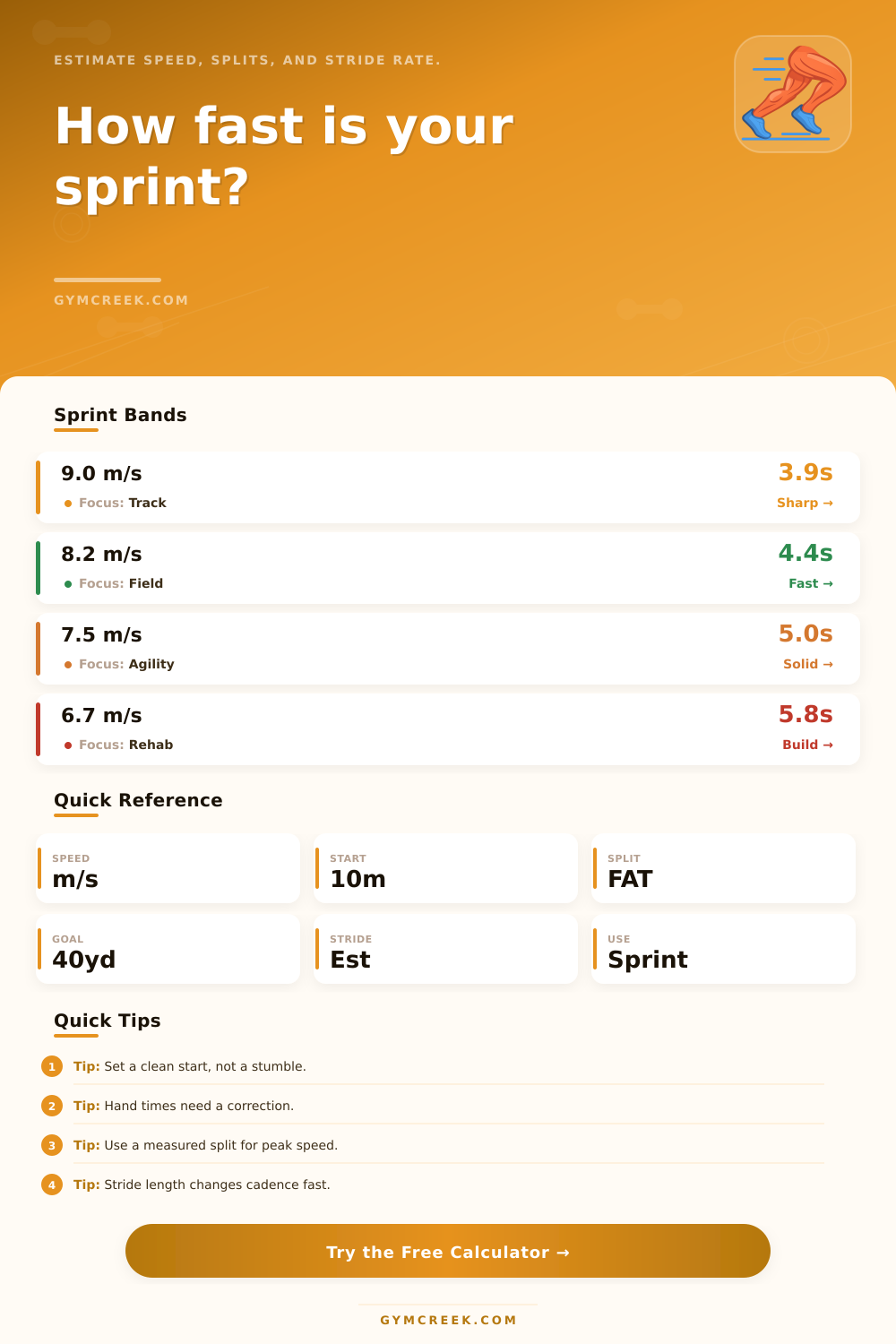
| Band | Speed | Focus | Read |
|---|---|---|---|
| Track | 9.0 m/s | 100m | Sharp |
| Field | 8.2 m/s | 40 yd | Fast |
| Agility | 7.5 m/s | Short | Solid |
| Rehab | 6.7 m/s | Return | Build |
| Split | Good | Strong | Elite |
|---|---|---|---|
| 10m | 1.95s | 1.82s | 1.72s |
| 20m | 3.20s | 3.00s | 2.82s |
| 30m | 4.20s | 3.95s | 3.70s |
| 40yd | 4.95s | 4.65s | 4.35s |
| Timing | Bias | Use | Note |
|---|---|---|---|
| Automatic | 0.00s | Meet | Clean |
| Video | 0.08s | Review | Near FAT |
| Gate | 0.12s | Train | Stable |
| Hand | 0.24s | Field | Fast bias |
| Goal | Target | Split | Cue |
|---|---|---|---|
| Track 100m | 100m | 30m | Hold form |
| Football 40 | 40yd | 10yd | Fast start |
| Soccer | 20m | 10m | Quick turn |
| Rehab | 10m | 5m | Clean stop |
💡Tips
Sprint speed are an important metric for athletes. Sprint speed helps to understand how athlete move during there athletic activities. Although many peoples believe that sprint speed is a sign of raw talent, it is actualy a combination of acceleration, peak velocity, and stride efficiency.
Since sprint speed can be measured in a variety of ways, the athlete must use precise analysis to determine acceleration versus average speed. Acceleration is the process of increasing an athlete’s speed. Peak velocity is the maximum speed that an athlete reaches during there sprint.
How to Measure and Improve Sprint Speed
The method used to time an athlete’s sprint can have an impact on the accuracy of the measurement of there sprint speed. For example, if an official use hand-timed stops to measure split times, the official’s reaction time can introduce inaccuracies into the split times for the sprinter. Since human reaction time can introduce delays in when the official begin to time the sprinters split times, the official’s recorded times will likely be faster then the sprint speed of the athletes.
In order to accurately time sprinters, video review or electronic gates can be used to avoid the inaccuracies caused by human reaction time. With accurate split times for each sprint distance, the math behind how the athlete built there sprint speed can be calculated. For instance, if an athlete’s split time for the first 10 meters of a 20 meter sprint is slow, this can indicate weakness in an athlete’s start mechanics.
Acceleration can be measured in meters per second during the early stage of a sprint. Acceleration indicates whether an athlete’s drive phase when explosive and how quickly they can reach there peak speed. Most athletes reaches there peak speed between the 20 and 40 meter marks of a 20 meter sprint.
After reaching there peak speed, athletes experience deceleration. Deceleration is the slowing of an athlete’s speed due to fatigue and wind resistance. The speed reserve for an athlete is the difference between there peak speed and there average speed over a given distance.
The more greater the speed reserve, the longer an athlete can maintain there sprint velocity. Speed maintenance is important for athletes who play sports like soccer. Flying 20 meter sprints can be used to measure an athletes peak speed.
A flying 20 meter sprint allow an athlete to gain peak speed while maintaining that peak speed. An athlete’s body mechanics and physical dimensions impacts there sprint speed. For instance, taller sprinters may have a physical advantage in that they can cover more ground with each stride.
However, longer strides will only provide an advantage for sprinters who has an appropriate cadence. Cadence is the number of strides an athlete can execute in a minute. If an athlete attempts to increase there stride length too much, there cadence will drop, which can ruin there running rhythm.
The biomechanics of women differ from those of men. As a result, women may have an advantage in sprinting if they use shorter strides than men. An athlete’s stride rate can be calculated by dividing there sprint speed by there stride length.
An athlete’s stride length can be calculated by dividing there sprint speed by there cadence. Factors beyond an athlete’s physical dimension can impact there sprint speed. For instance, wind resistance will slow an athlete down during a sprint.
The direction of the wind may impact the sprint speed that an athlete is able to reach. The grip that an athlete has on the sprinting surface can change with the type of shoe that they are wearing. An athlete’s age may impact there sprint speed.
A 15 year-old athlete will have different speed requirements than a 24 year-old athlete. Additionally, an athlete’s body mass index may impact there sprint speed. An athlete can use the information on there sprint speed to create a training plan.
If an athlete discovers that there acceleration speed is weak, there training plan may include resisted sled pushes or hill sprints. For athletes whose stride rate is too low, incorporating A-skips or high knees into there training may help. If an athlete’s weakness is there ability to maintain there speed for long period without deceleration, interval flies at 95% of there peak speed should be incorporated into there training plan.
Using sprint speed splits can help an athlete gauge there progress. In addition, using splits can help an athlete determine when to change the focus of there training plan. If an athlete’s readiness score is 90%, they should focus on split times.
If there readiness score is over 105%, they should shift there training focus to maintenance of there current sprint speed.