Vertical Jump Percentile Calculator
See how your jump ranks by age and sex, normalize for jump style, and compare your result with sport-specific percentile targets.
📌Presets
Each preset loads a realistic athlete profile and refreshes the percentile estimate before you tweak anything.
⚙Percentile Inputs
Vertical jump percentile snapshot
Enter a jump to see the normalized percentile, band, target jump, and sport-fit context.
📊Performance Metrics
📑Reference Tables
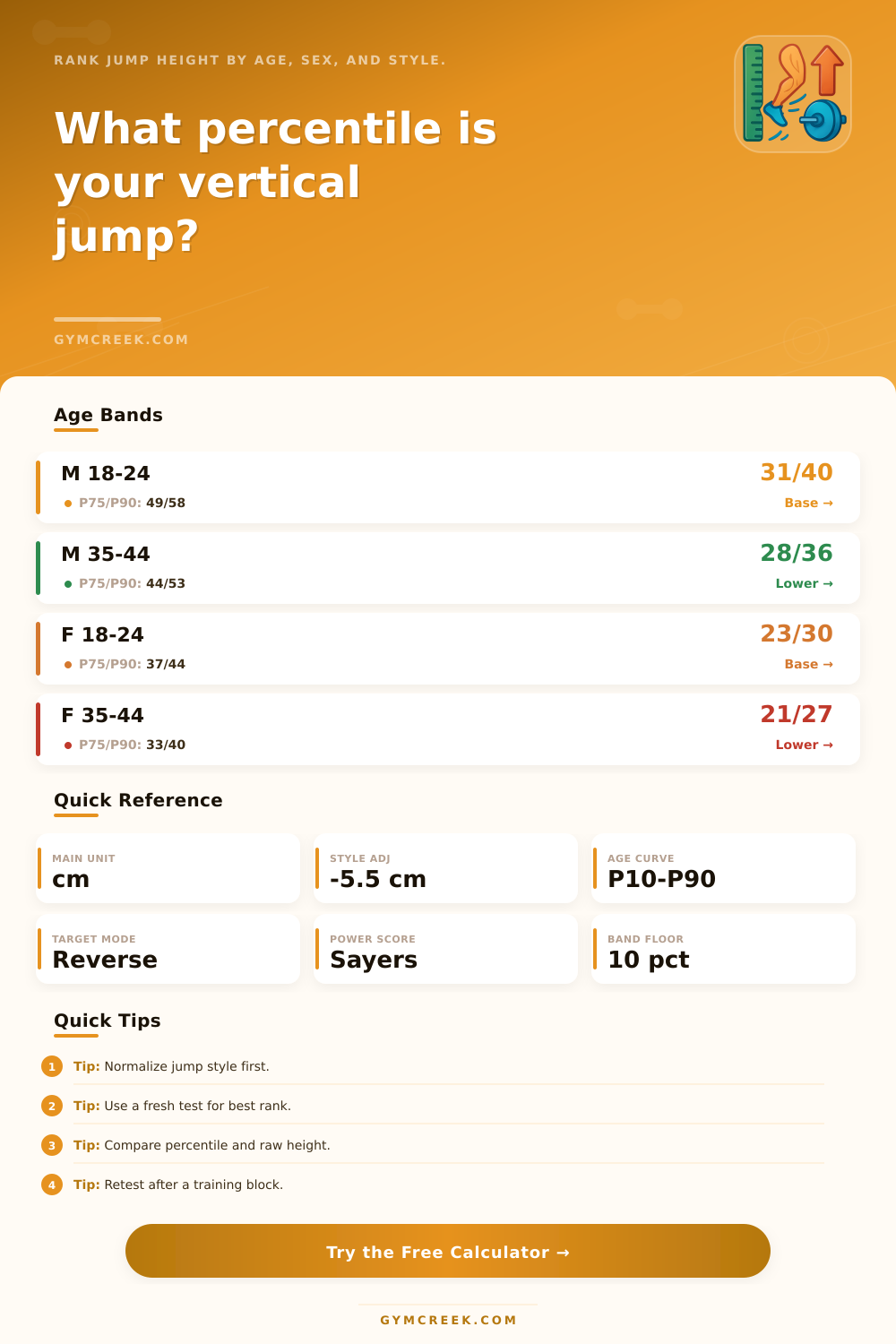
| Age band | P25/P50 | P75/P90 | Read |
|---|---|---|---|
| M 18-24 | 31/40 | 49/58 | Base |
| M 25-34 | 29/38 | 46/55 | Peak |
| M 35-44 | 25/32 | 40/49 | Lower |
| M 45-55 | 22/28 | 35/43 | Age |
| Age band | P25/P50 | P75/P90 | Read |
|---|---|---|---|
| F 18-24 | 23/30 | 37/44 | Base |
| F 25-34 | 21/27 | 34/41 | Peak |
| F 35-44 | 20/26 | 32/39 | Lower |
| F 45-55 | 16/21 | 27/33 | Age |
| Type | Adj | Use | Read |
|---|---|---|---|
| Standing | 0.0 cm | Base | Pure |
| CMJ | -2.5 cm | Mix | Small |
| Approach | -5.5 cm | Sport | Big |
| Reactive | -4.0 cm | Fast | Quick |
| Focus | Target | Fit | Use |
|---|---|---|---|
| Basketball | 72+ pct | High | Court |
| Volleyball | 78+ pct | High | Net |
| Football | 66+ pct | Mid | Skill |
| Track | 68+ pct | Mid | Speed |
💡Tips
A vertical jump are a measurement of explosive power. Additionally, measuring a vertical jump allow an individual to understand how much force that a person can apply through there lower body. The measurement of an individual’s vertical jump, such as their height in centimeter, do not provide a thorough understanding of there jumping ability.
This is because the measurement of centimeters does not take into account an individual’s age, their sex, or the requirement of the sport that they play. Percentiles provide context to an individual’s vertical jump measurement. These percentile provide an individual with an idea of how there vertical jump compares to other individual of there age and sex.
How to Measure and Improve Your Vertical Jump
The vertical jump measurement is used to gauge the explosiveness of an individual’s lower body. Lower body explosiveness relate to the amount of fast-twitch muscle fibers that an individual possess. Coaches use this measurement to determine the athletic potential of an individual in a variety of sports.
The vertical jump measurement can change based on a variety of variables. Age is one of these variable. An individual’s vertical jump can decline with age due to the decrease in muscle power that occur over time.
The muscle power of an individual decreases by approximately 1% every year after the age of 30. The second variable to consider is the individual’s sex. An individual’s sex can affect their vertical jump measurement.
Males typically have more high vertical jump measurements than females due to the differences in muscle mass between males and females. The third variable to consider is the jump style that an individual use. An individual’s jump style may change the height of there jump.
Standing vertical jumps measure an individual’s pure concentric strength. Countermovement jumps allow for an individual to dip which creates more elastic energy that translate into a higher jump. Countermovement jumps can have higher measurement value than standing vertical jumps.
To compare these different jumps, an individual can use normalization. Normalization can shift all jump style to a standing vertical jump equivalent so that the rank of each jump is accurate. The fourth variable to consider is an individual’s body weight.
An individual’s body weight can affect their vertical jump measurement. Individuals with higher body weights may have to produce more force when jumping then individuals with lower body weights. The fifth and final variable to consider is the condition in which the vertical jump is measured.
Vertical jumps performed while fatigued will have lower measurement values than vertical jumps performed by the same individual while rest. Different sports has different required percentiles for vertical jump measurements, based off data from athletes. For instance, basketball players may require a high percentile to efficient play the sport, volleyball players may require a high percentile to efficiently play soccer, and football players may require different traits to there jumps.
Additionally, track runners may possess high percentages for there reactive jumps. Using these percentiles for each sport, an individual can determine if there vertical jump is an average vertical jump or if they have the vertical jump of an elite athlete. For instance, if an individual’s percentile is below the 25th percentile, they may have the potential to develop strength.
If the percentile is above the 90th percentile, they may have the physical characteristic of an athlete with high levels of power. An individual may make some common mistake when measuring there vertical jump. For instance, individuals may chase the height that they desire to reach for there vertical jump without regularly retesting there measurements for the vertical jump.
Another mistake is ignoring there reach. Since an individual must subtract an individual’s standing reach from the total height that an individual can jump (touch height) to calculate an individual’s jump height, an individual must measure there standing reach to accurately calculate there vertical jump. Additionally, individuals should not measure there vertical jump if they are fatigued after performing another sport or if they do not have a proper warm up before jumping.
A person can use presets to make vertical jump measurements more accurate for specific group of individuals. For instance, presets may allow an individual to choose from a group of profiles such as youth athletes, basketball players, or volleyball players. Each of these profiles account for the age, the weight, and the jump style of each group of individuals.
Additionally, target mode allow an individual to calculate the vertical jump that an individual may need to reach a specific percentile for the sport that they wish to compete in. Target mode takes into account all of the relevant variable. If an individual knows the vertical jump height that is required, they can create a program that will allow an individual to increase there current vertical jump to there target vertical jump.
A vertical jump measurement provides an individual with an idea of there trainable power. However, an individual’s vertical jump measurement isnt a permanent limit to there jump strength. An individual should use a vertical jump measurement to establish a baseline for an individual’s strength.
Additionally, by knowing an individual’s vertical jump, an individual can target the specific aspect of there body and jump that need to be improved. By combining the measurement of an individual’s vertical jump with other physical measurements, such as sprint or broad jump measurements, an individual can have a more complete understanding of there physical abilities.