Mini-Cut Calculator
Set a realistic calorie deficit, protect lean mass, and map your path to a cleaner cut with practical bodybuilding-style planning.
Mini-Cut Snapshot
Calories, pace, macros, and target weight are estimated from your current size, activity, and lean mass assumptions.
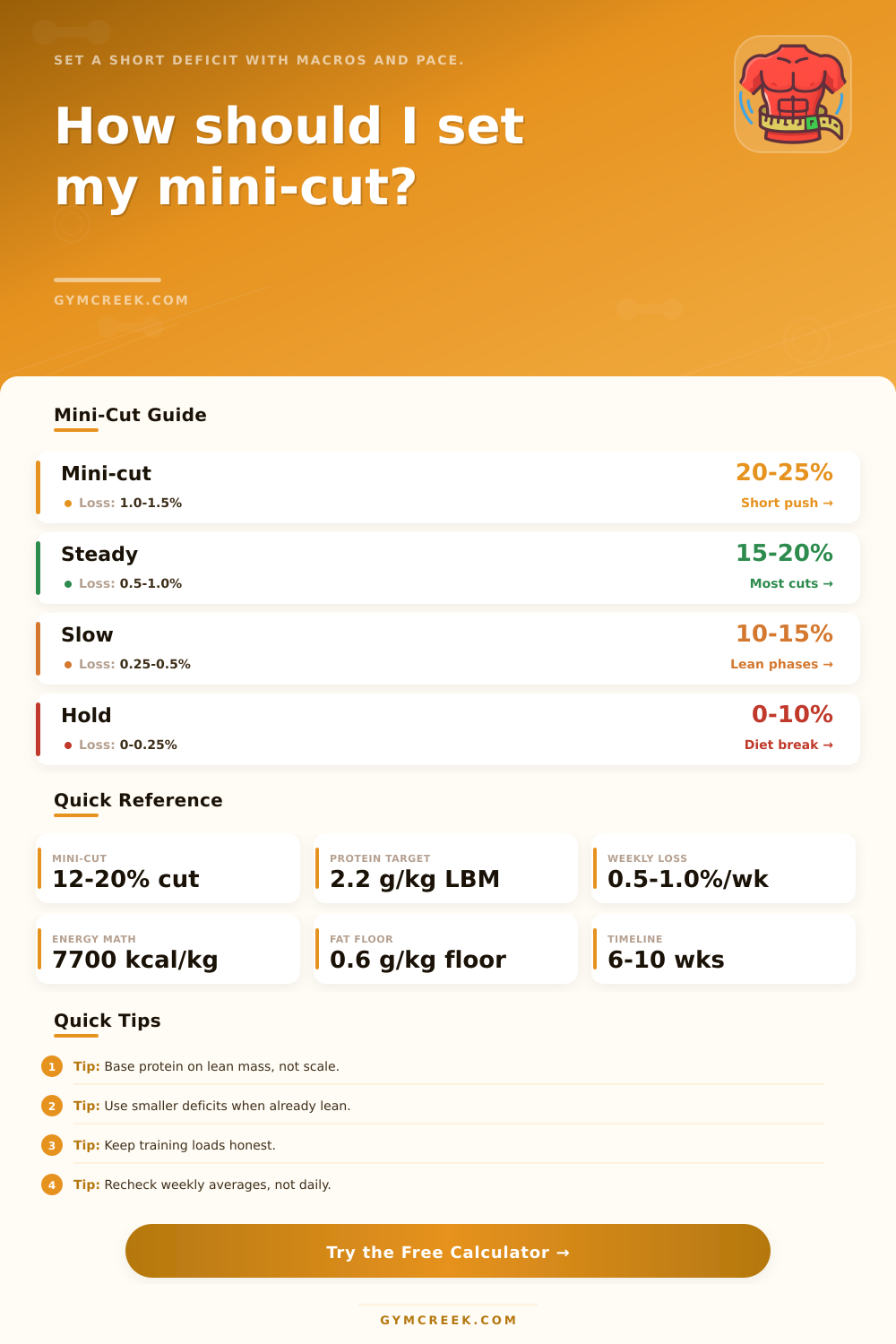
| Phase | Deficit | Weekly loss | Best for |
|---|---|---|---|
| Mini-cut | 20-25% | 1.0-1.5% | Short push, fast trim, strict recovery focus |
| Steady cut | 15-20% | 0.5-1.0% | Most physiques, balanced performance, muscle retention |
| Slow cut | 10-15% | 0.25-0.5% | Already lean lifters, longer dieting windows, higher training load |
| Diet break | 0-10% | 0-0.25% | Recovery, adherence reset, maintenance rehearsal |
| Activity level | Multiplier | Typical pattern | Cut note |
|---|---|---|---|
| Sedentary | 1.20 | Desk job, low steps | Use conservative cuts first |
| Lightly active | 1.375 | Some walking, 2-3 lifts | Standard deficit works well |
| Moderately active | 1.55 | Most training schedules | Good balance of speed and recovery |
| Very active | 1.725-1.90 | High steps, frequent sessions | Protect carbs around training |
| Situation | Protein | Fat floor | Carb fill |
|---|---|---|---|
| Higher body fat | 2.0 g/kg LBM | 0.6 g/kg LBM | Fill the rest |
| Mid-lean cut | 2.2 g/kg LBM | 0.7 g/kg LBM | Prioritize training days |
| Very lean cut | 2.4 g/kg LBM | 0.7-0.8 g/kg | Conserve performance |
| Mini-cut | 2.4 g/kg LBM | 0.7-0.9 g/kg | Keep carbs around lifts |
| Profile | Suggested pace | Protein cue | Notes |
|---|---|---|---|
| Desk worker | 15% | 2.0-2.2 g/kg LBM | Use step count to set realistic maintenance |
| Runner | 10-15% | 2.2 g/kg LBM | Watch recovery and keep carbs higher |
| Strength athlete | 10-20% | 2.2-2.4 g/kg LBM | Use a slower cut near heavy blocks |
| Lean finisher | 10% | 2.4 g/kg LBM | Small deficits preserve fullness better |
| Formula | Inputs | Output | Use |
|---|---|---|---|
| Mifflin-St Jeor | Weight, height, age, sex | BMR estimate | Best when body fat is unknown |
| Katch-McArdle | Lean body mass | BMR estimate | Best when body fat is known |
| Maintenance | BMR x activity | TDEE | Starting point for the cut |
| Target weight | Lean mass + target BF | Goal scale weight | Helps define the finish line |
A mini-cut is a period of time in which a person consume fewer calories than the person require in order to maintain there weight. These periods is intended to last between six and ten weeks. During these periods, a person aim to lower their body fat percentage while maintaining their muscle mass.
Mini-cuts are different than diet that are pursued over long periods of time in that the mini-cut include more aggressive calorie restriction in a shorter period of time, and that allow the individual to return to consume the calories required to maintain their weight. In order to begin a mini-cut, a person must determine the number of calories that they require to maintain their weight. The number of calories that a person burn each day includes the calories burned while performing basal metabolic rate (basal metabolism), calories burned during the movement that they perform each day, and calories burned through exercise.
Mini-Cut: How to Lose Fat and Keep Muscle
Basal metabolism can be calculated using a formula that consider a person’s weight, height, age, and sex. Furthermore, the activity that a person perform each day will change the number of calories that are burned through basal metabolism. Individuals that sit at desks all day will burn fewer calories through basal metabolism than individuals that walk many steps each day or perform exercises like weight lifting.
In addition to calculating the calories that are burned through basal metabolism, the bodys fat percentage of the individual will also impact the number of calories that are burned through a mini-cut. Individuals with high amount of body fat can allow for larger deficit in the number of calories consumed each day. Individuals with high amount of body fat can utilize a deficit of 20 to 25% of the calories that are burned through basal metabolism.
Individuals with low amounts of body fat will require fewer calories to be burned each day during the mini-cut. Individuals with low amount of body fat can utilize a deficit of 10 to 15% of the number of calories that are burned through basal metabolism. Individuals with low amounts of body fat will require the implementation of a smaller deficit in their diet to ensure that their strength and muscle mass are preserved.
The nutrient that should be incorporated into the diet during a mini-cut include protein, fat, and carbohydrates. Protein should be the primary focus of the diet, and a person’s lean body mass (the amount of body weight that does not include body fat) calculates the amount of protein that should be consume. A person should consume 2.2 grams of protein per kilogram of lean body mass to help maintain their muscle.
The importance of protein is that the protein in a person’s diet provide the body with amino acids, which are the building blocks for muscle. Additionally, a person should consume approximately 0.6 grams of fat per kilogram of lean body mass to ensure that hormone, such as testosterone, are maintained in the body. The remaining calories each day should be carbohydrates.
In order to track the progress of a mini-cut, the average weight of a person each week should be calculated. Calculating the weight each day can provide inaccurate measurement of weight loss, as a person may retain or lose water each day. A week-long average of a person’s weight can provide a more accurate indication of weight loss each week.
Additionally, in order to lose weight rapidly during a mini-cut, the individual may aim to lose 1 to 1.5% of their body weight each week. Losing 1.5% of a person’s body weight each week is, however, difficult to accomplish; a person must have good control over their sleep and stress levels in order to accomplish this target number. Additionally, if the percentage of calories burned through basal metabolism that are utilized during a mini-cut are too great for an individual to accomplish each day, the deficit should be reduced.
Instead, the individual should allow for a deficit of 10 to 25% of their basal metabolism calories to ensure that they can adhere to the diet plan. In order for a mini-cut to be effective, the body of the individual must be permitted to recover. A mini-cut increase the amount of cortisol that is present in the body.
Sleep is one way to allow the body to recover during the mini-cut. Additionally, walking is one exercise that can be utilized to increase the amount of activity of the individual. Both of these action will allow the body to recover from the mini-cut.
If the strength of an individual’s muscle declines significantly during a mini-cut, the individual may require an increase in the calories or protein that is consumed. Additionally, taking a diet break every eight weeks can provide recovery for the body and allow the bodys hormone to reset. During a diet break, the individual should consume a surplus of calories to provide recovery for the body after such a mini-cut program.
People should of planned for this, it is actualy a part of the process. To ensure success, the individual must follow these steps comfortabley and avoid alot of mistakes. The moddern approach to dieting is complex, but its easier when you know the rules.
Don’t forget to monitor how you’re feeling, as well as the progress you’re making. Making sure you get enough sleep is more important then you think. The diet plan needs to be followed closely, and the results will follows.
You shouldnt ignore the advice from experts, especially when it comes to nutrition and exercize. The body needs time to adapt to the changes. If you dont listen to your body, you might feel tired.
The process takes time, and you must stay patient. The individual shouldnt skip meals, and they should of eaten enough protein. It is a common mistake to do too much too fast.
Youll see better results if you stay consistent. The protein intake affects how you feel. This process is slightly different than other diets.
The results will eventually appear. A person could of avoided this by being careful. The weight loss should be steady.
If you follow the plan, you will see progress. You can achieve your goals if you try hard. Most people finds it difficult to stay on track.
The diet will work if you are dedicated.