💪 Lean Body Mass Calculator
Estimate your muscle & lean tissue mass using proven scientific formulas
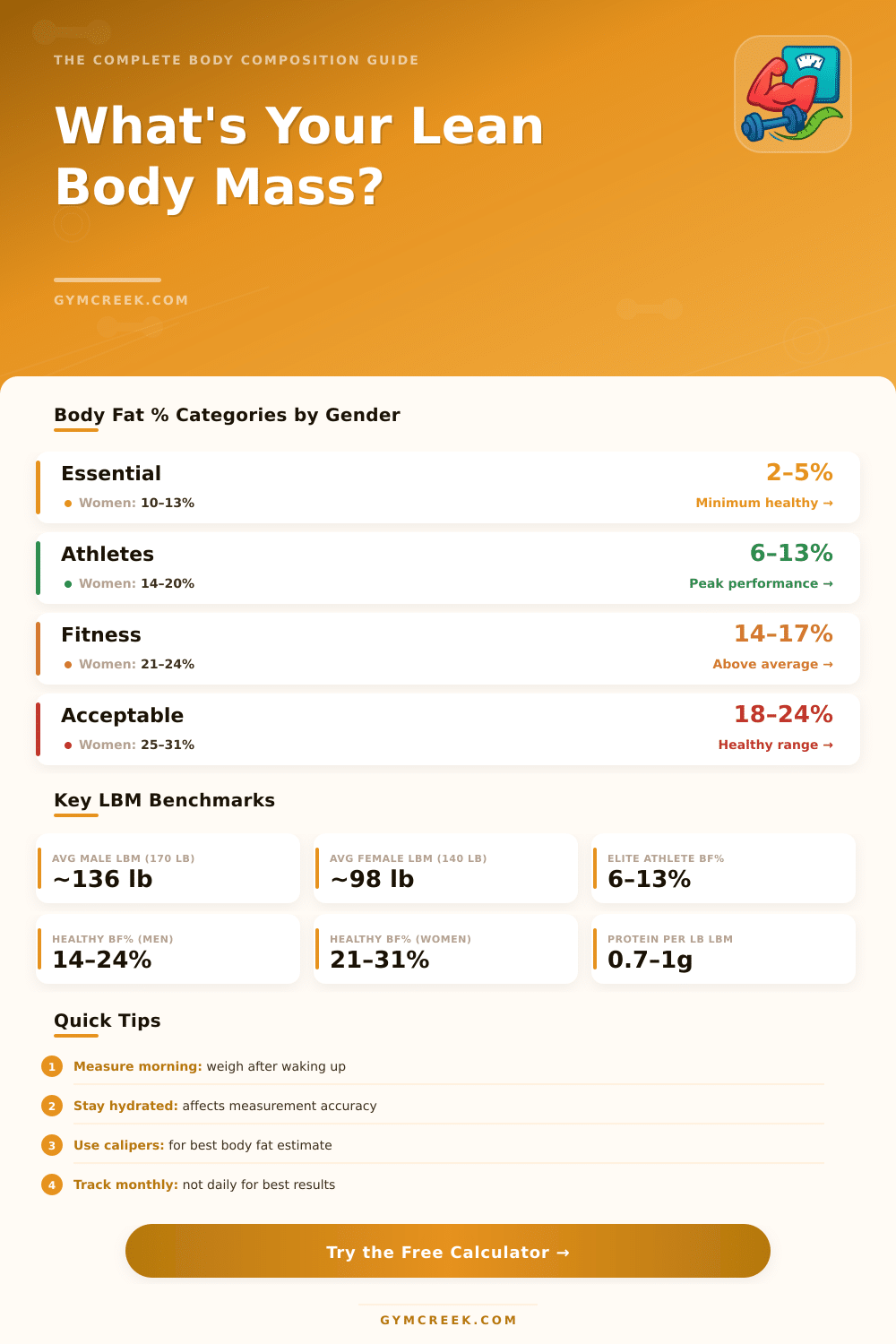
| Category | Men (BF%) | Women (BF%) | LBM% (Men) | LBM% (Women) |
|---|---|---|---|---|
| Essential Fat | 2–5% | 10–13% | 95–98% | 87–90% |
| Athletes | 6–13% | 14–20% | 87–94% | 80–86% |
| Fitness | 14–17% | 21–24% | 83–86% | 76–79% |
| Acceptable | 18–24% | 25–31% | 76–82% | 69–75% |
| Overweight | 25–30% | 32–39% | 70–75% | 61–68% |
| Obese | 30%+ | 40%+ | <70% | <60% |
| Formula | Basis | Best Used For | Accuracy Note |
|---|---|---|---|
| Boer (1984) | Height & Weight | General population | Most widely validated |
| James (1976) | Height & Weight | Classic clinical use | Underestimates obese |
| Hume (1966) | Height & Weight | Research studies | Good for lean individuals |
| Katch-McArdle | Body Fat % | Known BF% available | Highest accuracy with BF% |
| Goal | Protein per lb LBM | Protein per kg LBM | Example (150 lb LBM) |
|---|---|---|---|
| Maintain muscle | 0.6–0.7 g | 1.3–1.5 g | 90–105 g/day |
| Build muscle | 0.8–1.0 g | 1.8–2.2 g | 120–150 g/day |
| Cutting (fat loss) | 1.0–1.2 g | 2.2–2.6 g | 150–180 g/day |
| Endurance athlete | 0.6–0.8 g | 1.3–1.8 g | 90–120 g/day |
| Seniors (65+) | 0.9–1.1 g | 2.0–2.4 g | 135–165 g/day |
| Age Decade | LBM Change (Untrained) | LBM Change (Active) | Recommendation |
|---|---|---|---|
| 20s | +1–2 lb (peak building) | +3–10 lb | Build foundation |
| 30s | –0.5–1 lb/yr | Maintain or slight gain | Resistance training |
| 40s | –1 lb/yr | –0.1–0.3 lb/yr | Progressive overload |
| 50s | –1.5 lb/yr | –0.3–0.5 lb/yr | High protein + strength |
| 60s+ | –2 lb/yr | –0.5–1 lb/yr | Daily activity critical |
Lean Body Mass is made up of everything in your body that does not belong to fat. It includes your muscles, bones, organs, blood, skin and water. Simply said, you take your whole body weight and remove the whole amount of fat and what stays is your Lean Body Mass.
Two people can stand on the scale and note same numbers, but their looks are totally different. Why? Because their body structure differs a lot.
What Is Lean Body Mass and How to Find It
One of them probably has more fat while the second is rich in muscles and bones. Such difference shows more than simply the number on the scale.
Here is where things get a bit confusing: Lean Body Mass and fat-free mass is not truly the same, although folks commonly use those words the same way. Fat-free mass is easy, you simply remove the weight of fat from the whole body weight. But Lean Body Mass is somehow different, because it carries a bit of fat that naturally lives in your cells.
You even find this mix in science articles, what truly does everything more difficult than needed.
Healthy Lean Body Mass usually falls between 70 and 90 percent of your whole body weight although women commonly are in the lower part of that range. Watching that value helps you understand your body progress better than always checking the scale daily.
Do not mix Lean Body Mass with muscle mass, they do not match. Muscle mass forms only one part of the whole Lean Body Mass. Everything that is not fat tissue belongs to Lean Body Mass, so your bones and organs also enter in the calculation.
It works as a broad main category.
To estimate your Lean Body Mass, first you need too know your percentage of body fat. The math is not hard: multiply your current weight by the fat percentage in decimal form, and you find the weight of fat. Then remove that value from your whole weight.
Say, you weigh 180 pounds and have 30 pounds of fat, then your Lean Body Mass is 150 pounds.
DEXA scans can well estimate your body makeup, although they have a bit of error. Tools for fat weight are not perfect, but they well help to follow trends over time. There are also online tools that estimate your Lean Body Mass based on measures like waist and thighs.
Crash diets usually destroy muscle protein together with fat, which does not help you. Losing weight slowly; around 1 to 2 pounds a week, protects your muscles and even helps to build them during strength training. You can increase Lean Body Mass without the scale showing big changes, which means that you grow muscles while you dump fat for a slimmer look.
Do not forget protein. Aim for around 0.8 grams per kilo of Lean Body Mass if you are not very active, or go up to 1.2 grams if youregularly train.