💪 Lean Body Mass Calculator for Women
Estimate your LBM, body fat mass, and healthy muscle range using proven formulas
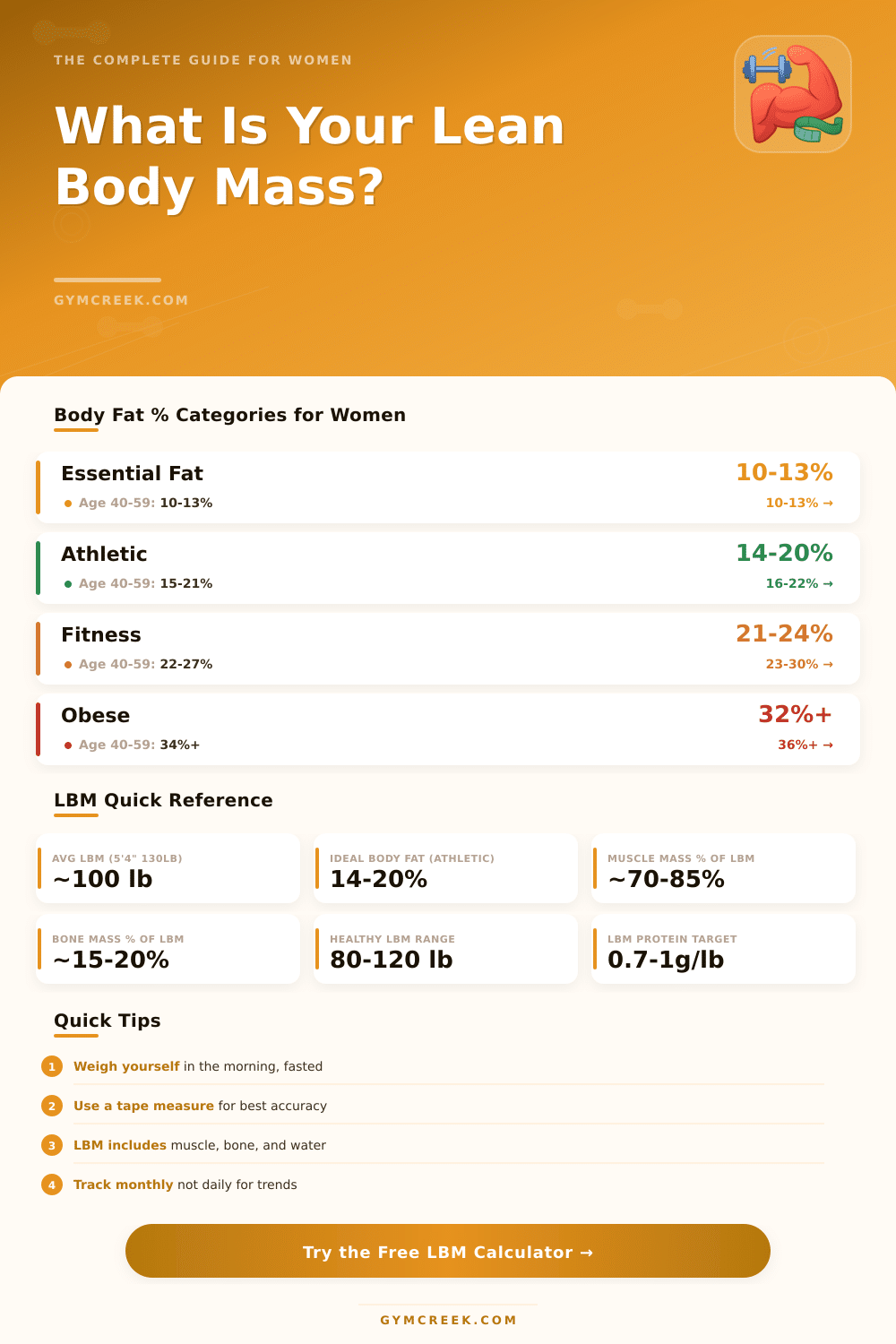
| Category | Body Fat % | Description | LBM Ratio |
|---|---|---|---|
| Essential Fat | 10–13% | Minimum for survival & hormonal health | 87–90% |
| Athletic | 14–20% | Competitive athletes & very active women | 80–86% |
| Fitness | 21–24% | Active, health-focused women | 76–79% |
| Average | 25–31% | Acceptable health range | 69–75% |
| Obese | 32%+ | Associated with elevated health risks | <68% |
| Height | Low LBM (lb) | Avg LBM (lb) | Athletic LBM (lb) |
|---|---|---|---|
| 5’0" (152 cm) | 84 | 95 | 108 |
| 5’2" (157 cm) | 90 | 101 | 115 |
| 5’4" (163 cm) | 96 | 107 | 122 |
| 5’6" (168 cm) | 102 | 114 | 129 |
| 5’8" (173 cm) | 108 | 120 | 136 |
| 5’10" (178 cm) | 114 | 127 | 143 |
| 6’0" (183 cm) | 120 | 134 | 151 |
| Formula | Best For | Inputs Used | Accuracy Note |
|---|---|---|---|
| Boer (1984) | General population | Height, Weight | Most accurate for most women |
| James (1976) | Normal BMI range | Height, Weight | May underestimate at high BF% |
| Hume (1966) | Older reference data | Height, Weight | Less accurate, historical use |
| Katch-McArdle | Known body fat % | Weight, BF% | Most accurate if BF% is known |
Weigh yourself first thing in the morning, after using the bathroom, and before eating or drinking. This reduces daily fluctuation by 1–3 lb. If you know your body fat % from a DEXA scan, hydrostatic weighing, or a reliable skinfold test, enter it above — it will use the Katch-McArdle formula for the most precise result. LBM includes muscle, bone, water, and organ mass — not just muscle tissue alone.
| Goal | Protein / lb LBM | Example (100 lb LBM) | Source |
|---|---|---|---|
| Sedentary / Maintenance | 0.5–0.7g | 50–70g/day | RDA + ISSN |
| Fat Loss (preserve muscle) | 0.7–1.0g | 70–100g/day | ISSN 2017 |
| Muscle Building | 1.0–1.2g | 100–120g/day | Morton et al. 2018 |
| High-Intensity Training | 1.2–1.4g | 120–140g/day | Phillips & Van Loon 2011 |
Lean Body Mass is made up of the whole weight of everything in the body that is not fat. One counts it by taking the body fat from the total weight. For instance, if someone weighs 180 pounds and has 30 pounds of fat, then their Lean Body Mass equals 150 pounds.
That is pretty easy math when one breaks it down like this.
What Is Lean Body Mass?
Lean Body Mass includes muscles, bones, organs, blood, skin and water. In short, everything except the fat. Sometimes one calls it “fat-free mass“, though there is a bit of technical difference between those two terms.
Lean Body Mass does include a small amount of fat in the cell walls, but fat-free mass does not. In scientific settings, folks commonly use the two terms the same way, which can create a bit of confusion.
Healthy range for Lean Body Mass is about 70 to 90 percent of the whole body weight. Two people can have the same weight, but look entirely different because of different body makeup. So just watching teh number on the scale can trick you, when one follows body progress.
One commonly mixes Lean Body Mass with muscle mass. They are not the same. Muscle mass refers to the muscles alone, while Lean Body Mass includes everything that is not fat.
And the term “lean muscle” is not truly scientific or correct. All muscles are naturally fat-free. In muscle tissue itself there is no fat.
One can measure Lean Body Mass using several methods. DEXA scans are one of the best. Even so, DEXA scans and tests using body impedance have errors in their limits.
Fat scales for the body do not give perfect values, but they help to track long-term direction over time. Online calculators also estimate the Lean Body Mass using entered data like height, weight, waist and hip size. For most goals, perfect accuracy is not entirely needed.
Too fast weight loss can cause loss of muscle protein instead of fat. Slow weight loss, around one to two pounds a week, helps too preserve and even build muscle mass, especially when one combines it with strength training. Also protein intake matters.
For normal living, minimum is 0.8 grams of protein per kilo of Lean Body Mass. For active life, one must reach at least 1.2 grams per kilo.
It is possible to grow Lean Body Mass without the weight on the scale going up. That means gaining muscles while losing fats at the same time, which gives a more toned look. Cutting caloriestoo much can lead to loss of current muscle mass, so a slow method works more well.