🏋 RDL to Deadlift Calculator
Convert between Romanian deadlift and conventional deadlift — find your ideal working weight
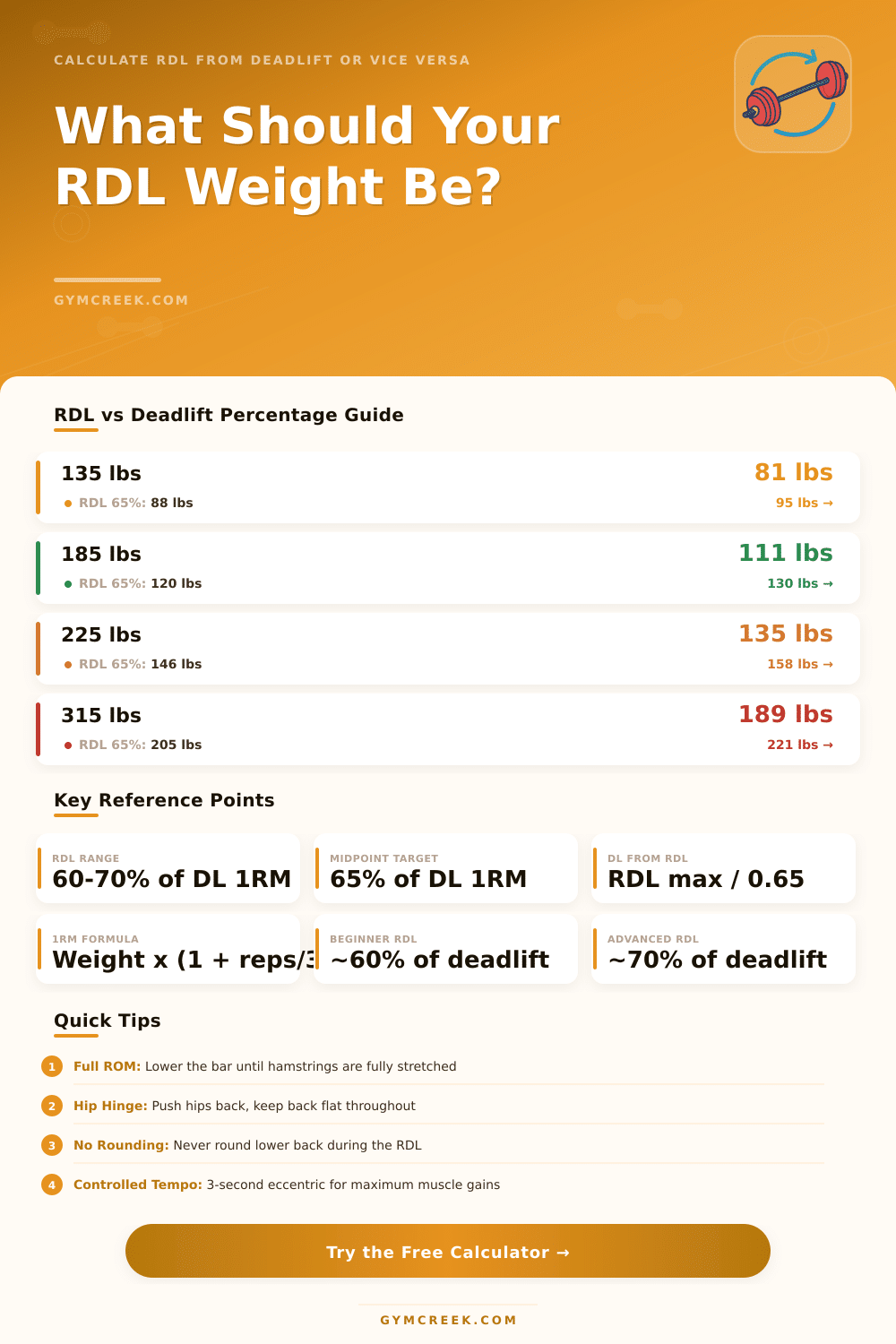
| Deadlift 1RM | RDL at 60% | RDL at 65% | RDL at 70% |
|---|---|---|---|
| 100 lbs | 60 lbs | 65 lbs | 70 lbs |
| 135 lbs | 81 lbs | 88 lbs | 95 lbs |
| 185 lbs | 111 lbs | 120 lbs | 130 lbs |
| 225 lbs | 135 lbs | 146 lbs | 158 lbs |
| 275 lbs | 165 lbs | 179 lbs | 193 lbs |
| 315 lbs | 189 lbs | 205 lbs | 221 lbs |
| 365 lbs | 219 lbs | 237 lbs | 256 lbs |
| 405 lbs | 243 lbs | 263 lbs | 284 lbs |
| RDL Working Weight | Estimated DL (÷ 0.60) | Estimated DL (÷ 0.65) | Estimated DL (÷ 0.70) |
|---|---|---|---|
| 80 lbs | 133 lbs | 123 lbs | 114 lbs |
| 100 lbs | 167 lbs | 154 lbs | 143 lbs |
| 135 lbs | 225 lbs | 208 lbs | 193 lbs |
| 185 lbs | 308 lbs | 285 lbs | 264 lbs |
| 225 lbs | 375 lbs | 346 lbs | 321 lbs |
| 275 lbs | 458 lbs | 423 lbs | 393 lbs |
Romanian deadlift, or simply RDL, is a form of the usual deadlift. It mainly targets the hamstrings of the thigh and the glutes. The name apparently came about through a somewhat funny history.
A weightlifter from Romania showed the exercise, and when someone asked about its name even no one knew that. So someone offered to call it Romanian deadlift, and everyone accepted without question.
What is the Romanian Deadlift?
The main difference between normal deadlift and RDL lies in the position of the bar and in the range of the move. During classic deadlift, the bar starts on the floor and rises until fully upright. Rather, the RDL starts when one holds the bar in standing position at the height of the hips.
From that spot, one lowers it until almost middle of the shin and then rises upward. In standard deadlift, the weight usually reaches the floor between every rep.
The RDL acts as a precise hip hinge with only little bending of the knees. They stay quite bent during the whole process. It does not involve squatting.
The deadlift, on the other hand, mixes pushing against the floor by means of the quads with pulling of the hamstrings of the thigh and glutes. Like this it requires more knee motion and uses more muscles of the quads. The RDL keeps the lower part of the body almost still, while the back works down and then back upward.
The RDL highlights the slow phase of lowering in the exercise. This keeps the muscles in constant tension. Because of that it really helps four building the size and the strength of the hamstrings of the thigh.
Normal deadlift works more as a general compound lift, that uses many more muscles together. Deadlifts also are useful for the muscles of the spine and for the glutes.
For goals of muscle growth, RDLs usually beat the traditional deadlifts. Muscle growth depends on building up volume, and RDLs allow to reach bigger volume. Pairing RDLs with bar presses above the head can bring equal or even more growth push with less tiredness.
The difference in tiredness is big between deadlifts with many reps and RDLs.
RDLs work well as a lighter version for the usual deadlifts, commonly with half to two-thirds of the weight, based on the number of reps. Some weightlifters can do RDL at around 70 percent of their max single deadlift for sets of five reps fairly easily. RDLs also work as helpful extra work along with squats and good mornings for the back, when one does not train deadlift directly.
RDLs can create strong pain in the hamstrings of the thigh, sometimes for almost a whole week. The hamstrings of the thigh and glutes usually feel it more the next day than during the same lift itself. Because normal deadlifts cannot be loaded heavily for muscle growth without problems in theback areas, RDLs commonly become the better choice for that task.