🏀 Dunk Calculator — Squat Strength Test
Find out if you can dunk based on height, vertical jump, and squat strength
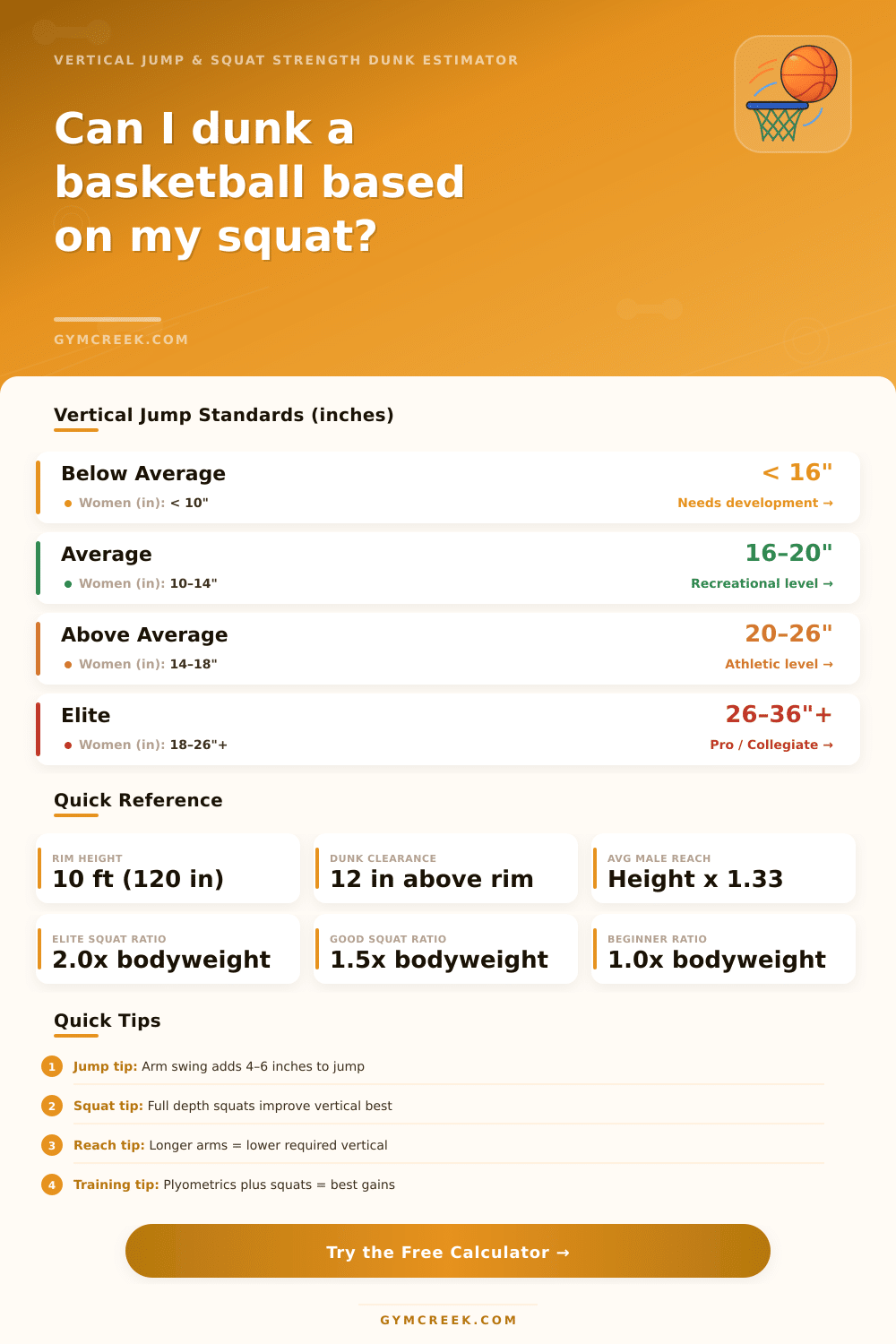
| Level | Men (inches) | Women (inches) | Description |
|---|---|---|---|
| Below Average | <16" | <10" | Needs significant development |
| Average | 16–20" | 10–14" | Recreational athlete |
| Above Average | 20–26" | 14–18" | Competitive athlete |
| Excellent | 26–32" | 18–24" | High-level athlete |
| Elite / Pro | 32"+" | 24"+" | Professional / collegiate |
| Level | Ratio (Squat/BW) | Estimated Vert Boost | Notes |
|---|---|---|---|
| Beginner | 0.75–1.0x | 9–12 inches est. | Building foundation |
| Intermediate | 1.0–1.5x | 12–18 inches est. | Functional strength |
| Advanced | 1.5–2.0x | 18–24 inches est. | Athletic strength |
| Elite | 2.0x+ | 24+ inches est. | High-performance level |
Build strong legs are basic for doing a dunk, but here the cause: only squats alone will not bring you to the limit. For a dunk you need technique, speed and a lot of specific training. Squats truly give you basic leg power.
The moves and speeds that you use in a deep squat, fully differ from what happens during a jump to the ring.
Squats Help but You Need Jump Training
Good achievement is reach around 1.5 times your body weight in a deep squat. If you weigh 150 pounds, that puts you at around 225 pounds. Even so, and this deserves to know.
There is no direct promise that a stronger squat will force a higher vertical jump. I saw lifters with average squats doing amazing jumps and vice versa, folks that can raise heavy weight, but can not rise off the ground. Your real jump height depends on power creation, so clean your technique and pure explosion.
Not only on the weight on the bar.
Here where jump training enters as a total game changer. Jump training forces your muscles to work at maximum power in short times, what builds the explosive power that you need later. We talk about vaults, long jumps, rope jumps, hops, squat jumps, runs and all kinds of big maximum jumps.
Doing jump training twice weekly best works for the majority of floks. Box jumps, deep jumps, hurdle jumps, broad jumps, rim jumps and one-leg steps upward all answer for that. Four or five exercises each session, with four sets of ten reps each, keep causes under control.
You plan around 30 minutes of jump work, give or take, each session.
Do not forget core training. Work your abs and lower back two or three times weekly to steady the whole chain and back the jump move. Play real basketball some times weekly is also important…
It ties your gym training with real moves and builds the muscle memory that you knead. Shoot to a low ring or go upward in games to build your timing skills.
Your body type determines what is real. Height, arm length, body fat levels and flexibility all play a role that you can not ignore. One-leg access to a dunk depends much on your body type and natural bounce, while two-foot dunks or standing attempts mostly need stacked explosive power above leg force.
Standing vertical jump in the center of 30 inches well lines up with a deep squat reaching two to two and a half times your body weight.
The majority of lifters benefit from squats twice weekly. One session can be heavy triples, and the other sets of six with more light weight. Real gains come from sticking with heavy weights, strict form and not too harsh chasing of numbers.
Deeper squats sometimes cause knee pain, though wider foot spots can help that. Lead with your hips and keep tension through your core for safer moves. Usetraining tools to balance basic strength with the explosive power that truly helps for a dunk.