🏋 Bench Press Plate Calculator
Enter your target weight — instantly see which plates to load on each side of the bar
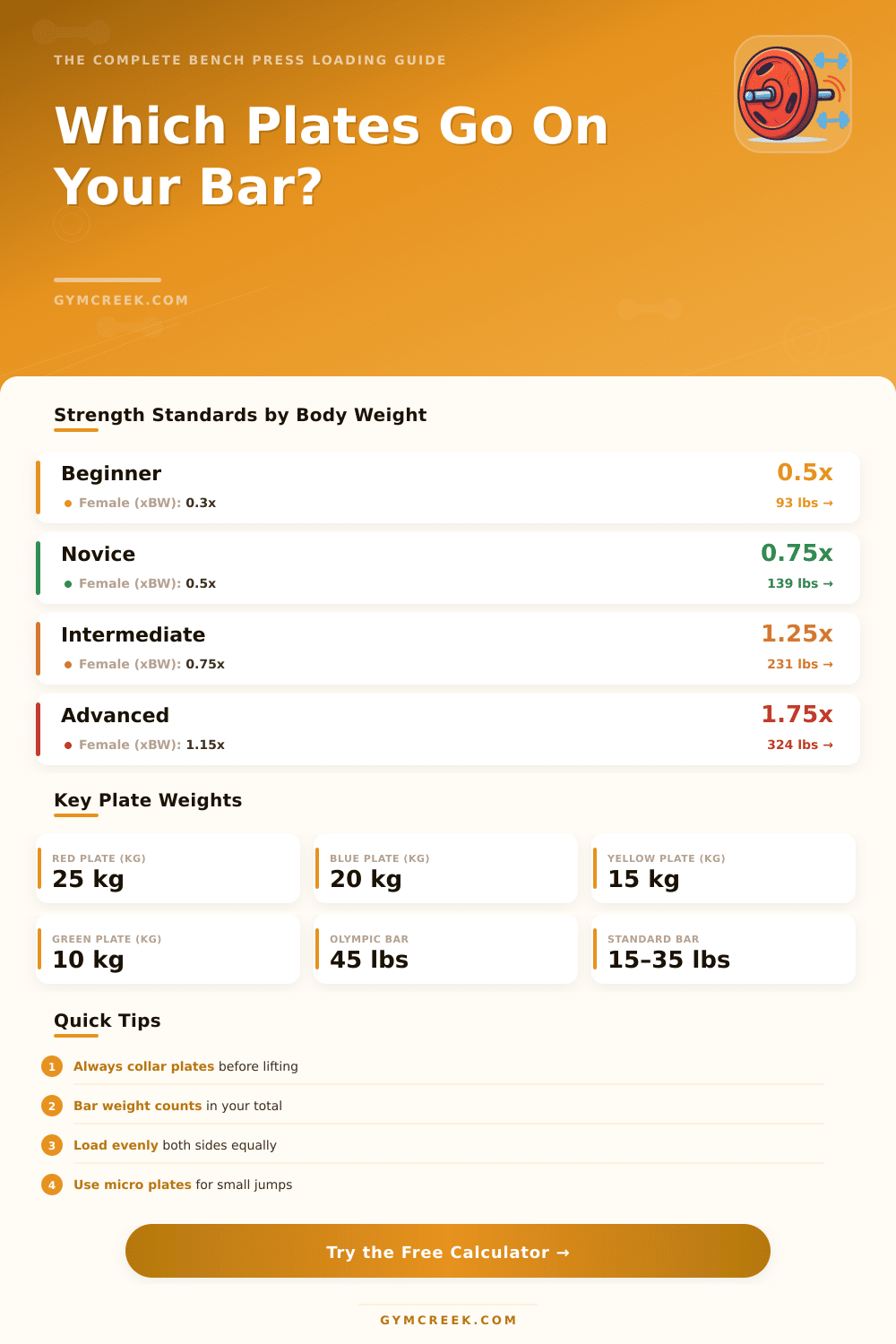
| Level | Male (x Bodyweight) | Female (x Bodyweight) | Example: 185 lb Male |
|---|---|---|---|
| Beginner | 0.5x BW | 0.3x BW | ~93 lbs |
| Novice | 0.75x BW | 0.5x BW | ~139 lbs |
| Intermediate | 1.25x BW | 0.75x BW | ~231 lbs |
| Advanced | 1.5x BW | 1.0x BW | ~278 lbs |
| Elite | 2.0x BW | 1.3x BW | ~370 lbs |
| Bar Type | Weight (lbs) | Weight (kg) | Common Use |
|---|---|---|---|
| Olympic Barbell (Men’s) | 45 lbs | 20 kg | Standard gym, powerlifting |
| Olympic Barbell (Women’s) | 33 lbs | 15 kg | Lighter training, women's competitions |
| Standard Barbell | 15–35 lbs | 7–16 kg | Home gyms, beginner use |
| EZ Curl Bar | ~20 lbs | ~9 kg | Bicep curls, skull crushers |
| Safety Squat Bar | ~60 lbs | ~27 kg | Specialty squats |
| Goal | % of 1RM | Rep Range | Sets |
|---|---|---|---|
| 💪 Max Strength | 85–100% | 1–5 reps | 3–5 |
| 💥 Power | 75–85% | 3–6 reps | 3–5 |
| 🏋 Hypertrophy | 65–80% | 6–12 reps | 3–4 |
| 🔥 Muscular Endurance | 50–65% | 12–20 reps | 2–3 |
| 🟢 Warm-Up | 30–50% | 8–15 reps | 2–3 |
Step 2 — Enter your target total weight. This is the complete loaded bar weight you want to lift.
Step 3 — Select which plates you have available. The calculator uses only your selected plate sizes.
Step 4 — Click Calculate. You'll see exactly which plates to add to each side, plus a visual diagram.
⚠ Always use collars to secure plates before lifting. Load both sides equally to keep the bar balanced.
The bench press is an exercise with weights, where one pushes the weight upward while lying on a special bench for training. That move works several parts of the body. Main muscles that it works are the big chest muscle, the front shoulder muscles and the triceps.
It also works the core. Like this it works many muscles of the upper body at the same time what makes it one of the most useful tools for building strength and size.
Bench Press Basics
The move itself is simple. One lies on the bench and pushes the weight upward using a bar or two dumbbells. The weight lowers until the level of the chest, then one extends the arms to raise it again.
In a good bench press one stops a moment at the chest before pushing upward. The downward move must be slow and controlled.
The position is very important. On a flat bench one lies flat with the bar directly above the eyes, when a spotter is beside you, or above the nose and mouth, if you are alone. The feet stay flat on the floor, while the buttocks and upper back sit flat on the bench.
Push the shoulders down to help settle them well for the position. It also matters to keep the shoulder blades drawn back. The wrists stay strait, so that the joints line up and the move stays stable, because bending the wrist can cause injury.
It is better to use controlled weight than take too much with wrong form. Although it seems like going backwards, better results come from less weight done correctly. Commonly skipping reps or pushing too quickly without control ends with stopped progress for a long time.
Doing bench press three times weekly with different sets of reps and a lot of volume forms a good plan. One can work in the range for muscle growth of eight to twelve reps and in the range for endurance of fifteen to thirty, during periods of four to six weeks each, what helps to get past a plate. Change the bench press program using different sets, numbers of reps and weights to shock the body to get past any wall.
Weak moments in the lift show certain muscles that lack strength. If one fails in the middle of the move, usually the shoulder muscles are the problem. Failure at the chest commonly points to weak chest muscles or back muscles, and adding dumbbells on a bench with heavier weight can help.
Because the triceps help a lot, JM presses and overhead presses work better than tricep pushdowns.
Adding moves like the flat bar bench press and the decline dumbbell bench press hits the chest from different directions and works the upper, middle and lower parts of the chest muscles. A decline bench most often gives the best setting of the chest for many folks. The flat press involves the triceps and front shoulders more.
Naturally one lifts less on an incline than on a flat or decline bench. Dumbbells can replace bars, but one must expect lessweight because of less stability. The bench press setup forms a key part of gym gear, and the benches should feel strong and firm.