🏋 Bench Press Plate Calculator
Enter your target weight — instantly see which plates to load on each side of the bar
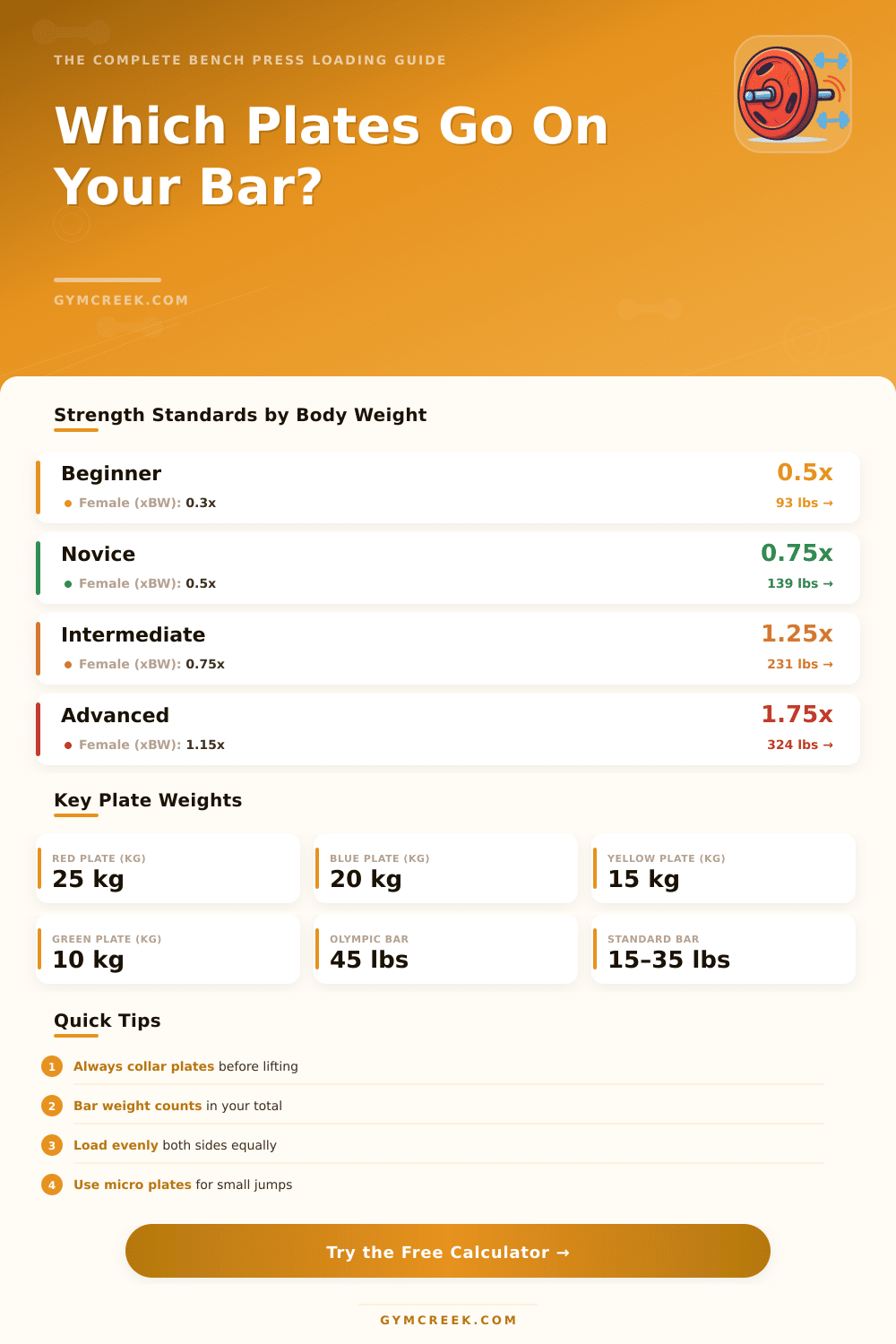
| Level | Male (x Bodyweight) | Female (x Bodyweight) | Example: 185 lb Male |
|---|---|---|---|
| Beginner | 0.5x BW | 0.3x BW | ~93 lbs |
| Novice | 0.75x BW | 0.5x BW | ~139 lbs |
| Intermediate | 1.25x BW | 0.75x BW | ~231 lbs |
| Advanced | 1.5x BW | 1.0x BW | ~278 lbs |
| Elite | 2.0x BW | 1.3x BW | ~370 lbs |
| Bar Type | Weight (lbs) | Weight (kg) | Common Use |
|---|---|---|---|
| Olympic Barbell (Men’s) | 45 lbs | 20 kg | Standard gym, powerlifting |
| Olympic Barbell (Women’s) | 33 lbs | 15 kg | Lighter training, women's competitions |
| Standard Barbell | 15–35 lbs | 7–16 kg | Home gyms, beginner use |
| EZ Curl Bar | ~20 lbs | ~9 kg | Bicep curls, skull crushers |
| Safety Squat Bar | ~60 lbs | ~27 kg | Specialty squats |
| Goal | % of 1RM | Rep Range | Sets |
|---|---|---|---|
| 💪 Max Strength | 85–100% | 1–5 reps | 3–5 |
| 💥 Power | 75–85% | 3–6 reps | 3–5 |
| 🏋 Hypertrophy | 65–80% | 6–12 reps | 3–4 |
| 🔥 Muscular Endurance | 50–65% | 12–20 reps | 2–3 |
| 🟢 Warm-Up | 30–50% | 8–15 reps | 2–3 |
Step 2 — Enter your target total weight. This is the complete loaded bar weight you want to lift.
Step 3 — Select which plates you have available. The calculator uses only your selected plate sizes.
Step 4 — Click Calculate. You'll see exactly which plates to add to each side, plus a visual diagram.
⚠ Always use collars to secure plates before lifting. Load both sides equally to keep the bar balanced.
The bench press exercise are one of the most popular among weightlifters because it provides the best upper-body strength gains. Whether you are new to lifting weights or an experienced weightlifter seeking new personal records, calculating the proper way to load the barbell is a critical first step in establishing proper form and maximizing gains from the exercise.
Understand how to load the barbell proper to ensure your safety and to maximize your strength gains. Depending off the gym, the available weights of the bench press plate may vary. Additionally, the weights of the barbells themselves may vary. A bench press plate calculator will allow lifters of all experience levels to quickly determine the proper combination of bench press plates required to reach a desired weight.
How to Calculate Bench Press Plate Loadings
Despite the simplicity of the bench press exercise, the math behind calculating the proper loading of the barbell can be complex. To calculate the loading of the plates, it is first important to understand that the total weight of the barbell will be the total weight of the plates loaded onto the bar divided by two, representing the number of plates on each side of the bar, plus the weight of the bar itself. For example, a standard bar weighs 45 pounds (20 kg). If your goal is to bench press 225 pounds, the total weight of the loading plates will have to be 180 pounds (225 pounds. 45 pounds of the bar).
Bench press plates come in various sizes: 45 lb (25 kg), 35 lb (20 kg), 25 lb (15 kg), 10 lb (5 kg), 5 lb (2.5 kg), and 2.5 lb (1.25 kg) in imperial units, or 25 kg, 20 kg, 15 kg, 10 kg, 5 kg, and 2.5 kg in metric units. The heavier the plates, the few that will be needed to reach the target weight of the lift. While experienced lifters may incorporate plates of 1.25 lb (0.5 kg) or even 0.5 kg into their lifts, lifters that is new to the weightlifting world may find it challenging to incorporate such small weights into their lifts.
For both safety and etiquette within the gym, the lifter loads the heaviest plates onto the bar first. This is also referenced as how powerlifters load the bar. They will load the bar, the heaviest plates, and then work to the lightest weights.
The proper weight to lift on the bench press will depend on your body weight, your lifting experience, and your overall strength training goal. For example, a man that weighs 180 pounds may find it challenging to bench press 135 pounds when just beginning to lift weights. In contrast, an experienced weightlifter of 180 pounds may be lifting 315 pounds.
Bench pressing strength standards vary. For most men, lifting one’s body weight on the bench press is a solid goal that indicates strength gains. More experienced weightlifters may aim to bench press 1.5 time one’s body weight. Elite athletes may bench press up to double their body weight. For women, the same standards may vary slightly due to physiological differences. Powerlifters may aim for 1.5 times one’s body weight for women, while the elite athletes may bench press up to 2 times their body weight.
Bench pressing can be used to achieve various training goals. For example, powerlifters will perform the bench press with very low repetitions and high degree of lifting strength. Bodybuilders may perform the same exercise with moderate weights and higher repetitions. Depending upon the goals of the lifter, various weights may be used and loaded onto the bar.

Thanks to moddern technology, the calculations regarding the loading of the barbell are no longer a mental calculation. Tools such as the bench press plate calculator above will show the proper loading of the barbell plates needed to achieve any desired bench press strength.
Proper warm-up sets are essential for those that perform the bench press lift. Performing sets with no added weight to the barbell or with very light weights for the bench press will help the body and muscle to warm up. These warm-up sets are crucial to avoiding injuries. Additionally, a bench press plate calculator can make these calculations for the new lifter entirely effortless.
Strength gains take time to develop. While there are many benefit to incorporating the bench press into one’s training routine, consistency is the most important component to developing the upper-body strength that lifts can achieve. The ability to instantly calculate the proper loading of the barbell will save time and allow individuals to focus more on lifting. Over time and with each lifting session, these efforts will pay off.
Regardless of what stage of strength training an individual is achieving, calculating the proper loading of the bench press plates can provide a valuable perspective on one’s training experience. Along with incorporating proper training routines, providing adequate recovery for the body, and incorporating the loading calculations above, individuals will achieve the best results from their bench press routine.
The journey of strength training requires both patience and precision. The removal of the mental calculations associated with loading the bar will allow lifters to better focus on their long-term training goals. The best strength gains come from consistent training over time. Your strongest bench press is still ahead of you, and with the proper plates loaded on the bar, youll get there one rep at a time.