🔥 TDEE Calculator for Teens
Discover your Total Daily Energy Expenditure — personalized for ages 13–19
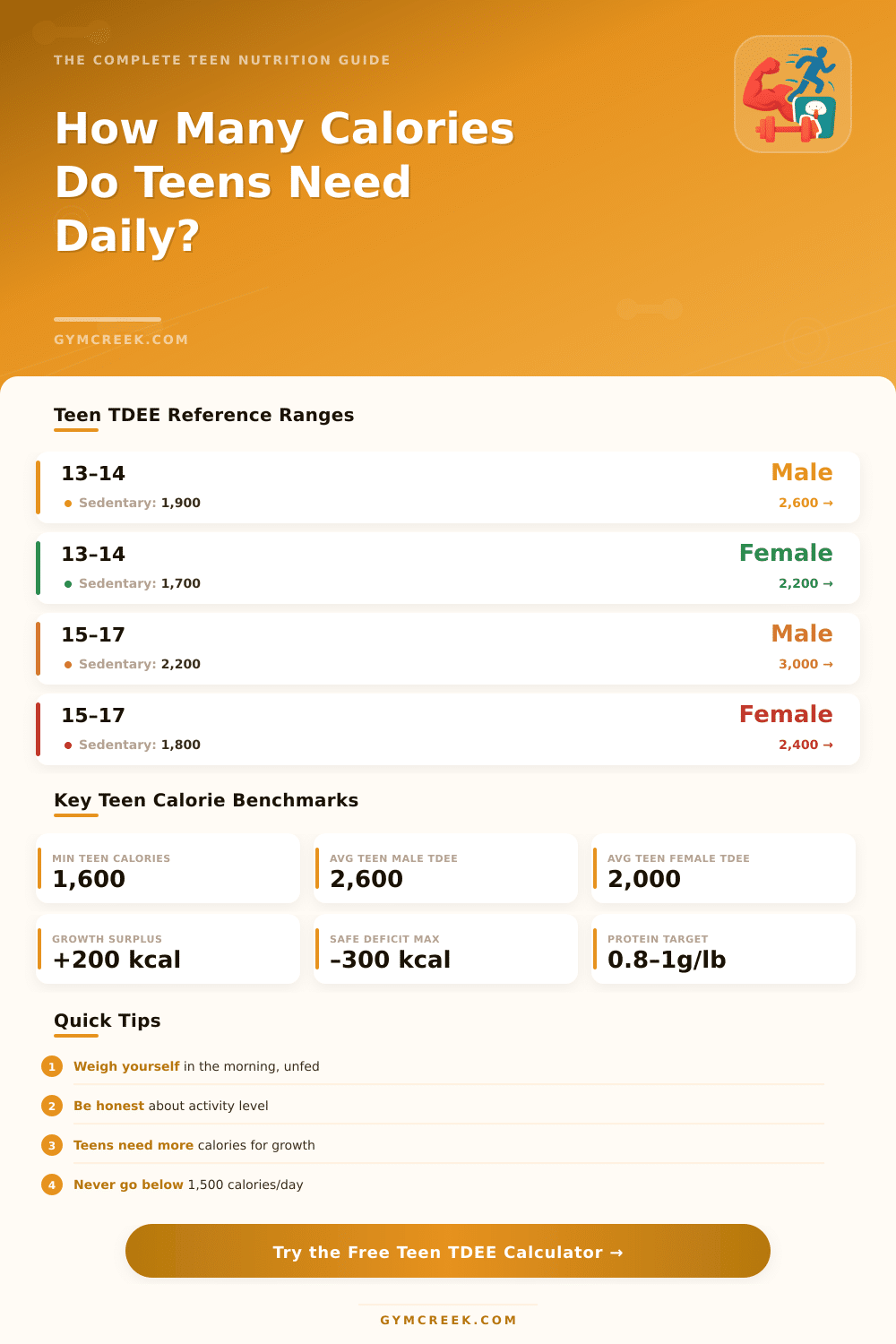
| Age | Gender | Sedentary | Lightly Active | Moderately Active | Very Active |
|---|---|---|---|---|---|
| 13–14 | Male | 1,900 | 2,100 | 2,400 | 2,600 |
| 13–14 | Female | 1,700 | 1,900 | 2,100 | 2,400 |
| 15–16 | Male | 2,100 | 2,300 | 2,600 | 2,900 |
| 15–16 | Female | 1,750 | 2,000 | 2,200 | 2,400 |
| 17–18 | Male | 2,200 | 2,500 | 2,800 | 3,100 |
| 17–18 | Female | 1,800 | 2,000 | 2,200 | 2,500 |
| 19 | Male | 2,200 | 2,500 | 2,800 | 3,000 |
| 19 | Female | 1,800 | 2,100 | 2,300 | 2,500 |
| Goal | Protein | Carbohydrates | Fat | Notes |
|---|---|---|---|---|
| Maintain Weight | 15–20% | 50–55% | 25–35% | Balanced for teens |
| Lose Weight | 25–30% | 40–45% | 25–30% | Max 300 kcal deficit |
| Gain Muscle | 25–30% | 45–55% | 20–25% | +200–300 kcal surplus |
| Support Growth | 15–20% | 50–60% | 25–30% | Extra carbs for growth |
| BMI Category | BMI Range | Interpretation | Action Note |
|---|---|---|---|
| Underweight | Below 18.5 | Below healthy weight | Consult a doctor |
| Healthy Weight | 18.5 – 24.9 | Normal range for teens | Maintain habits |
| Overweight | 25.0 – 29.9 | Slightly above range | Mild deficit + exercise |
| Obese (Class I) | 30.0 – 34.9 | High body fat | Medical guidance needed |
| Obese (Class II+) | 35.0+ | Very high body fat | Doctor consult essential |
| Goal | Daily Calorie Adjustment | Weekly Change | Safe for Teens? |
|---|---|---|---|
| Mild Weight Loss | −200 to −300 kcal | ~0.5 lb / week | ✅ Yes |
| Moderate Loss | −400 to −500 kcal | ~1 lb / week | ⚠ With guidance |
| Aggressive Deficit | −500+ kcal | 1–2 lb / week | ❌ Not recommended |
| Muscle Gain | +200 to +300 kcal | ~0.5 lb / week | ✅ Yes |
| Growth Support | +150 to +200 kcal | Gradual growth | ✅ Yes |
The total everyday energy use, or simply TDEE, is made up of the whole amount of calories that your body burns during one day. It covers your basic metabolic rhythm together with what you spend through physical activity and everyday moves. A calculator for TDEE uses your data about age, height, weight, gender and amount of motion to give an estimate based on that info.
It considers both your basic calorie burning and the extra energy that you need when you move.
Why TDEE Calculators Give Wrong Numbers for Teens
Here is where it gets hard for youngsters. Youngsters truly need more calories than adults. The problem is that most TDEE calculators that show up online are done for adults and simply do not work for folks under 18 years.
Children and youngsters need more calories because their bodies still grow, and too harshly cutting calories at that age can cause serious problems.
From a math viewpoint, TDEE is only BMR added to the calories that you burn during activity. BMR itself depends on your lean muscle, height, gender and hormone changes. Like this, in theory, those calculators should work well for youngsters.
But here is the key cause; numbers on the screen do not match to real food reality. Youngsters have totally different eating needs, because they still grow, and those needs show up differently in their calorie demands.
Another trouble is that youngsters need there own guidelines completely. They have different standards for BMI, different formulas for TDEE and different everyday minimums than adults. Girls at that age usually need around 1800 calories a day, while boys commonly need something closer to 2000.
It is useful to recall that when you think about this topic.
Some calculators rely on research about doubly labelled water, thanks to the Institute for Dietary Reference Intake of Medicine, which usually is more reliable than old equations like Harris-Benedict or Mifflin-St Jeor. Even so, no online calculator will be able to exactly estimate your personal TDEE. They serve only as a starting point.
Reality is that TDEE changes from day to day, and exactly estimating it is truly hard.
Growth in the teen years does not go along a straight line. During some weeks a youngster will be very hungry, and that is fully normal… Nothing to panic about.
If a youngster passes their ideal weight and thinks to cut calories, it is good to talk with a doctor first. Even better? Search for help from a registered nutritionist who focuses on nutrition for youngsters.
The most direct way is to carefully note food intake, weigh yourself every morning and later watch the average weightchange over several weeks to estimate your real daily calories. That gives real data instead of calculator guesses. Because TDEE changes with lifestyle shifts, keeping everything steady over time makes those ratings more stable and reliable.