🔥 TDEE Calculator for Teens
Discover your Total Daily Energy Expenditure — personalized for ages 13–19
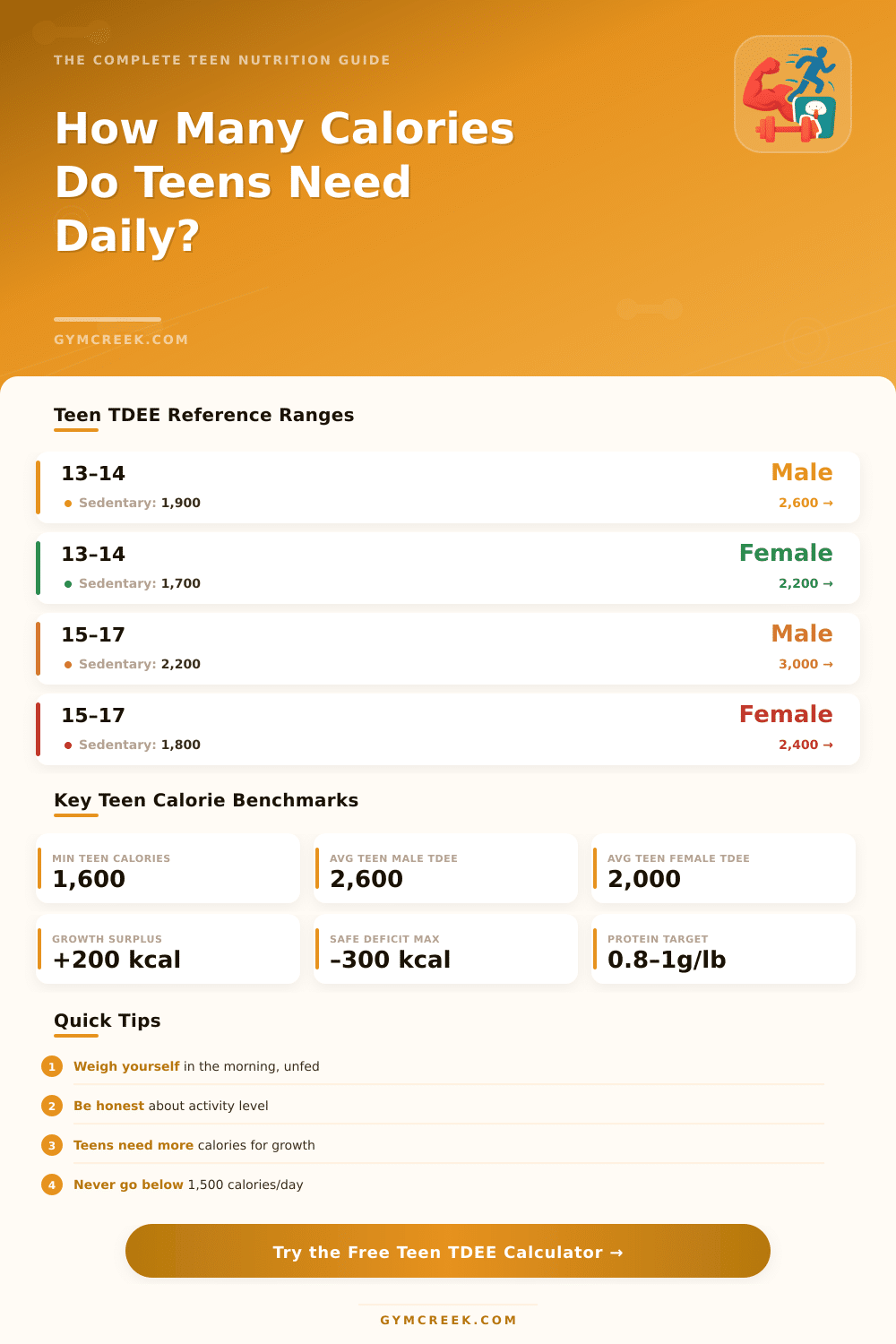
| Age | Gender | Sedentary | Lightly Active | Moderately Active | Very Active |
|---|---|---|---|---|---|
| 13–14 | Male | 1,900 | 2,100 | 2,400 | 2,600 |
| 13–14 | Female | 1,700 | 1,900 | 2,100 | 2,400 |
| 15–16 | Male | 2,100 | 2,300 | 2,600 | 2,900 |
| 15–16 | Female | 1,750 | 2,000 | 2,200 | 2,400 |
| 17–18 | Male | 2,200 | 2,500 | 2,800 | 3,100 |
| 17–18 | Female | 1,800 | 2,000 | 2,200 | 2,500 |
| 19 | Male | 2,200 | 2,500 | 2,800 | 3,000 |
| 19 | Female | 1,800 | 2,100 | 2,300 | 2,500 |
| Goal | Protein | Carbohydrates | Fat | Notes |
|---|---|---|---|---|
| Maintain Weight | 15–20% | 50–55% | 25–35% | Balanced for teens |
| Lose Weight | 25–30% | 40–45% | 25–30% | Max 300 kcal deficit |
| Gain Muscle | 25–30% | 45–55% | 20–25% | +200–300 kcal surplus |
| Support Growth | 15–20% | 50–60% | 25–30% | Extra carbs for growth |
| BMI Category | BMI Range | Interpretation | Action Note |
|---|---|---|---|
| Underweight | Below 18.5 | Below healthy weight | Consult a doctor |
| Healthy Weight | 18.5 – 24.9 | Normal range for teens | Maintain habits |
| Overweight | 25.0 – 29.9 | Slightly above range | Mild deficit + exercise |
| Obese (Class I) | 30.0 – 34.9 | High body fat | Medical guidance needed |
| Obese (Class II+) | 35.0+ | Very high body fat | Doctor consult essential |
| Goal | Daily Calorie Adjustment | Weekly Change | Safe for Teens? |
|---|---|---|---|
| Mild Weight Loss | −200 to −300 kcal | ~0.5 lb / week | ✅ Yes |
| Moderate Loss | −400 to −500 kcal | ~1 lb / week | ⚠ With guidance |
| Aggressive Deficit | −500+ kcal | 1–2 lb / week | ❌ Not recommended |
| Muscle Gain | +200 to +300 kcal | ~0.5 lb / week | ✅ Yes |
| Growth Support | +150 to +200 kcal | Gradual growth | ✅ Yes |
Navigating the world of nutrition and diet during the teenage years can be both overwhelming and challenging. For teens, determining the number of calories their body need in a day can be a challenge due to there range of activities and commitments. However, understanding the concept of TDEE can be of great value to teens looking to understand their nutritional needs. TDEE stand for total daily energy expenditure, which is the total number of calories that an individual burn in a day. For teenagers, the TDEE can be more dynamic due to the changes in their bodies during adolescence.
Calculating the TDEE for teens involves several factor, including age, gender, weight, height, and activity level. Considering the differences in the needs of teenagers as compared to the rest of the adult population, using a TDEE calculator for teens will offer an estimate that more accuratley reflect their needs compared to the estimates for adults. The estimates calculated for teens will provide a starting point for their nutritional goals for the year.

Why TDEE Matters More During Adolescence
The human body go through a range of changes during the teenage years. Teens typically experience growth spurts, the development of more muscle mass, and changes to their hormones. These changes correlate to an increase in the number of calories that a 15-year-old boy, for example, may need as compared to an adult boy of the same size. Additionally, active teen girls who participates in sports may require more calories to fuel their bodies to accomplish their athletic goals and to maintain their health-related aspect of their bodies, such as their menstrual cycles.

Many teens either eat too little or too much due to a variety of reason. Eating too little may be the result of a strong desire to lose weight or to possess a certain body image. Eating too much can be the result of a lack of knowledge of the true calorie needs of the teen’s body. Too little calories can lead to poor health, lack of energy, and missed puberty milestones. Consuming too many calories without engaging in enough physical activity can also have detrimental effect on a teen’s health and lead to weight gain.
The concept of TDEE considers several factors of the bodys metabolism. The BMR, or basal metabolic rate, is the number of calories that an individual burns while at rest. A factor that represent an individual’s level of activity throughout the day multiplies this number. For teenagers, the BMR is higher relative to their body weight as compared to adults.
By understanding an individual’s TDEE, goals can be created according to an individual’s body changes. For instance, if a teen is trying to gain more height or increase their muscle mass, or if they are trying to lose weight, understanding this number will allow for the creation of goals that will work with the teen’s body. Additionally, understanding these numbers allow for better understanding of the role of physical activity in TDEE calculations.
An individual’s level of physical activity have a tremendous impact upon their TDEE. For instance, a teen who remains inactive the majority of the day will require fewer calories than a teen who participates in a variety of physical activities each day. A teen who ignores their physical activity levels will likely underestimate their physical activity, and thus, underestimate the calories that they burn each day.
Nutrition experts suggest that achieving the TDEE for teens requires an increase in the consumption of foods that contain the nutrients required for a teen’s body and mind to function at their best. The bodys growth phases requires an increase in the consumption of protein, complex carbohydrates for the brain and muscles, and healthy fats for the development of hormones during puberty.
Online TDEE calculators for teens will provide estimates for the number of calories that each teen should consume. However, the actual number of calories that is burned by each individual can vary from the estimate due to differences in metabolism. Instead of relying on the calculator to gauge the calories consumed by a teen, the teen is encouraged to monitor their body and their health indicator, and to regularly visit their healthcare providers for checkups and health reports.
The calorie guidelines for teens are entirely different than those recommended for adults. The calories that is required by adults to support their health can be significantly higher than those required of adults who are not as active. However, drastically reducing the calories consumed by teens, as is encouraged of adults who aim to lose weight, can interfere with the normal development of their bodies during adolescence. Experts suggest that teens consume between 200-300 calories above or below their TDEE at most as a means of achieving weight goals. This range provide enough calories for the teen’s development while allowing for progress towards weight-related goals.
Overall, the TDEE calculators that are created for teenagers do not require teenagers to adhere to the numbers calculated for their bodies. By understanding the role that activity plays in the TDEE and the role that nutrition has upon TDEE, teens are encouraged to develop a relationship with their food that does not require tracking each calorie that is consumed by the body.
There are certain situation in which a teen may require the attention and care of a registered dietitian. Athletes that participate in numerous sports each day, teens with health issues that impact their metabolism, and teens with eating disorders may benefit from the attention and care of a dietitian who specializes in the nutrition of adolescents.

Ultimately, the true goal of teenagers in relation to the TDEE calculator is not to master the numbers and understand how many calories their bodies requires each day. Instead, understanding the concept of TDEE allows teens to form a healthier relationship with their bodies, their physical activity, and the type of nutrition that their bodies require to develop normally. A TDEE calculator for teens will provide teens with valuable data regarding their bodies. When combined with an understanding of the body’s needs for physical activity, sleep, and healthy eating, the calculator can allow teens to create a comprehensive wellness program for themselves during these critical years of adolescence.
Furthermore, because the bodies of teens change at a rapid rate, the calories that are considered appropriate for a 13-year-old may not be the same for a 17-year-old. To account for these rapid changes in teens bodies, it is recommended to reassess their TDEEs every few months. By understanding these recommendations and suggestions for teens regarding TDEE, they can begin to have a better understanding of their bodies, the changes that occur within them, and how to maintain a healthy and well-developed body during adulthood.
By learning about TDEE in the context of the bodies of teenagers, teens will gain knowledge that will stay with them throughout their adulthood. Not only will they understand how to manage their health and their bodies during their adolescence, but they will understand the long-term impact of healthy eating habits and body confidence. Understanding TDEE helps teens build lifelong healthy habits and body confidence.