🥩 Protein Intake Calculator for Weight Loss
Get your personalized daily protein target based on your body, activity level & weight loss goal
| Food Source | Protein (per 100g) | Calories (per 100g) | Category |
|---|---|---|---|
| Chicken Breast (cooked) | 31g | 165 kcal | Animal |
| Turkey Breast (cooked) | 29g | 135 kcal | Animal |
| Canned Tuna (in water) | 25g | 116 kcal | Animal |
| Salmon (cooked) | 25g | 208 kcal | Animal |
| Egg Whites | 11g | 52 kcal | Animal |
| Greek Yogurt (0% fat) | 10g | 59 kcal | Dairy |
| Cottage Cheese (low fat) | 11g | 72 kcal | Dairy |
| Lentils (cooked) | 9g | 116 kcal | Plant |
| Chickpeas (cooked) | 9g | 164 kcal | Plant |
| Tofu (firm) | 8g | 76 kcal | Plant |
| Edamame (shelled) | 11g | 121 kcal | Plant |
| Whey Protein Powder | 80g | 352 kcal | Supplement |
| Goal | g per lb BW | g per kg BW | Priority |
|---|---|---|---|
| RDA Minimum (sedentary) | 0.36 g/lb | 0.8 g/kg | Baseline |
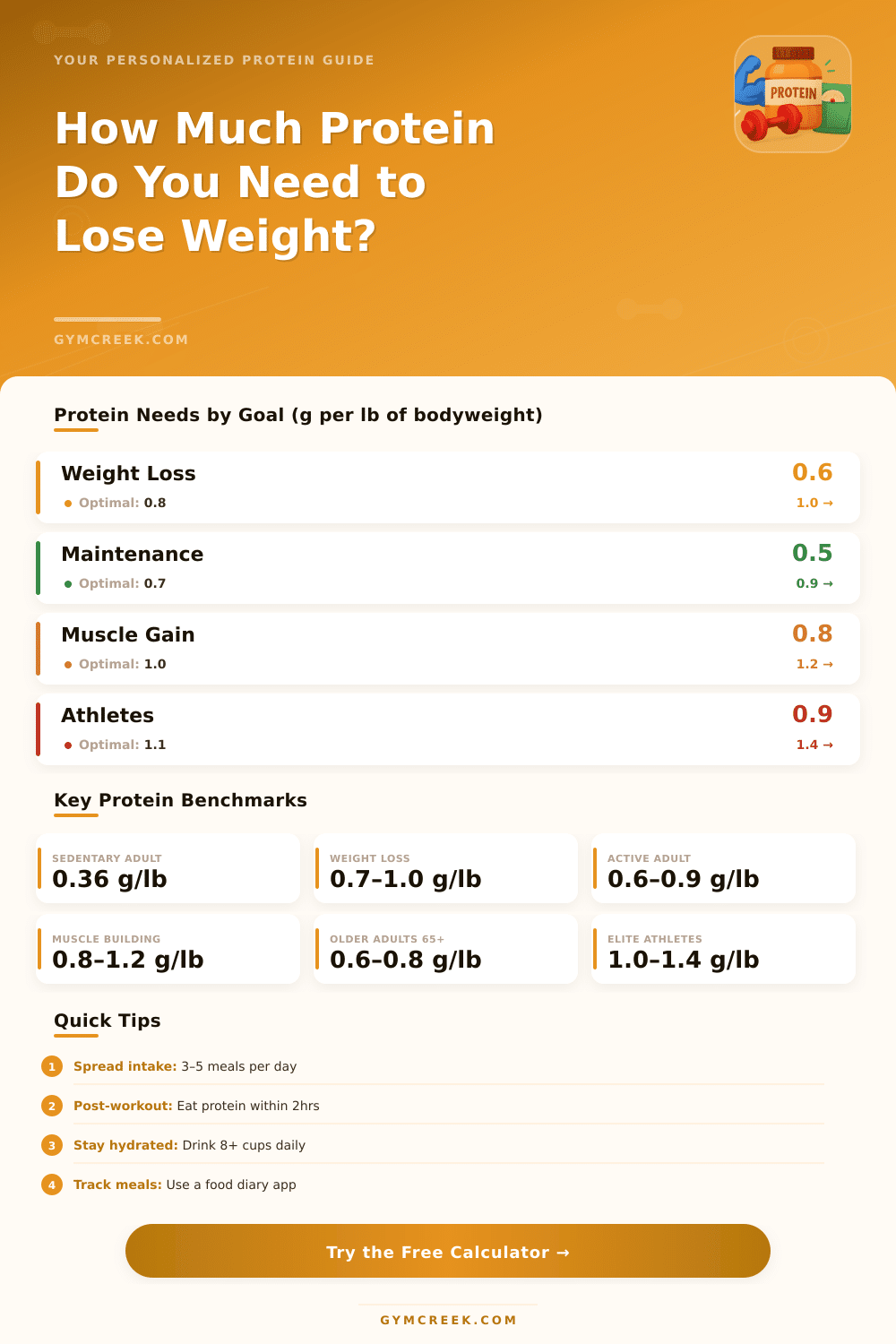
| General Weight Loss | 0.6–0.8 g/lb | 1.3–1.8 g/kg | High |
| Aggressive Weight Loss | 0.8–1.0 g/lb | 1.8–2.2 g/kg | Very High |
| Preserve Muscle While Cutting | 0.9–1.1 g/lb | 2.0–2.4 g/kg | Critical |
| Active Adult / Athlete | 0.8–1.2 g/lb | 1.8–2.6 g/kg | High |
| Senior Adult (65+) | 0.6–0.9 g/lb | 1.3–2.0 g/kg | High |
| Plant-Based / Vegan (+15%) | 0.7–1.0 g/lb | 1.5–2.2 g/kg | High |
| Postpartum / Breastfeeding | 0.7–0.9 g/lb | 1.5–2.0 g/kg | High |
| Diet Type | Protein % | Carbs % | Fat % |
|---|---|---|---|
| Standard / Balanced | 25–35% | 40–50% | 20–30% |
| High Protein Focus | 35–45% | 30–40% | 15–25% |
| Ketogenic / Low Carb | 25–35% | 5–10% | 55–70% |
| Plant-Based | 20–30% | 45–55% | 20–30% |
| Mediterranean | 20–25% | 40–50% | 25–35% |
Your body depends on protein for almost everything; for growth, fixing damaged cells and so that everything works well. The ideal sits around 10 to 35 percent of your daily intake which lines up with the advice of the National Academy of Medicine. For someone with a mostly sitting lifestyle, the lowest minimum to escape lack is 0.8 grams per kilo of body weight.
This comes to around 46 grams daily for women of 19 years and older, and around 56 grams for men in the same age group, according to the Recommended Daily Intake.
How Much Protein Do You Need?
Even so, the thinking changed in the last years. Current research tends to show that a bit more, between 1.2 and 1.6 grams per kilo per day… Seems more useful.
That marks quite a big step from the old base of 0.8 grams, that really only meant to keep your nitrogen level in balance and stop lack from happening. A woman weighing around 140 pounds would do well raechign almost 100 grams per day. For a woman of 220 pounds, aim for around 155 to 165 grams as a good standard.
What you really need depends on your lifestyle, how much you move, your shape and how hard you train. For building muscles, starting with around one gram per pound of body weight is a good spot. Serious bodybuilders commonly aim for at least 1.6 grams per kilo during the off-season, although something near 2.2 grams per kilo works better four many folks.
Pregnant women, on the other hand? They need more than young athletes.
The spread matters just as much as the whole amount. Getting around 15 to 30 grams per meal is a good plan. Having more than 40 grams in one sitting does not give something better than staying in that range of 15 to 30.
Your body really can process only around 30 grams of protein in one sitting. Eating it with every meal makes things simple and keeps them working.
Older adults above 65 years commonly benefit from moving to the upper limit, up to 35 percent of daily calories from protein. Even sitting people in that group see real gains from 1 to 1.6 grams per kilo.
A clinical study followed 65 overweight women during six months. Those on a high-protein diet, where protein formed 25 percent of their energy, lost much more weight than the other groups. If you want weight loss, getting protein between 0.45 and 0.68 grams per pound helps to keep your muscle mass.
Remember that the protein advice counts the whole grams from everything that you eat, not only from shakes and powder. Meat, fish and eggs are complete proteins with all eight essential amino acids that you need. Quinoa, lentils, Greek yogurt, eggs, rice, black beans, peanut butter and broccoli are common foods that many use to reach their targets.
High protein intake will not damage your kidneys if they are healthy. It onlycauses problems when kidney damage already exists.