🚴 Cycling VO2 Max Calculator
Estimate your aerobic capacity from cycling performance data — get your fitness category, training zones & benchmarks
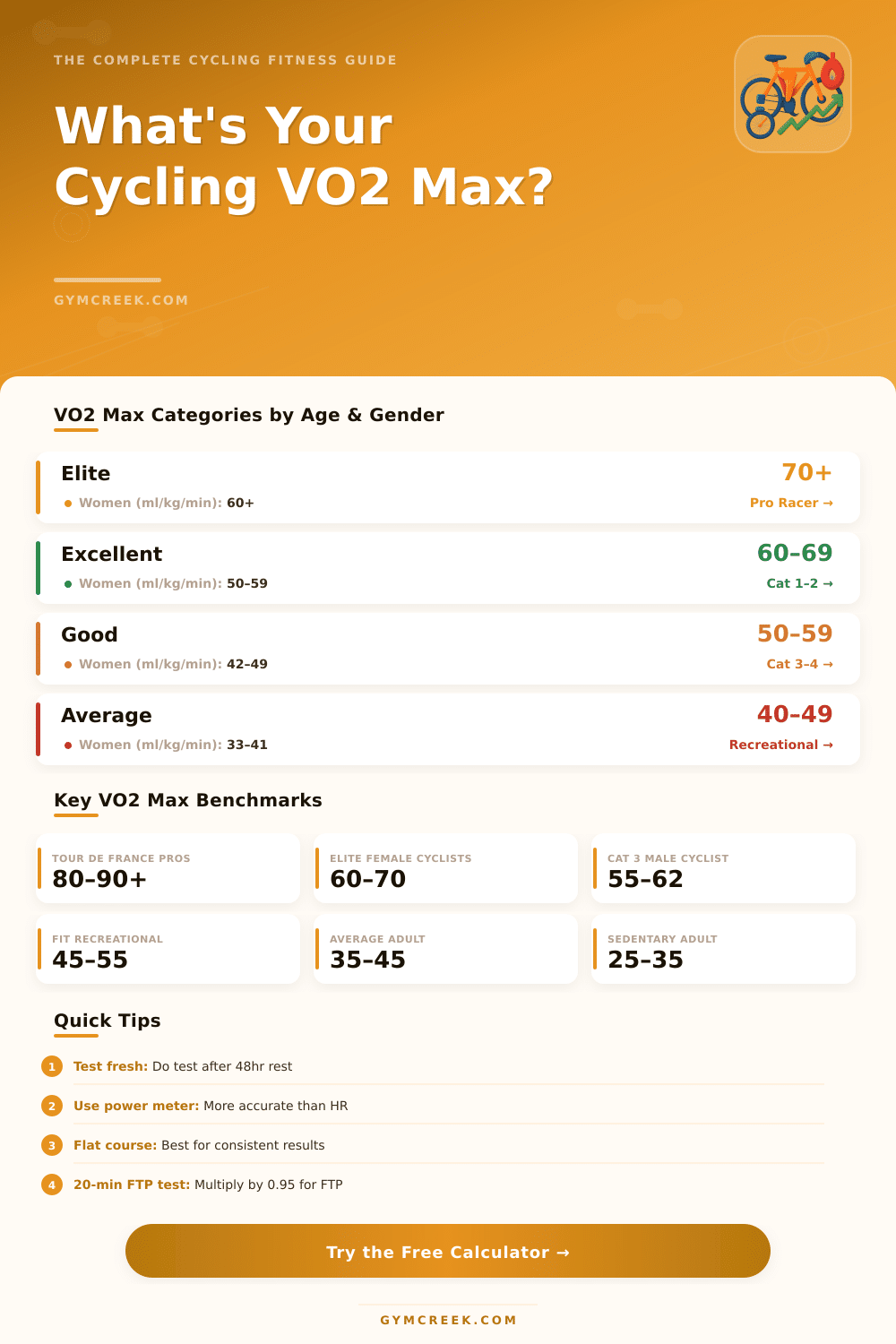
| Category | Men (ml/kg/min) | Women (ml/kg/min) | Typical Rider Level | Est. FTP/kg (men) |
|---|---|---|---|---|
| 🟣 Poor | Below 30 | Below 25 | Very sedentary / untrained | Below 2.0 w/kg |
| 🟡 Below Average | 30 – 39 | 25 – 33 | Casual / infrequent rider | 2.0 – 2.5 w/kg |
| 🟢 Average | 40 – 49 | 34 – 41 | Recreational rider (2–3x/wk) | 2.5 – 3.0 w/kg |
| 🔵 Good | 50 – 59 | 42 – 49 | Serious club rider / Cat 3–4 | 3.0 – 3.7 w/kg |
| 🟠 Excellent | 60 – 70 | 50 – 59 | Competitive racer / Cat 1–2 | 3.7 – 4.5 w/kg |
| 🟥 Elite / Pro | 71 – 90+ | 60 – 75+ | Pro tour / national team | 4.5 – 6.4+ w/kg |
| Level | Men FTP (w/kg) | Women FTP (w/kg) | 5-Min Power (w/kg) | Approx VO2 Max |
|---|---|---|---|---|
| Untrained | Below 2.0 | Below 1.5 | Below 3.0 | < 35 |
| Fair | 2.0 – 2.5 | 1.5 – 2.0 | 3.0 – 4.0 | 35 – 42 |
| Moderate | 2.5 – 3.2 | 2.0 – 2.6 | 4.0 – 5.0 | 42 – 52 |
| Good | 3.2 – 3.8 | 2.6 – 3.2 | 5.0 – 6.0 | 52 – 58 |
| Very Good | 3.8 – 4.5 | 3.2 – 3.8 | 6.0 – 7.0 | 58 – 65 |
| Exceptional | 4.5 – 5.5 | 3.8 – 4.5 | 7.0 – 8.5 | 65 – 75 |
| World Class | 5.5 – 6.4+ | 4.5 – 5.5+ | 8.5 – 10+ | 75 – 90+ |
| Zone | Name | % Max HR | % VO2 Max | Perceived Effort | Primary Benefit |
|---|---|---|---|---|---|
| Z1 | Active Recovery | < 68% | < 55% | Very easy | Recovery, fat oxidation |
| Z2 | Aerobic Base | 68 – 75% | 55 – 65% | Easy / conversational | Aerobic base, mitochondria |
| Z3 | Tempo | 75 – 83% | 65 – 80% | Moderate / comfortably hard | Lactate threshold |
| Z4 | Threshold | 83 – 91% | 80 – 90% | Hard / race pace | FTP, lactate clearance |
| Z5 | VO2 Max | 91 – 97% | 90 – 100% | Very hard / 3–8 min efforts | VO2 max, aerobic power |
| Z6 | Anaerobic | 97 – 100% | 100%+ | Maximal / sprint | Anaerobic capacity |
🏆 Oskar Pereiro (Tour de France Winner)
Measured VO2 Max in lab testing
🥇 Lance Armstrong (7x TdF)
Measured in 1993 (age 21)
🇳🇴 Espen Harald Bjerke
One of the highest ever recorded
🚴 Average Recreational Cyclist
Cycling 3x per week, moderate intensity
❤️ Heart Rate Reserve: Best when you know your TRUE max HR from a race or all-out hill sprint. Age-predicted max HR (220 – age) reduces accuracy. Accuracy: ±7%.
📊 Astrand Method: Perform 6 minutes at constant power. Ideal HR = 125–170 bpm. More accurate at moderate intensity. Accuracy: ±10%.
🏁 Cooper Method: Use a flat, windless course. 12 minutes, absolute maximum effort. Warm up well. Accuracy improves on an indoor trainer. Accuracy: ±8%.
VO2 Max represents the biggest amount of oxygen that the body can absorb during physical activity. One measures it in milliliters for every kilo of body mass in one minute. That is the main sign about heart and lung fitness and skill for aerobic efforts.
For cyclists it shows how much oxygen one can pick and use during a ride.
VO2 Max: What It Is and How Cyclists Can Improve
Rise of VO2 Max allows the heart to send more blood to the muscles, by means of bigger stroke volume or faster heart rhythm. Indeed, the transport of oxygen forms the main limit for VO2 Max. The stroke volume is the main limiter, what truly tests the physical limits. Training in zone 2 strengthens the oxygen carrying, so that it helps to improve VO2 Max over time.
For testing of VO2 Max one usually wears a breathing mask, when one cycles on a fixed device with slowly increasing effort. The mask gathers and studies the air, that enters and exits from the lungs. A test specific for Cycling probably will give a lower result than a running or swimming attempt, because those engage more muscles and thus expand the oxygen use.
One also can estimate VO2 Max from maximum power output and body mass by meens of separate calculations. Some estimates are based on the power, that the cyclist reaches at a certain heart rate, later scaled to the maximum heart rhythm.
For average men the typical values of VO2 Max rest around a fixed standard. For women it sinks to 27 to 30 ml/kg/min. Top male cyclists reach around 80 to 90 ml/kg/min.
Top female cyclists reach 60 too 70 ml/kg/min. VO2 Max matches well with the average power during long lasting time trials.
The base for improving VO2 Max is made up of frequent short and hard efforts. One possible way is to pedal as hard as possible for five minutes, then rest easy during another five minutes and repeat that four to six times, once or twice per week. The traditional Cycling interval exercise is made up of five intervals of five minutes at full force, ending each of them feeling fully exhausted.
Each interval should last two to five minutes at 106% to 120% of FTP. Above 120% is too hard. Such efforts require reaching 90 to 95% of VO2 Max to be useful.
Exercises for VO2 Max target aerobic effort, skill to last pain, muscle work and muscle stretch. A sample is the Taylor +1 session, that lasts ninety minutes with three sets of twenty to twenty-three second intervals. Training of VO2 Max at highest aerobic energy is very demanding.
Before, people believed that VO2 Max cannot be trained, but that is wrong. It can be improved, although in the end it has a ceiling. No wayspares time, only dedication, plan and staying steady gives results.