❤ Zone 1 Heart Rate Calculator
Find your Zone 1 aerobic training range using Simple % and Karvonen methods
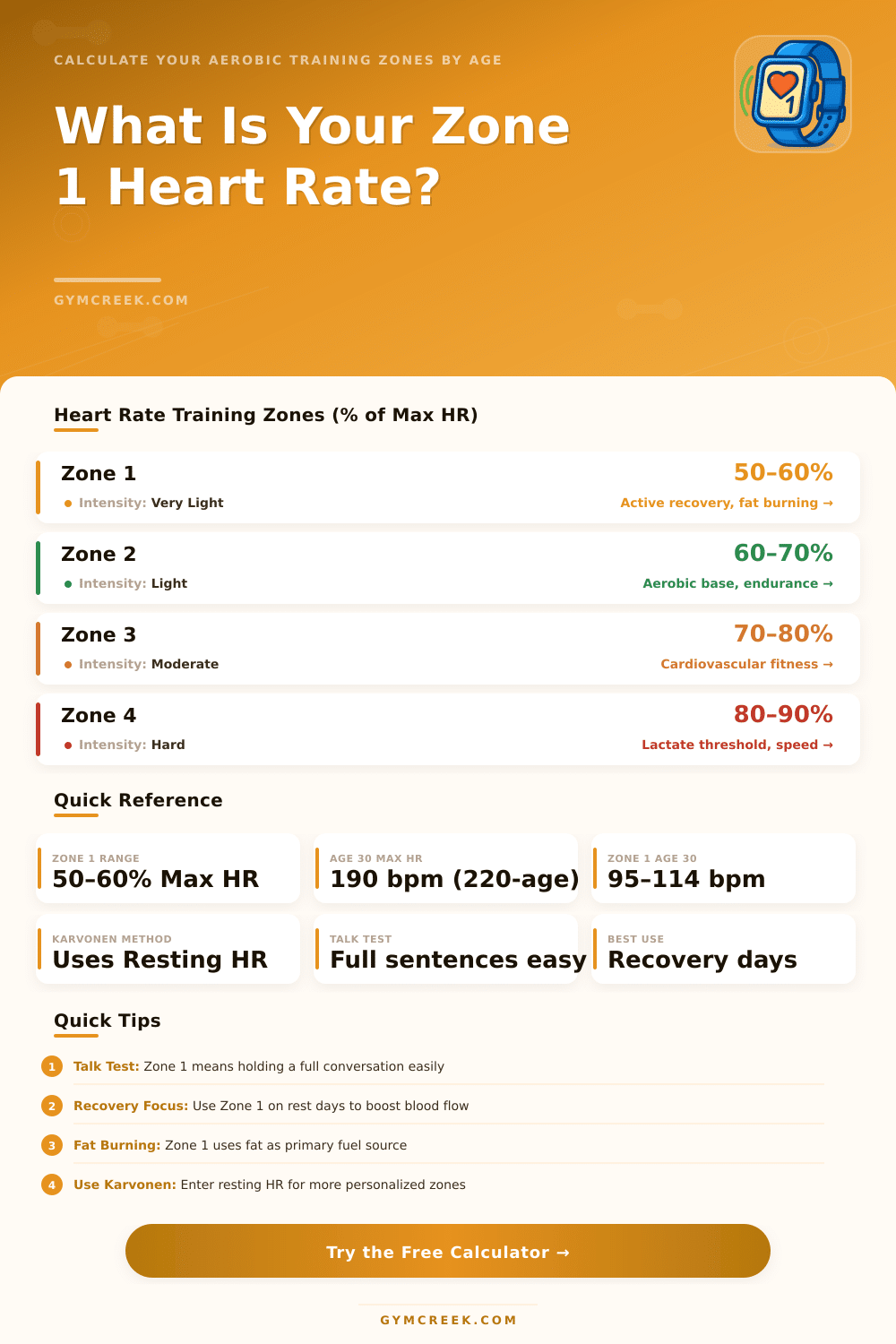
| Zone | % Max HR | Intensity | Training Benefit | Feel |
|---|---|---|---|---|
| Zone 1 | 50–60% | Very Light | Active recovery, fat oxidation, circulation | Easy conversation, barely breathing hard |
| Zone 2 | 60–70% | Light | Aerobic base building, endurance, fat burning | Can speak in sentences, slight effort |
| Zone 3 | 70–80% | Moderate | Cardiovascular fitness, lactate buffering | Short sentences only, noticeably breathing |
| Zone 4 | 80–90% | Hard | Lactate threshold, race pace, speed | Few words, breathing heavy |
| Zone 5 | 90–100% | Maximum | VO2 max, neuromuscular power, sprint | Cannot speak, all-out effort |
| Formula | Equation | Age 30 Example | Best For |
|---|---|---|---|
| Classic (220 – Age) | 220 – age | 190 bpm | General population, simple reference |
| Tanaka (2001) | 208 – (0.7 × age) | 187 bpm | More accurate for adults 40+ |
| Gellish (2007) | 207 – (0.7 × age) | 186 bpm | Active adults, fitness populations |
| Karvonen Method | HRrest + % × (HRmax – HRrest) | Varies by RHR | Most personalized; requires resting HR |
Zone 1 sits in the bottom part of the scale for training the heart, it reaches around 50% to 60% of your maximum Heart Rate. Some training models suggest a bit higher level, around 68% to 73% however the range of 50-60% stays the most commonly used among folks. Some call it warm-up zone, rest area or simply easy part, and that has good reason.
To find the range of your first zone does not need to be rocket science. The traditional way to estimate the maximum Heart Rate is 220 minus your age. For a thirty-year-old folk, the maximum comes to about 190 beats per minute.
What Is Heart Rate Zone 1?
Then you multiply that number by the percentages to reach the value of Zone 1. With a maximum of 190, it starts at 95 BPM and climbs form there. If your maximum is 180, then the range falls between 90 and 108 beats per minute.
The calculation is simple, when you already have set the maximum number.
Heart Rate zones are simply ranges, that show the weight with which your heart works during exercise. They help to control the intensity and fit it to your need. The more upward you go in the zones, the more hard you push yourself.
Zone 1 stays only a bit above your resting Heart Rate, it matches the intensity of everyday activity, like walking, without extra tension. Your breathing stays calm and natural. You could talk a full conversation without struggling.
Here is the cause: those zones do not answer for all primarily. They adjust according to your training level, age and even genetics. Some athletes favour the Karvonen-method, that considers both your maximum and resting Heart Rate to count the reserve.
That approach commonly gives higher values then the usual percent rating.
Zone 1 shows during warm-ups, cool-downs and rest days. It is the pace that you can keep, while your breathing and attitude stays fully normal. Although it seems surprisingly easy, it still forms the core of your training plan.
After an intense session, many folks return to rest time and stay there, until the Heart Rate falls back into Zone 1, there happens your cool-down.
Portable devices, like chest straps and wrist bands for monitoring, give you live info about the Heart Rate. Smart watches from Garmin, Fitbit or Apple follow your Heart Rate and bind it to your history of exercises. Apps like Strava and Polar Flow allow you to control the zone pulse during activity.
No tool? No matter. Feel your pulse on the wrist, count for 10 seconds, multiply by 6, anddone.
During tough training, your Heart Rate jumps according to the kind of activity. Chest press could park you in Zone 1 or 2, while jumping with a box puts you in zone 3 or higher. Even so, motion in Zone 1 and simple hiking?
Both help only for your whole health.