Somatotype Calculator
Estimate the Heath-Carter body type score, somatochart position, and practical physique profile from your anthropometric measurements.
📌Presets
Each preset loads a real measurement profile, updates the unit labels, and recalculates the somatotype immediately.
⚙Calculator
Somatotype snapshot
Enter your measurements and the calculator will estimate endomorphy, mesomorphy, ectomorphy, and chart position.
📊Somatotype Metrics Grid
📑Reference Tables
| Component | Low | Mid | High |
|---|---|---|---|
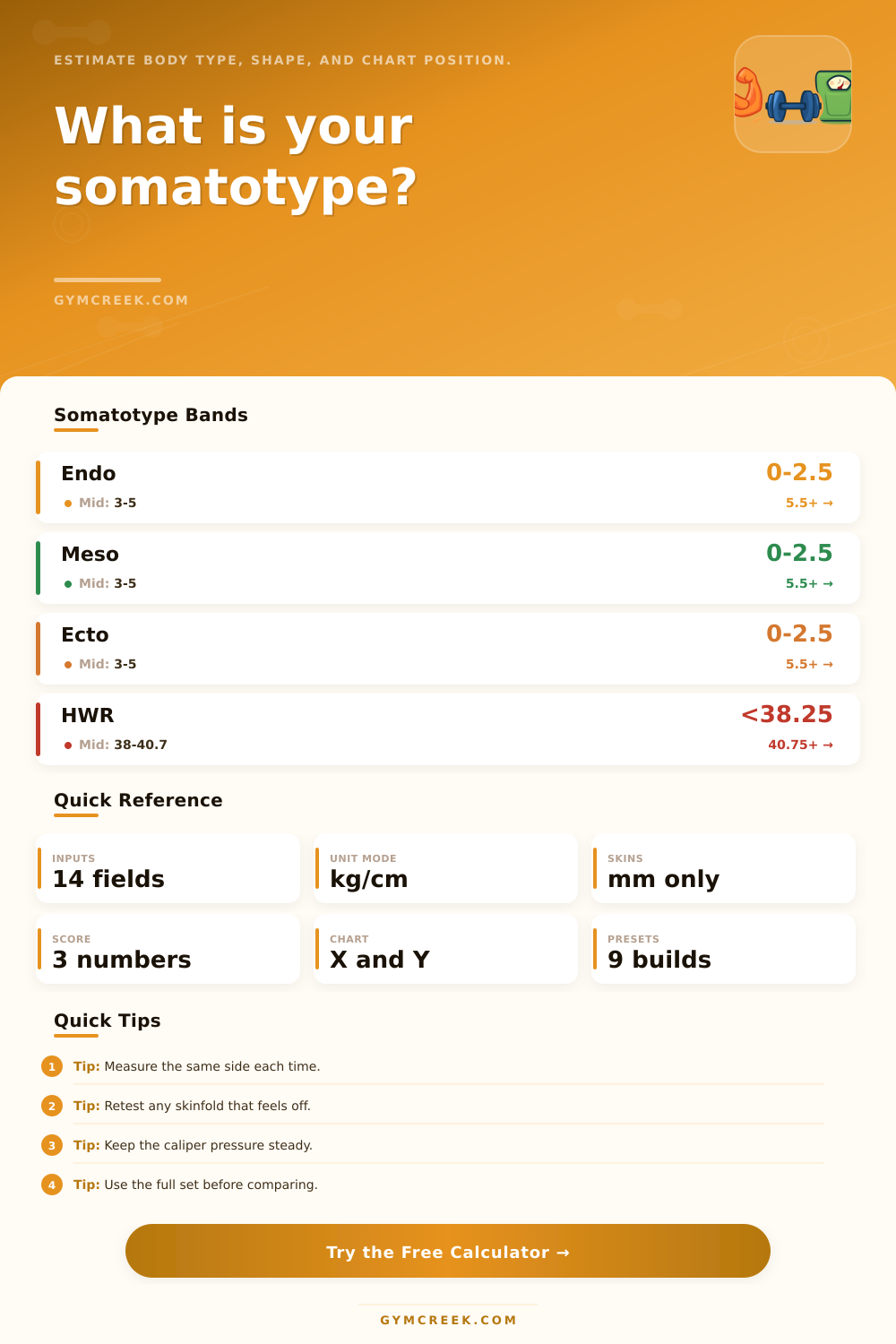
| Endomorphy | 0-2.5 | 3-5 | 5.5+ |
| Mesomorphy | 0-2.5 | 3-5 | 5.5+ |
| Ectomorphy | 0-2.5 | 3-5 | 5.5+ |
| HWR | <38.25 | 38-40.7 | 40.75+ |
| HWR | Ecto | Shape | Use |
|---|---|---|---|
| <38.25 | 0.1 | Short | Low line |
| 38.26-40.74 | 0.46x | Mid line | Blend zone |
| >=40.75 | 0.73x | Tall | Linear |
| High HWR | Lean look | Slender | Ecto case |
| Profile | Pattern | Clue | Note |
|---|---|---|---|
| Balanced | Close trio | Even spread | Mixed build |
| Mesomorphic | Strong meso | Broad frame | Robust |
| Endomorphic | Strong endo | Higher folds | Rounder |
| Ectomorphic | Strong ecto | Long frame | Linear |
| Formula | Inputs | Output | Use |
|---|---|---|---|
| Endomorphy | 3 folds + ht | Fatness | Shape |
| Mesomorphy | Breadths + girths | Robustness | Frame |
| Ectomorphy | HWR | Linearity | Length |
| Chart | 3 scores | X and Y | Plot |
💡Tips
Somatotype is an method of categorizing individuals according to the three different physical trait. These three traits is endomorphy, mesomorphy, and ectomorphy. Endomorphy is a trait in which an individual store a large amount of fat and have a softer body composition.
Mesomorphy is a trait in which an individual possess a muscular and robust body composition. Ectomorphy is a trait in which an individual has a leaner and more linear body composition. Each of these trait can be use to understand in what ways an individual may respond to various form of training or nutrition.
Somatotype: Three Body Types and How to Measure Them
William Sheldon first use the concept of somatotype in the 1940s, but he utilized photographs of individuals to determine which somatotype each individual possess. Heath and Carter later refned the concept of somatotype in the 1960s, but they utilized calipers and tape measure to determine an individual’s somatotype. Heath and Carter gathered measurements of skinfolds to determine endomorphy, bone breadth to determine mesomorphy, and girth measurements to determine both mesomorphy and endomorphy.
Because Heath and Carter utilized these measurement, athletes could plot their somatotype on a chart. By knowing an athlete’s somatotype, coaches can adjust the training methods applied to those athletes to suit the athlete’s body type. To calculate endomorphy, an individual’s skinfolds at various areas of the body are to be measure.
These skinfold measurements can be taken at the triceps, the subscapular area, the suprailiac crest, and the medial calf. Each of these area is where fat is commonly store in the body. If the skin is pinched too loosely, the endomorphy will be overestimated.
Pinching the skin too tight will result in underestimating an individual’s endomorphy. The sum of each skinfold measurement divided by the individual’s height will calculate an individual’s endomorphy. Mesomorphy is calculated through measuring the bone breadths of an individual, as well as taking the corrected girth measurement of the body.
An individual’s humerus and femur bone are to be measured at the epicondyles. An individual’s girth measurements will be taken at the upper arm when flex and the calf when relaxed. Because endomorphy measurements may skew the mesomorphy measurement of an individual, the thickness of the skinfold measurement will have to be subtracted from the girth measurements.
The result is an indication of an individual’s mesomorphy or robustness. The advantage of calculating an individual’s mesomorphy is that it account for the frame size of an individual without having to take into account their height. Ectomorphy is calculated through the ratio of an individual’s height to their weight, but through the use of the cube root formula.
An individual with a high ratio of height to weight have high ectomorphy, indicating that an individual is lean and linear in their body composition. An individual with a low ratio of height to weight have low ectomorphy, indicating that they have a stockier composition with a lower level of linearity in their body. An individual’s ectomorphy score can be divided into bands to indicate whether their ectomorphy is low, moderate, or high.
The somatotype analysis will reveal to an individual three different number that indicate their level of endomorphy, mesomorphy, and ectomorphy. These three number can be plotted on a somatochart. An individual’s X-coordinate will reveal if their ectomorphy is higher than their endomorphy.
The Y-coordinate will reveal the individual’s level of mesomorphy. An individual’s profile may be labeled with the individual’s name and their somatotype, such as if they possess a mesomorphic-ectomorphic profile. An individual’s profile is balanced if the three number are relatively similar to one another.
If an individual’s number are more distant from one another, they possess a specialized somatotype. Somatotype is not a permanent number, but one that can change over time. Somatotype can change in children, as their bodies is still growing and developing.
Somatotype can change in adults, as well, through the years of training and changes in their lifestyle. For instance, an individual may have high ectomorphy during their adolescence, but exhibit higher level of mesomorphy as adults. Furthermore, men and women has different somatotype averages, but each individual is an outlier to some degree.
Accuracy in measuring somatotype require consistency. An individual must hold the caliper for ten seconds on each skinfold measurement. The same side of the body should be measured for all individuals to ensure accuracy.
When measuring an individual’s girth measurement, those limb should be relaxed or flexed, as required by the protocol for measuring girth. By performing these measurement each month, an individual can track their change in somatotype. Somatotype measurements are far more precise than merely look into a mirror or stepping on a scale.
The number will reveal to an individual whether they are experiencing challenge in gaining strength due to high level of endomorphy or challenge in gaining weight due to high level of ectomorphy. Athletes of different category have different Somatotypes. For instance, power athlete may desire to increase their level of mesomorphy, while endurance athlete may wish to possess higher level of ectomorphy.
Because somatotype reveal the physical trait of an athlete, that athlete can use those finding to adjust their diet and training. An individual with high level of endomorphy may focus on strength training to increase their muscle mass, while those with high level of ectomorphy may focus on increasing their caloric intake to gain more muscle mass.