Intermittent Fasting Time Calculator
Build a fasting schedule around the clock that actually runs your day: first meal, last calorie, wake time, bedtime, and training all feed the final timing score.
📌Preset Schedules
Each preset loads a real meal clock so you can see whether the fast length, sleep buffer, and workout timing all work together.
⚙Timing Inputs
Fasting timing snapshot
Enter your schedule and calculate how your feeding window fits around sleep and training.
📊Timing Metrics
📑Reference Tables
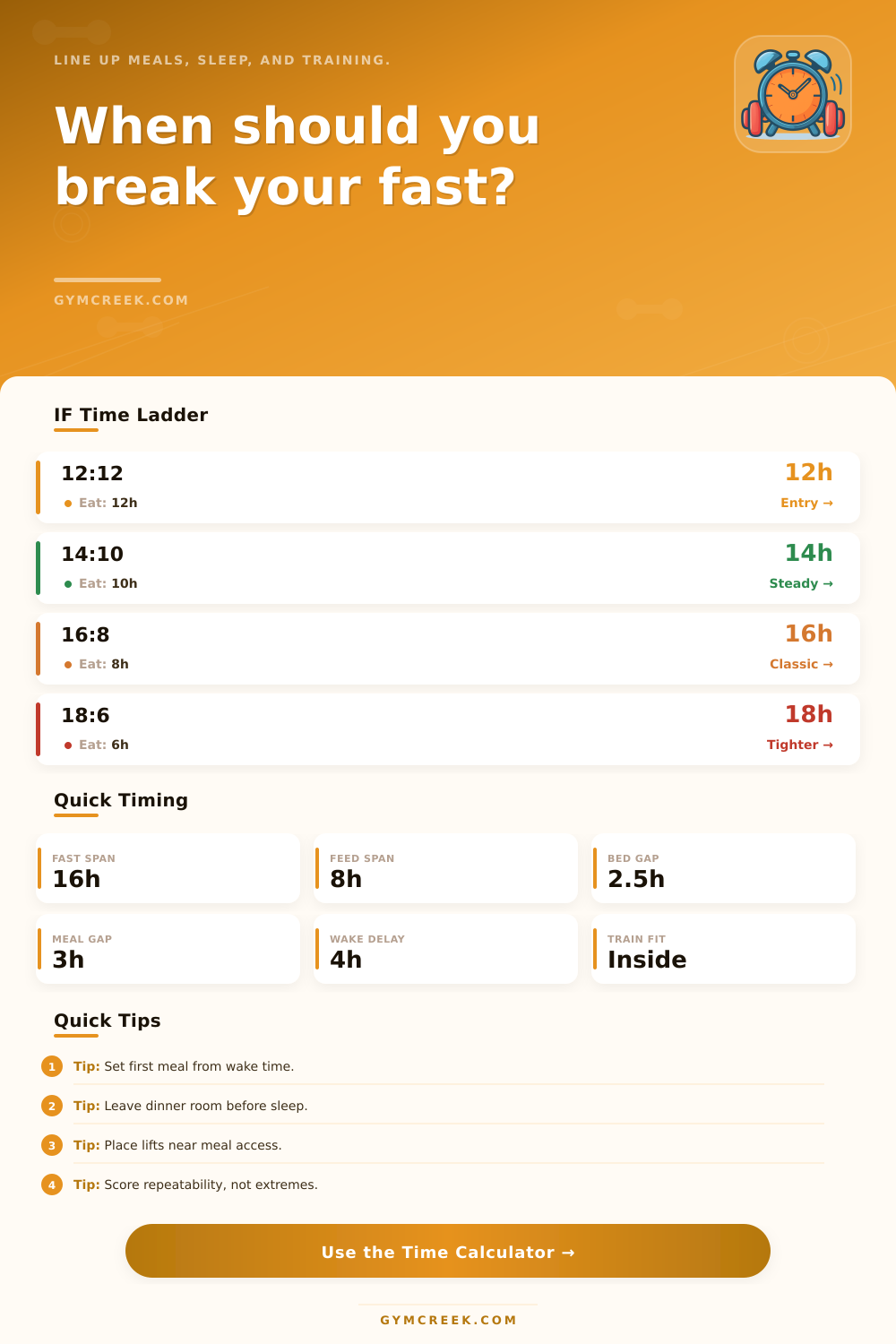
| Protocol | Fast | Eat | Best use |
|---|---|---|---|
| 12:12 | 12h | 12h | Entry point |
| 14:10 | 14h | 10h | Easy cut |
| 16:8 | 16h | 8h | Mainstream |
| 18:6 | 18h | 6h | Sharper cut |
| Training slot | Fit signal | Meal cue | Who it suits |
|---|---|---|---|
| Inside window | Best | Lift and eat | Most lifters |
| Pre first meal | Good | Break fast soon | AM trainers |
| Post dinner | Okay | Use carryover | Late movers |
| Far outside | Weak | Move a meal | Review plan |
| Bed buffer | Sleep feel | Typical use | Score effect |
|---|---|---|---|
| <60 min | Heavy | Late dinner | Hard penalty |
| 60-119 min | Mixed | Busy night | Small hit |
| 120-179 min | Better | Solid default | Strong fit |
| 180+ min | Light | Early dinner | Full credit |
| Score | Meaning | Main issue | Next move |
|---|---|---|---|
| 90-100 | Locked in | None big | Repeat it |
| 75-89 | Workable | One drift | Tighten one cue |
| 60-74 | Borderline | Two misses | Fix meal clock |
| <60 | Fragile | Poor fit | Rebuild day |
💡Tips
Intermittent fasting is a form of eating that relies upon a specific schedule for the fasting and eating portions of the diet. The efficacy of intermittent fasting are reliant upon how well that schedule can be incorporated into a persons daily routine. Many peoples attempt to incorporate ratios of fasting to eating into their routine, but that schedule should account for a person’s daily activities.
For instance, if an individual modifies their bedtime or exercise routine, they will have to alter their fasting schedule, as well. During intermittent fasting, individuals consumes their daily calories within a defined time frame known as the feeding window, and they take a fasting window where they consume no calories. By consuming the calories too close to bedtime, these individuals may experience sleep issues due to the process of digestion.
How to Make a Simple Intermittent Fasting Schedule
Similarly, if an individual exercises while they are fasting, they may experience a decrease in the intensity with which they can exercise. Thus, individuals schedule should be adjusted to ensure that their feeding window accounts for their sleep and eating need. To create an effective intermittent fasting schedule, individuals should start with establishing a consistent wake time.
By waking at a consistent time, they can begin their fasting period. During this period, individuals should delay their first meal three to four hours after waking; delaying their meals allow individuals to experience mental clarity throughout their fasting period. Additionally, individuals should ensure that there is a two to three hour period between their last meal and bedtime; this buffer period is essential for allowing the body to fully digest food, as digesting food while sleeping can lead to poorly sleeping habits.
Not all individuals has the same lifestyle, and, therefore, individuals will require different schedules. For instance, individuals with desk jobs may use an 16-8 schedule beginning at noon. Individual that rise early in the morning may use a 14-10 schedule; this schedule allows those individuals to exercise in the morning.
Individuals with night shifts may have to invert their schedule to ensure they are consuming the majority of their calories after they have slept. Thus, each individual should find a schedule that fits their lifestyle and adjust their schedule as necessary for consistency. Individuals must also consider where they will perform their exercise in relation to their fasting schedule.
If an individual performs weightlifting during their feeding window, their body will be supplying the energy and nutrients required for these muscle to exercise and repair. If an individual performs weightlifting during their fasting period, they may experience a dip in their strength and the rate at which they can increase their weights. Thus, the placement of exercise is a critical factor for the effectiveness of an individuals fasting schedule.
Individuals can use adherence score to measure how well an individual follows their established intermittent fasting schedule. An adherence score can range from 0 to 100, with scores between 0-24 indicating a fragile schedule, 25-49 being moderate adherence, and 50-100 being high adherence. An adherence score indicates how well the individual’s schedule is functioning, and if adjustments are required to optimize the schedule.
There are several common mistakes with intermittent fasting schedules. One common mistake with intermittent fasting schedules is creating a fasting period that is too long without ensuring a buffer period before bedtime; this can lead to increased levels of cortisol, which make it difficult for individuals to sleep. Another common mistake is eating one large meal, or an OMAD diet, while sitting at the desk.
Eating one meal while sitting at the desk may lead to bloating. Lastly, individuals may create an eating and fasting schedule that is appropriate during the work week, but does not account for holidays or the lack of an evening cutoff during the work week. These mistakes can be avoided by focusing on creating an intermittent fasting schedule that can be repeated daily.
Another important component of intermittent fasting is the spacing of meals. For instance, if meals are spaced throughout an 8-hour period, individuals can consume three meal with a 3-hour gap between meals. Consuming meals too closely together can cause insulin to spike.
Reference tables exist to help individuals map out their eating schedule to include adequate buffers before sleep and exercise to maintain energy throughout the day. Additional factors that may influence the effectiveness of an individuals fasting period include biological sex, age, and travel. For instance, women who take part in intermittent fasting may experience longer fasting periods work better during certain parts of their menstrual cycle than others.
Similarly, older individuals that lift weights may require longer fasting periods before sleep than younger individuals; this is due to the need for more rest to recover from exercise. Individuals who travel across the world may have to alter their fasting schedule to use a more flexible fasting protocol, such as a 15-9 protocol. Additionally, individuals should ensure that they are adequately hydrated; using salts or broths helps to maintain the individuals state throughout the fasting period.
Individuals should create a fasting schedule that is based off consistency. For instance, individuals can begin with a 12-12 fasting schedule to learn the bodys rhythm, then adjust to either a 14-10 or a 16-8 fasting protocol. During the fasting period, individuals should consider the placement of their first meal after waking, the placement of their bedtime buffer, and the placement of their exercise during the fasting period.
Thus, an effective fasting schedule will accommodate an individual’s routine and be repeated daily.