🏋 Push-Up to Bench Press Calculator
Estimate your bench press 1RM from your push-up performance & bodyweight
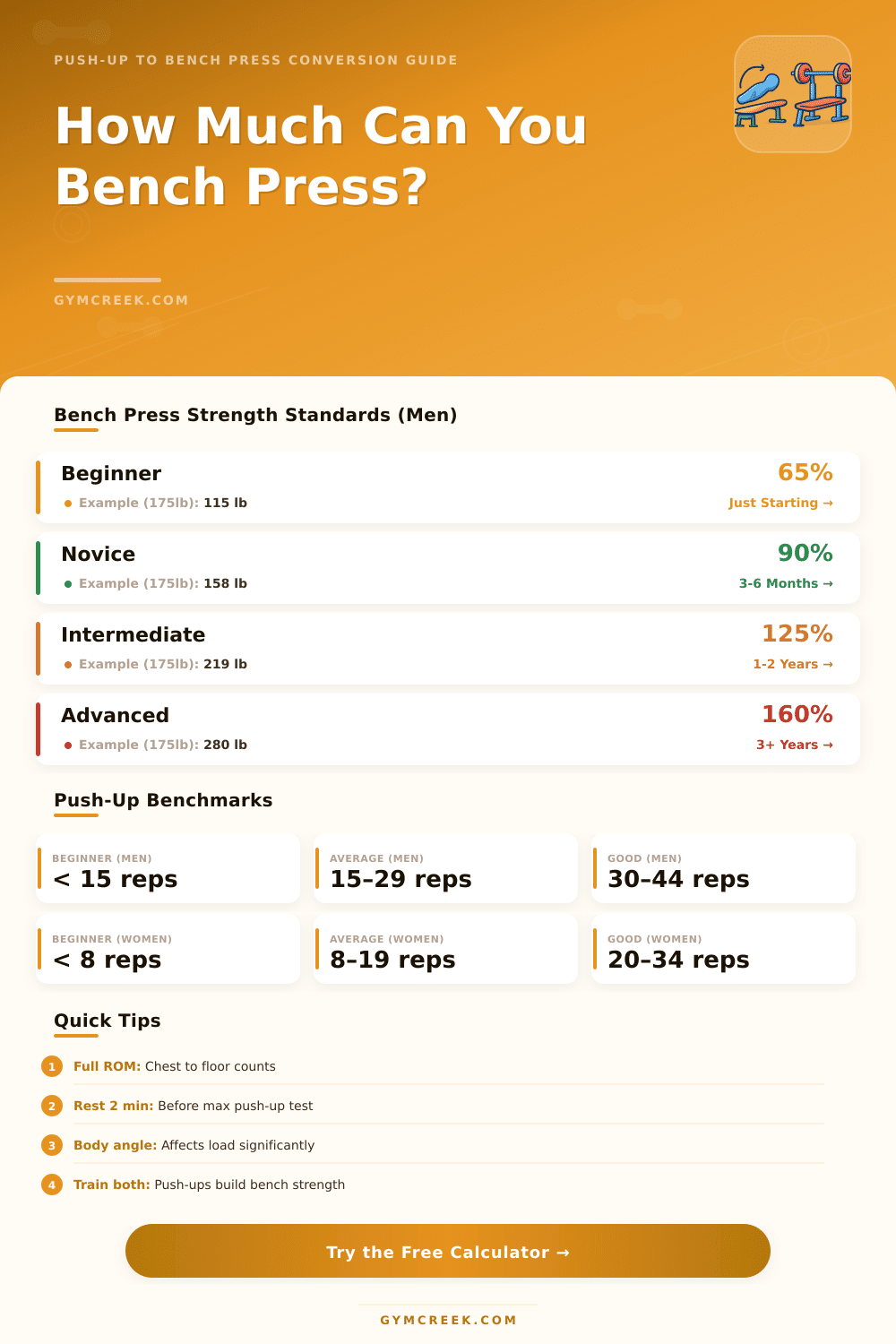
| Level | Men (% BW) | Men (175 lb) | Women (% BW) | Women (135 lb) |
|---|---|---|---|---|
| Beginner | 65% | 114 lb / 52 kg | 35% | 47 lb / 21 kg |
| Novice | 90% | 158 lb / 72 kg | 50% | 68 lb / 31 kg |
| Intermediate | 125% | 219 lb / 99 kg | 75% | 101 lb / 46 kg |
| Advanced | 160% | 280 lb / 127 kg | 100% | 135 lb / 61 kg |
| Elite | 210%+ | 368 lb+ / 167 kg+ | 140%+ | 189 lb+ / 86 kg+ |
| Category | Men 20–29 | Men 40–49 | Women 20–29 | Women 40–49 |
|---|---|---|---|---|
| Needs Work | < 17 reps | < 13 reps | < 12 reps | < 8 reps |
| Fair | 17–21 | 13–16 | 12–17 | 8–11 |
| Good | 22–28 | 17–21 | 18–24 | 12–17 |
| Excellent | 29–36 | 22–28 | 25–32 | 18–24 |
| Superior | 37+ | 29+ | 33+ | 25+ |
| Push-Up Type | % of Bodyweight | Notes |
|---|---|---|
| Knee Push-Up | ~49% | Reduced lever arm — easier option |
| Incline Push-Up (hands elevated) | ~41% | Lower chest activation |
| Standard Push-Up | ~64% | Baseline reference (Suprak et al., 2011) |
| Wide-Grip Push-Up | ~69% | Greater pec activation |
| Close/Diamond Push-Up | ~69% | More tricep emphasis |
| Decline Push-Up (feet elevated) | ~75% | Upper chest & shoulder emphasis |
| Goal | % of 1RM | Rep Range | Rest Period |
|---|---|---|---|
| Max Strength | 90–100% | 1–3 reps | 3–5 min |
| Strength / Power | 80–90% | 3–5 reps | 2–4 min |
| Hypertrophy (Muscle Growth) | 67–80% | 6–12 reps | 60–90 sec |
| Muscular Endurance | 50–67% | 12–20 reps | 30–60 sec |
| Active Recovery | < 50% | 20+ reps | Minimal |
• This calculator uses the Epley formula (1RM = weight × (1 + reps/30)) combined with research-backed push-up load percentages.
• Results are estimates only — actual bench press performance depends on technique, stability, and specific training history.
• For best accuracy, use a rep count between 5 and 20 reps. Very high rep counts reduce 1RM estimate accuracy.
• The conversion assumes similar movement pattern between push-ups and bench press; trained bench pressers may exceed this estimate.
The bench push-up works as a useful piece of training gear, that strengthens many groups of muscles in the upper body at once. One can use it for inclined push-ups, decline push-ups and many other types of exercise. The base of inclined push-ups one does by means of a bench, table or other stable surface at around three feet of height.
DISCLOSURE: This post may contain affiliate links, meaning when you click the links and make a purchase, I receive a commission. As an Amazon Associate I earn from qualifying purchases.

On that one lays the hands on the edge of the bench a bit more wide than the span of the shoulders, keep the body up at full length of the arms and lay the toes on the floor.
Push-ups and Bench Press: Simple Guide
For decline push-ups, one lays the feet up on the bench, with the body straight and shoulders down. That version well helps to build the chest, shoulders and triceps. It shifts more weight to the upper body and makes the moev more hard.
The push-up and bench press work the same main muscles, namely the chest, triceps and front delts. Even so they differ in some key ways. During the push-up the body moves, while the hands stay fixed.
During the bench press the weight moves, while the body stays in one position. The push-up also involves the belly muscles and the core much more, because it needs extra balance to keep good form. The bench press gives a bit of support to the trunk, so there is less work for the core.
An average push-up matches about seventy percent of the body weight, if one compares it to the bench press. When the trunk tilts upward in inclined push-ups, more weight goes to the feet, which makes it easier. Laying the feet on a box or bench pushes it more steep, but the bottom phase of the push-up always carries the biggest load.
The push-up allows the shoulder blades to move freely, pulling back and pushing forward naturally. During the bench press the bench limits the back movements, which blocks natural move of the shoulders. The push-up also works the rotator cuffs and uses the hole body, while the normal bench press mostly works the part of the waist upward.
For beginners the push-up and bench press help one another. The bench press well serves to grow the number of push-ups at first, and the reverse is true. But over time they differ too.
The push-up gives useful strength, while the bench press allows steady overload for max growth of muscles. Later comes a point, where one can no longer add enough load to push-up training for strength well. Doing thirty push-ups does not match the same push as a heavy five-by-five session.
Hard types of push-ups, like diamond push-ups, archer push-ups, clap push-ups and one-arm push-ups, can keep the test high. Changing the spot of hands and adding resistance with bands gives a stronger upper body. A good way is to use the bench press for strength and the push-up for stamina.
Wall push-ups work as astarting point for beginners, later one moves to a table, later to a lower bench, until floor push-ups become possible.