🏋 Dumbbell to Bench Press Calculator
Estimate your barbell bench press 1RM from dumbbell press weight & reps
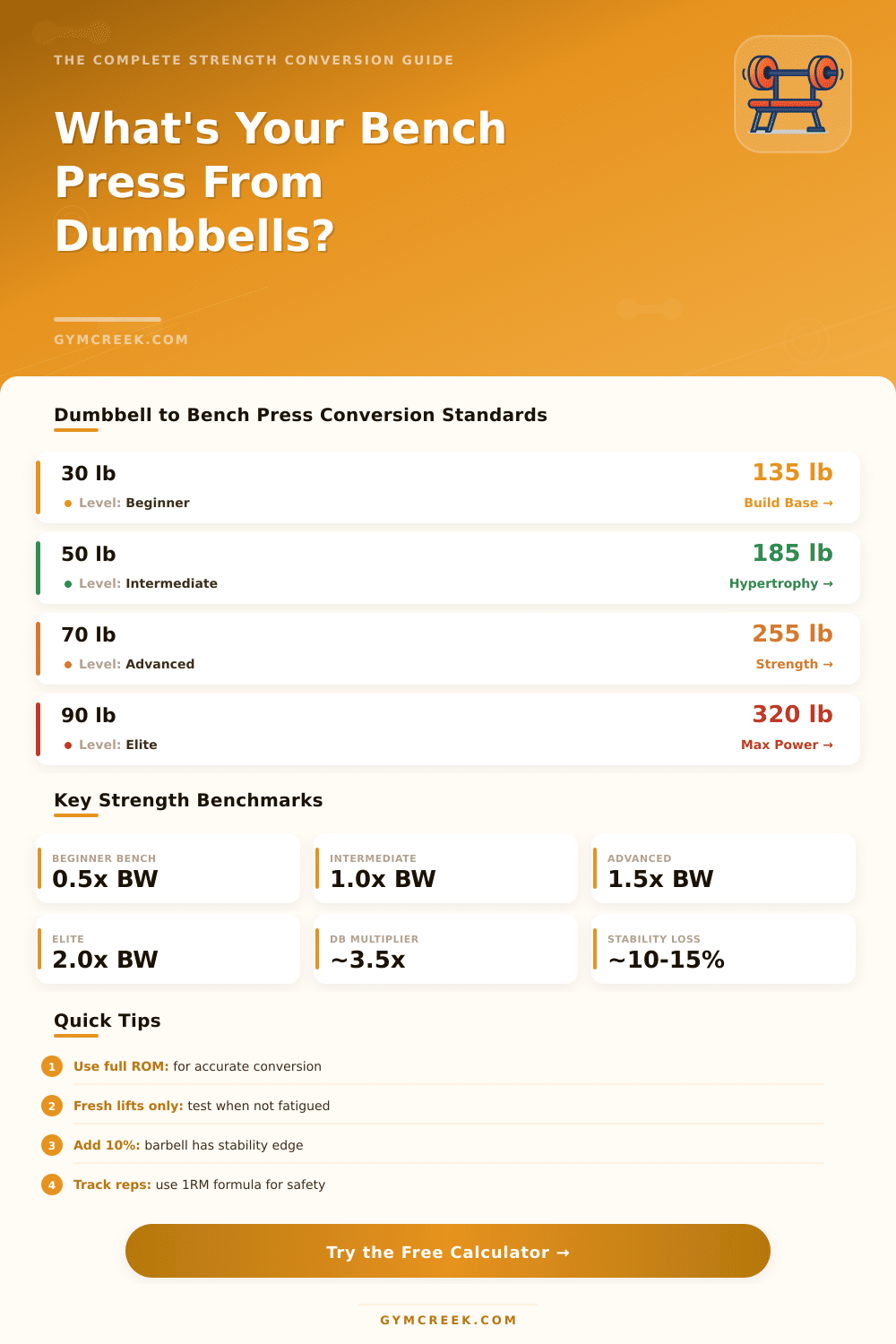
| DB Weight (each) | DB Weight (kg) | Est. Bench 1RM (lb) | Est. Bench 1RM (kg) | Level |
|---|---|---|---|---|
| 20 lb | 9 kg | ~95 lb | ~43 kg | Beginner |
| 30 lb | 14 kg | ~135 lb | ~61 kg | Beginner |
| 40 lb | 18 kg | ~165 lb | ~75 kg | Intermediate |
| 50 lb | 23 kg | ~185 lb | ~84 kg | Intermediate |
| 60 lb | 27 kg | ~215 lb | ~98 kg | Advanced |
| 70 lb | 32 kg | ~255 lb | ~116 kg | Advanced |
| 80 lb | 36 kg | ~285 lb | ~129 kg | Advanced |
| 90 lb | 41 kg | ~320 lb | ~145 kg | Elite |
| 100 lb | 45 kg | ~350 lb | ~159 kg | Elite |
| Reps | % of 1RM | Training Zone | Primary Benefit |
|---|---|---|---|
| 1 | 100% | Max Strength | Neural Drive |
| 2 | 97% | Max Strength | Neural Drive |
| 3 | 94% | Strength | Strength & Size |
| 4 | 92% | Strength | Strength & Size |
| 5 | 89% | Strength / Power | Strength & Size |
| 6 | 86% | Hypertrophy | Muscle Growth |
| 8 | 81% | Hypertrophy | Muscle Growth |
| 10 | 75% | Hypertrophy / Endurance | Size & Conditioning |
| 12 | 70% | Endurance | Conditioning |
| 15 | 65% | Muscular Endurance | Conditioning |
| 20 | 56% | Endurance | Conditioning |
| Bodyweight | Beginner | Intermediate | Advanced | Elite |
|---|---|---|---|---|
| 130 lb | 80 | 130 | 185 | 240 |
| 150 lb | 90 | 150 | 215 | 280 |
| 175 lb | 105 | 175 | 250 | 325 |
| 200 lb | 115 | 200 | 285 | 370 |
| 225 lb | 125 | 225 | 315 | 410 |
| 250 lb | 135 | 245 | 345 | 445 |
The dumbbell bench press is a type of bench press that uses dumbbells instead of a bar. By means of two dumbbells and a bench, that exercise has the lifter lower both weights to the chest, then extend the arms to press them upward. It ranks among the most useful moves for building the muscles of the upper body.
DISCLOSURE: This post may contain affiliate links, meaning when you click the links and make a purchase, I receive a commission. As an Amazon Associate I earn from qualifying purchases.

If one does it well it strengthens the body and improves the results in other lifts.
How to Do the Dumbbell Bench Press
Correct position is very important. One sits on a flat bench, with a dumbbell in every hand, that rests on the thighs. After that, one raises the weights to the shoulders and reclines on the back.
The weights one keeps near the chest, when one starts. The head, shoulders, buttocks and feet should stay in touch with the bench or the floor during the whole move. Hold every dumbbell with palms turned forward, with thumb around the handle, and then press until full reach of the arms.
To set the upper back well, imagine that you draw the back muscles down into the back pockets. Engage the traps with the bench and the feet with the floor, to create basic tension and better stability. Tighten the abs and fill the back muscles, to escape loss of fource.
Relaxing in the position commonly leads to weaker pressure.
The position of the elbows deserves attention. Rather than leave them flare out during the lowering, keep them near the body and turn the dumbbells a bit out for better impact. Lower the dumbbells in line with the nipples, which opens the tension up and focuses more on the chest than on the front delts.
Go deeply down in the stretch, pause a second or two before press upward, that is a solid method. A common mistake is using too heavy dumbbells and bouncing off the bottom, which can rip muscles or injure joints.
Dumbbells allow more natural move of the shoulders. Pressing with a half neutral grip removes tension from the shoulder joints, which helps to lower the risk of injuries. The bar can overwork the front delts, which makes the upper part of the chest noticeably empty in comparison.
Dumbbells also stop the stronger arm from making up for the weak, which helps to strip even hidden gaps in the force. They force the core to work harder to keep the body stable. Even so, usually one can lift less weight than with the bar, because of that instability.
The bar works more for maximum load and overall force, because one must less care about keeping steady.
Going up in weight works well for the dumbbell bench press. For instance, start with three sets of eight reps, then move to three of ten, then to three of twelve, before switching to a heavier dumbbell. The dumbbell bench press also shows up in CrossFit workouts.
It was used in the 2017 CrossFit Tournament. The move offers choice between flat, lower or upper form, and the angle of the upper can rangein 15, 30, 45 or 60 degrees.