💪 One Rep Max Calculator for Dips
Estimate your maximum dip strength using your bodyweight, added weight, and reps completed. Supports Epley, Brzycki, and Lander formulas.
| Formula | Equation | Best For | Your Estimate |
|---|---|---|---|
| Run the calculator to see formula comparison. | |||
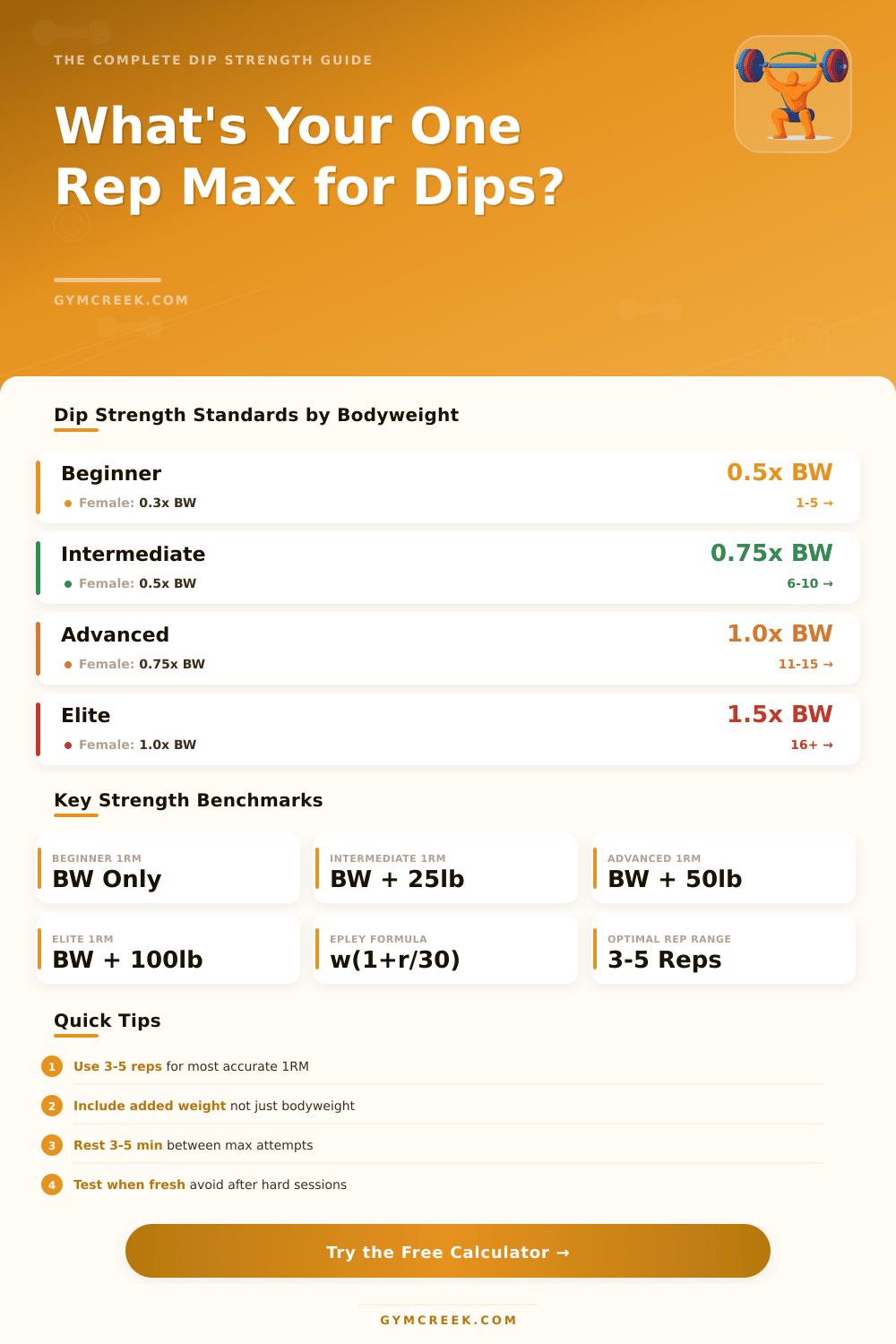
| Level | Male 1RM (% BW) | Female 1RM (% BW) | Description |
|---|---|---|---|
| Untrained | Less than 50% BW added | Bodyweight only | First time or very rarely trains dips |
| Beginner | BW only (0 added) | Assisted or BW only | Less than 6 months training |
| Novice | BW + 15–25 lbs | BW only cleanly | 6–12 months consistent training |
| Intermediate | BW + 45–65 lbs | BW + 15–25 lbs | 1–3 years structured training |
| Advanced | BW + 90–120 lbs | BW + 45–65 lbs | 3–5+ years consistent training |
| Elite | BW + 150+ lbs | BW + 90+ lbs | Competitive or professional level |
| Goal | Rep Range | % of 1RM | Sets |
|---|---|---|---|
| Max Strength | 1–3 reps | 90–100% | 3–5 |
| Power-Strength | 3–5 reps | 80–90% | 4–6 |
| Hypertrophy | 6–12 reps | 65–80% | 3–5 |
| Muscular Endurance | 13–20+ reps | 50–65% | 2–4 |
| Warm-Up | 8–15 reps | 40–60% | 2–3 |
| Formula | Source | Equation (w = total load, r = reps) | Notes |
|---|---|---|---|
| Epley | Epley, 1985 | w × (1 + r / 30) | Most commonly used; good for all rep ranges |
| Brzycki | Brzycki, 1993 | w × 36 / (37 – r) | Accurate for 1–10 reps; underestimates at high reps |
| Lander | Lander, 1985 | (100 × w) / (101.3 – 2.67123 × r) | Good for moderate rep ranges |
| Lombardi | Lombardi, 1989 | w × r^0.10 | Conservative; useful for high rep ranges |
| Mayhew et al. | Mayhew, 1992 | (100 × w) / (52.2 + 41.9 × e^(-0.055×r)) | Good for high rep ranges (10–20+) |
| O'Conner et al. | O'Conner, 1989 | w × (1 + 0.025 × r) | Conservative estimate; works for 1–10 reps |
✅ Count total load: Your 1RM for dips is bodyweight + added weight. This calculator handles that automatically.
✅ Test when fresh: Perform your test set after a proper warm-up but before other heavy work.
✅ Use a spotter: Always have a spotter or use a dip machine with safety features when attempting near-maximal loads.
✅ Full range of motion: A valid rep requires elbows at or below 90 degrees at the bottom and full lockout at the top.
The One Rep Max, usually written as 1RM, shows the biggest weight that someone can lift for only one time in any kind of exercise. That maybe deals with deadlift, bench press, deadlift or some other kind of lifting. It stands for the upper level of strength that one reaches during one whole muscle squeeze.
Knowing such numbers is useful for building a plan of resistance training, because various portions from it apply to different tasks in the program.
What Is a One Rep Max
The One Rep Max differs from simply doing a heavy single lift. It asks the whole physical and mental energy of the person to beat the exercise. With it there does not stay space for hesitation.
Whatever weight one manages to lift in that final single try that becomes the fresh maximum. One can not excuse himself by means of tiredness or hope of better showing the next time.
Testing a real 1RM too often does not help. The central nervous system requires two or three weeks to fully rest after such big effort. If tendons tighten, they can require even up to six weeks to recover.
First build a good base and later attempt when ready, that one advises more wisely. For newcomers the attention should turn too the right motion instead of chasing after a heavy One Rep Max.
Calculators for One Rep Max are popular for guessing that value without truly reaching the limit in the gym. The idea is made up of choosing a weight that one can lift from one to ten times, entering the weight and the done reps, and the tool shows an approximate maximum. For instance, lifting 100 pounds for 10 reps results in a rating of around 133 pounds for One Rep Max according to used formulas.
One well known method is that of Wendler, that takes the raised weight, multiplies by the reps, then by 0.0333, and finally adds that to the original weight.
The formula of Epley serves as another option and commonly one uses it for picking in contests. The Brzycki formula, that gives a bit more modest rating, works well as a training maximum for everyday programs. The approach of Wendler includes taking 90 percent of the intended One Rep Max and building the training on that base.
One Rep Max numbers usually apply to complex lifts with many joints using a barbell, as deadlifts, bench presses and squats, instead of more basic gestures and moves like bicep curls. Such maxima also adjust daily according to the quality of sleep and the rest after prior sessions. The squat works more muscles than a curl, so one can do more reps at the same portion of the maximum compared to curls.
Seeing the maximum grow gives a rush of excitement. That shows that the hard effort paid off. Strength in a five rep max transfers well to the One Rep Max, makingit a solid base for growing your strength.