Box Squat Max Calculator
Estimate your box squat max from a live set, then compare parallel depth, training max, and back squat carryover.
💪 Preset Box Squat Sets
🔧 Box Squat Inputs
Estimated box squat max
Your current work set will map to a box-specific max, a parallel-depth equivalent, and a carryover estimate.
📊 Fitness Metrics Grid
📖 Reference Tables
Box height guide
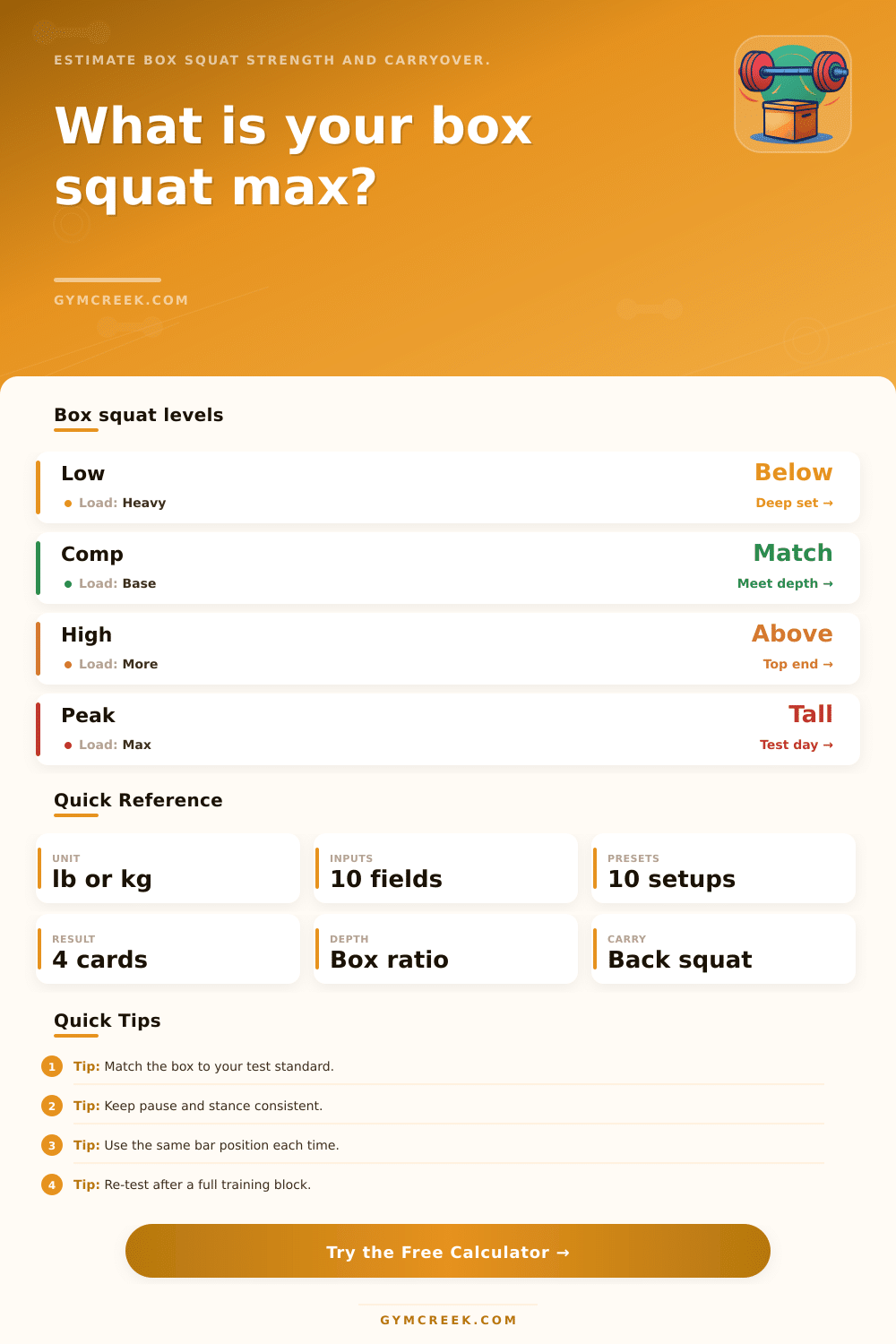
Use the ratio of box height to body height to understand how much depth and leverage the setup changes.
| Level | Ratio | Factor | Use |
|---|---|---|---|
| Deep | 0.42-0.45 | 0.97-0.99 | Below parallel |
| Match | 0.46-0.49 | 1.00-1.02 | Meet depth |
| High | 0.50-0.53 | 1.03-1.05 | Top half |
| Tall | 0.54+ | 1.06-1.08 | Test peak |
RPE and rep reserve
Rep reserve gives the calculator a realistic bridge from a working set to a projected max.
| RPE | RIR | Use | Feel |
|---|---|---|---|
| 10.0 | 0 | True max | No miss |
| 9.0 | 1 | Heavy single | Fast grind |
| 8.0 | 2 | Strength work | Solid reps |
| 7.0 | 3 | Volume work | Clean speed |
Stance and bar factors
Stance and bar position shift the estimate a little, especially when you compare training maxes over time.
| Setup | Factor | Bias | Note |
|---|---|---|---|
| Narrow | 0.98 | Quads | More ROM |
| Competition | 1.00 | Balanced | Baseline |
| Wide | 1.03 | Hips | Less ROM |
| Low bar | 1.02 | Posterior | Often best |
Rep max comparison
These quick cues show how rep count changes the conversion from a work set to a max estimate.
| Reps | Epley | Brzycki | Use |
|---|---|---|---|
| 1 | +3.3% | +2.8% | Single |
| 3 | +10.0% | +9.1% | Top triple |
| 5 | +16.7% | +15.8% | Strength set |
| 8 | +26.7% | +24.2% | Heavy volume |
💬 Calculator Tips
Measure the box to the top surface so every test keeps the same depth reference.
Keep pause seconds, stance width, and bar position matched when you compare tests.
The box squat is a famous exercise for strength training, even so it operates somewhat differently than normal squat. It removes the stretch reflex of the legs and requires more slow, controlled descent, so barbell box squats are harder than usual. For male lifters, typical weight for a one-rep maximum is 337 pounds.
Even so, you do not usually attempt maximum by means of box squat. It served mainly as helpful lift, that strengthens the maximum squat.
How to Do and Train Box Squats
Louie Simmons from Westside Barbell, probably the father of box squats, advises choosing weight for heavy box squats according to the box squat maximum, not the normal squat maximum. He offers 65 to 82 percents. A good method is 8 to 12 sets each 2 reps with short rest between them.
In the week when you reach 82 percents do only 6 sets and avoid more than that. After that training week it is possible to attempt maximum.
The used training weight stays under the maximum, usually between 50 and 75 percents of a one-rep maximum. It intends the force from a dead stop so precise technique and speed matters more than the whole load. Train by means of 3 to 5 sets each 3 to 5 reps in 70 to 85 percents of a one-rep maximum…
That is another good option.
Box squats help lifters squat more down than usually. The low box squat commonly serves for maximum effort as main or helpful exercise. For reaching parallel position most lifters require box in around 12 to 14 inches of height.
Lower knee stress here also is useful because box squats reduce the tension on the knee for athletes in rehabbing or wanting joint-friendly variations. The box gives a fixed stop position and reduces risk of going too down.
For maximum effort box squats work well for raw lifters because you easily repeat them and control the squat depth at every rep. A lifter had squat maximum of 570 and box squat maximum of 525. Another way is use a bit higher box with 10 or 15 percents more than the normal squat maximum so that the nervous system gets used to heavy loads.
After blending that the prior squat maximum almost feels light.
Box squat is not genuinely an excessive exercise. It strengthens and builds power from the bottom where many lifters fail. Train box squats during the whole year and leave free squats only for maximum days…
When box squats go up the free squats follow. Do not shake back while on the box because that will hurt the back. Stay tight push the knees out and keep them from moving forward.