Calorie Calculator for Hiking
Estimate trail calories with body weight, moving time, distance, elevation gain, pack load, and surface difficulty so your next local climb or mountain day feels easier to plan.
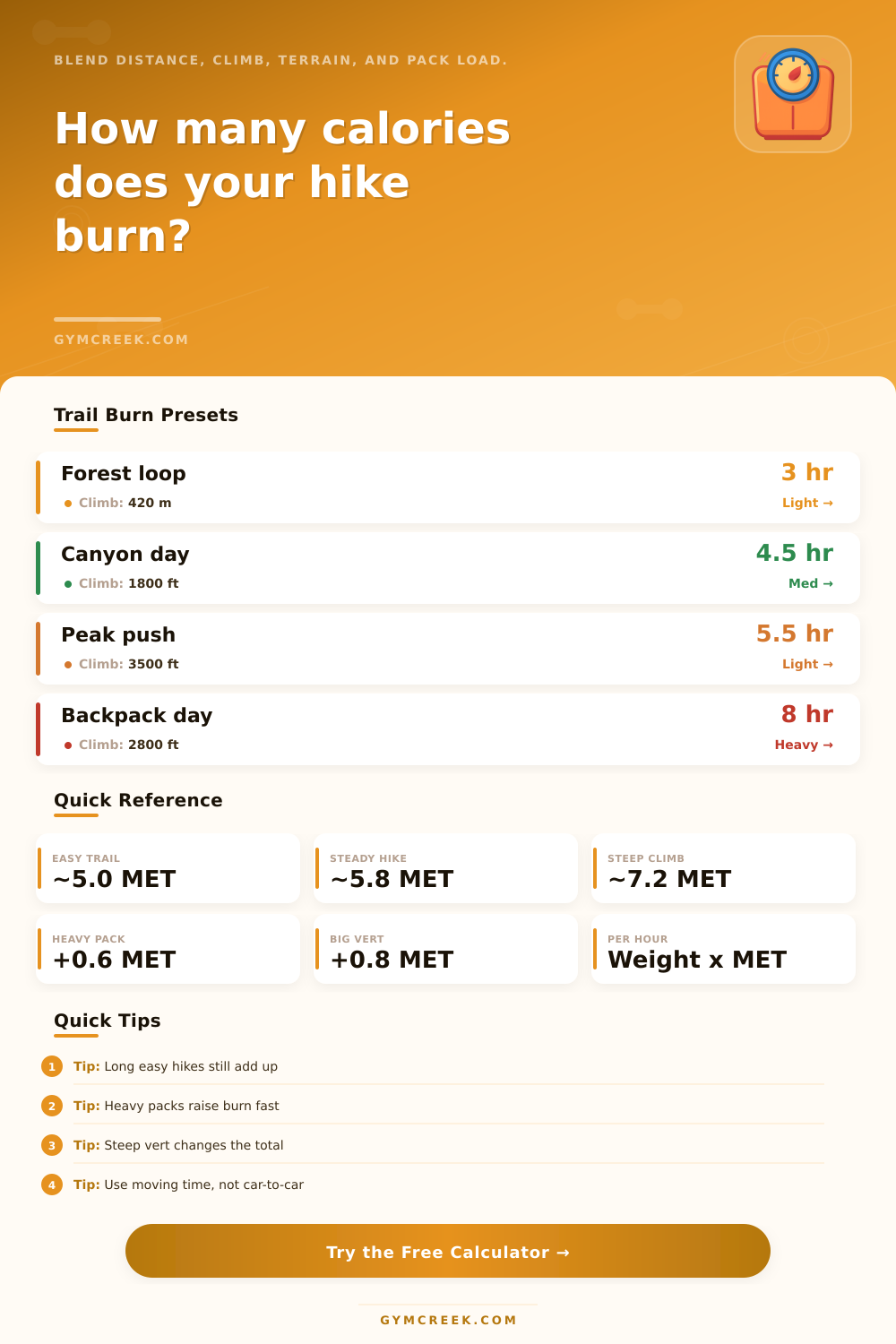
📌Trail Presets
Each preset drops in a believable trail day so you can compare easy loops, steep summit pushes, and heavier backpacking loads without rebuilding every field.
⚙Hike Inputs
Hiking calorie snapshot
Enter your trail details to estimate gross and net hiking burn.
📊Trail Metrics
📑Reference Tables
| Trail | Base MET | Grade cue | Typical day |
|---|---|---|---|
| Gentle path | 5.0 | Mostly mellow | Park or rail trail |
| Rolling trail | 5.8 | Frequent small ups | Wooded loop |
| Rocky hills | 6.5 | Uneven footing | Scrubby ridge |
| Steep mountain | 7.2 | Serious climbing | Summit push |
| Backpacking route | 7.8 | Load plus vert | All-day carry |
| Gain per km | Reading | Feel | Burn cue |
|---|---|---|---|
| <40 m | Flat | Flowing | Minimal climb bump |
| 40-80 m | Rolling | Noticeable | Small MET bump |
| 80-140 m | Hilly | Worky | Mid climb bump |
| 140 m+ | Steep | Grinding | Large climb bump |
| Pack ratio | Load | Example | Impact |
|---|---|---|---|
| <5% | Very light | Water and shell | Tiny calorie lift |
| 5-10% | Light daypack | Snacks and layers | Clear bump |
| 10-18% | Heavy day hike | Photo or winter gear | Strong bump |
| 18%+ | Backpacking | Overnight load | Big burn jump |
| Body weight | Easy trail | Steady hike | Steep climb |
|---|---|---|---|
| 59 kg / 130 lb | 295 | 342 | 425 |
| 73 kg / 160 lb | 365 | 423 | 526 |
| 82 kg / 180 lb | 410 | 476 | 591 |
| 95 kg / 210 lb | 475 | 551 | 684 |
💡Trail Tips
To calculate the calories that are burned during a hike, there is several variables that must be accounted for. These include your body weight, the weight of your pack, the difficulty of a terrain, and the elevation gain that you will experience on the hike. By accounting for these variables, you can accurately estimate how many calories will be burned so that you can plan your nutrition to ensure that you dont become to energly during your hike.
Your body weight will be the primary variable in calculating the calories that are burned during a hike. The heavier your body, the more calories burns during the hike. You will also need to consider the weight of your backpack.
How to Calculate Calories Burned on a Hike
Additionally, if you have a heavier percentage of your body weight as the weight of your pack, you will burn more calories. For instance, a pack that weighs eighteen percent of your body weight will lead to you burn more calories than if you were to carry a lighter pack. Another variable that may change the numbers of calories burned during a hike is the terrain that you hike on.
If the terrain is flat and your feet are on packed surfaces, you will burn fewer calories than if you are hiking on loose sand or mud. Additionally, if the trail that you are hiking on is steeper than another trail, you will burn more calories as your muscles has to work harder to move your body on a steeper trail. The third variable is the elevation gain that is present on the hike.
Climbing uphill will require your body to burn more calories than walk on flat terrain. Additionally, both climbing and descending will require your muscles to work to move your body, therefore burning calories. The fourth and most important variable in calculating the calories that will be burned during a hike is the moving time of the hike.
This is the total amount of time that you are on the hike while moving. Any time taken for lunch breaks will not account for this variable; this time does not require the same amount of calories as hiking. Additionally, this variable will not account for time used to prepare for the hike.
The total calories that your body burns during the hike (gross) will be higher than the calories that you burn while hiking (net). Other variables that may affect the number of calories burned during your hike include the weather and the altitude of the hike. If the hike occur in hot weather, your body will need to burn more calories to cool itself down.
If the hike occurs in cold weather, your body will burn more calories to maintain its internal body temperature. Additionally, if the hike occurs at high altitudes, your body will burn more calories because the air is thin and your body has to work harder to use the oxygen in the air to perform cellular respiration. To make calculating calories burned during a hike easier, hiking software can utilize several presets to calculate the calories burned for an individual.
These presets can include the comparison of a light hike on flat terrain to a heavy backpack on a steep trail. Additionally, another tool that you can use is the climb density table. Trails with a low climb density will be easier to hike and burn fewer calories than trails with a high measure of climb density.
These estimates of the calories that are burned while hiking can be used to plan your fueling while on the hike. The calories that you consume will need to account for the net calories that you burn while hiking. Carbohydrates burns quickly for energy and fats provide more energy for longer periods of time.
Additionally, if you are hiking uphill on steep trails, you will need to consider your hydration levels because you will feel thirsty. By utilizing these methods of calculating the calories that you will burn while hiking, you can ensure that you pack the correct amount of food and water for your hike.