
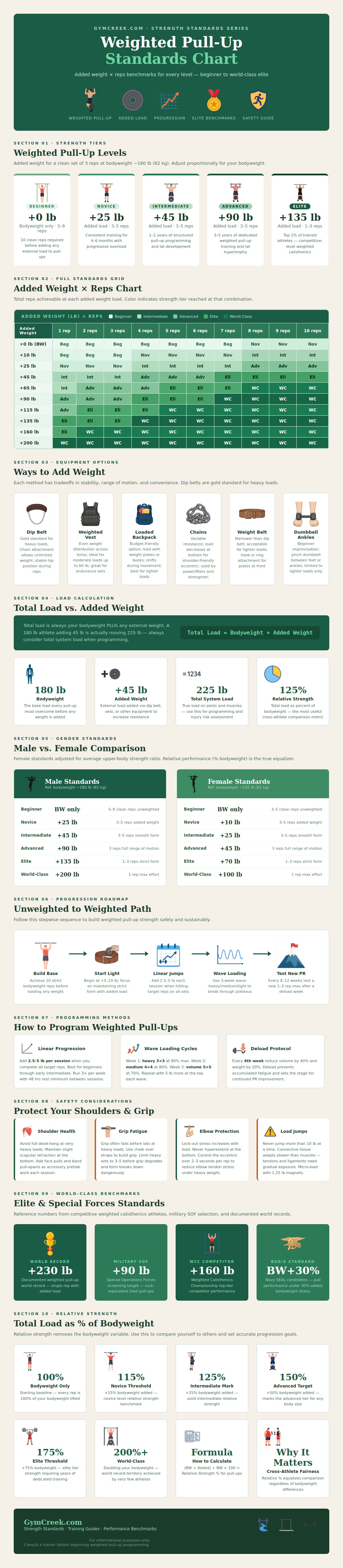
Weighted pull-ups is a type of exercise that adds weight to an bar during a pull-up. Pull-ups are an exercise that is considered to be very demanding of the muscles of the upper body. Additionally, weighted pull-ups are even more demanding of those same muscle because they must performing the exercise with the weight of there body as well as the added weight.
Many individual may desire to be able to perform more pull-ups. However, performing more pull-ups will increase the muscular endurance of those muscles rather then the raw strength of those muscles. Therefore, individuals may begin to use weighted pull-ups as a means of increasing there raw strength.
How to Do Weighted Pull-Ups Safely
Weighted pull-ups should not be performed until an individual have mastered performing bodyweight pull-ups. Should an individual perform weighted pull-ups without having mastered bodyweight pull-ups, it may lead to injuries to there shoulders. A person should be able to perform at least double-digit bodyweight pull-ups before beginning to add weight to performing pull-ups.
The types of equipment that you use for weighted pull-ups can change the way that you experience the added weight during those exercises. One type of equipment that you can use is a dip belt. A dip belt help to keep the center of gravity low.
This type of equipment allows individuals to focus their attention on the lat muscles of the upper body. Another type of equipment that you can use is a weight vest. A weight vest will distribute the added weight of the vest across the upper body.
However, it may interfere with the expansion of the rib cage. A third type of equipment that you can use is a loaded backpack. However, backpacks is unstable.
They may shift in relation to the body when performing a pull-up. This may lead to the core muscles of the body have to work to stabilize the body with the added load in the backpack. Additionally, it is important for an individual to understand the difference between the added weight and the total system load that is being use during a set of weighted pull-ups.
For instance, if an individual weighs 180 pounds and adds 45 pounds of added weight, the total system load that individual is moving is 225 pounds. The most important metric for an individual to measure with their performance of weighted pull-ups is their relative strength. Relative strength is used to measure the amount of added weight in relation to the body weight of the individual performing the exercise.
This allows for individuals that weigh less to compare their strength to an individual that weigh more. An individual may not always be able to continually increase the amount of weight performed during a series of weighted pull-ups. At some point, an individual may reach a plateau with the amount of weight that can be add to their pull-up.
At this point, one method that one may use is known as wave loading. Wave loading is a method where an individual alternate between heavy weeks, medium weeks, and light weeks. By using this method, the central nervous system are provided time to rest and recover between sets of strength training.
An individual should take safety into consideration when performing any type of exercise. For instance, an individual should never perform a dead hang while performing weighted pull-ups as this will place too much stress on the joint of their shoulder. An individual should always maintain a slight retraction of their shoulder blades during a weighted pull-up to provide protection for the muscles of there rotator cuff.
Additionally, an individual should pay special consideration to the position of their elbow during a weighted pull-up as the tendons in the elbows adapt to stress at a more slow rate than the muscles of that elbow. If an individual increases the amount of weight that they are using for their pull-ups too quick, they may develop tendonitis. Finally, an individual should ensure that they are performing the eccentric phase of a pull-up.
The eccentric phase is when an individual is lowering there body and this phase is an important part of the overall performance of a pull-up.
