German Volume Training Calculator
Score 10x10 volume, compare load to classic GVT bands, and estimate workout density, 1RM, and recovery demand.
📌Preset GVT Blocks
Each preset loads a realistic block style so you can compare classic GVT to specialty variations quickly.
⚙Training Inputs
German volume training snapshot
Enter your working load and block details to score classic GVT fit, volume, and recovery demand.
📊Benchmark Metrics
📑Reference Tables
GVT prescription ladder
Compare the classic 10x10 block against common variations.
| Goal | Sets x reps | Load | Rest |
|---|---|---|---|
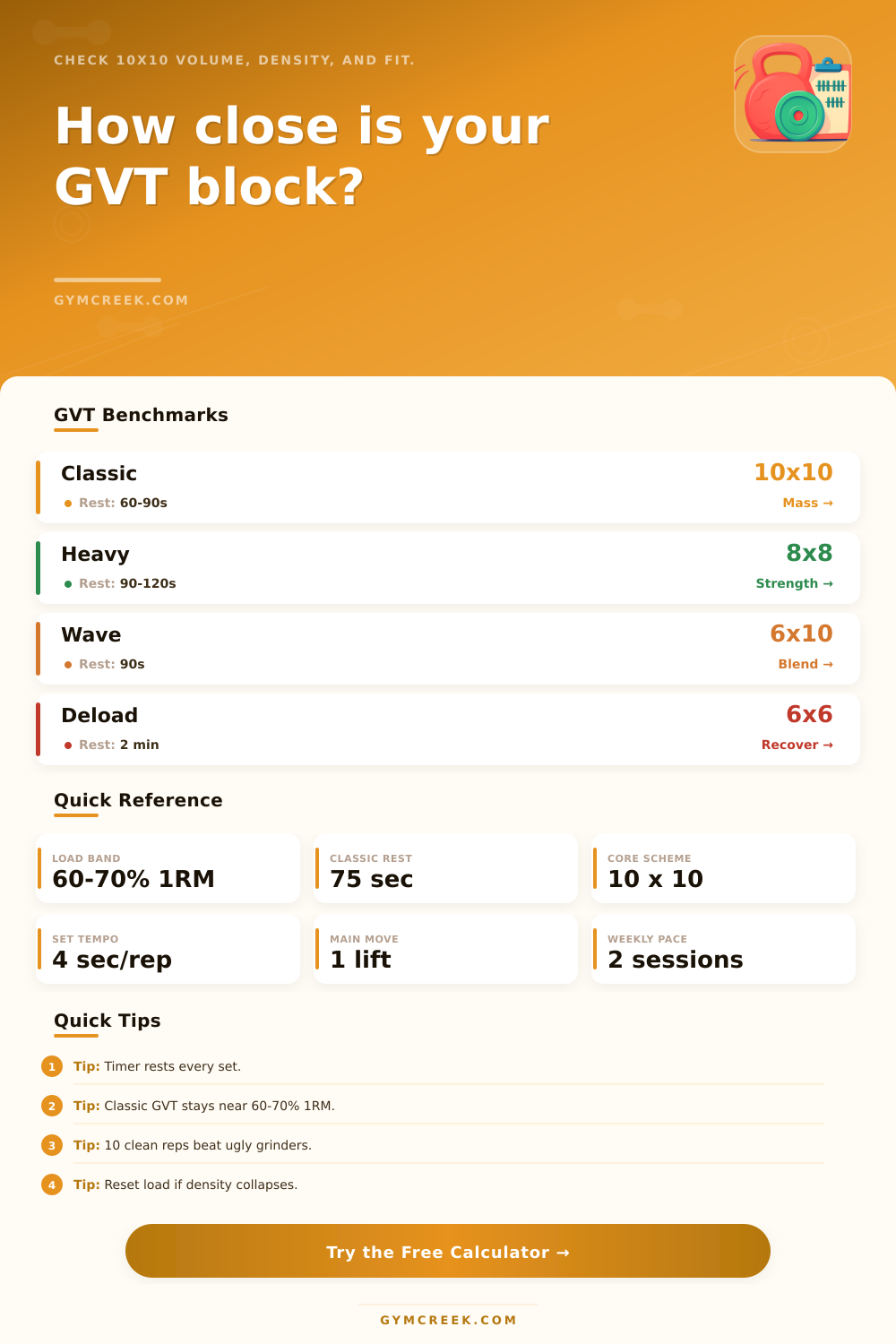
| Classic | 10 x 10 | 60-70% | 60-90s |
| Strength | 8 x 8 | 70-75% | 90-120s |
| Specialization | 10 x 10 | 58-65% | 45-75s |
| Deload | 6 x 6 | 45-55% | 90-120s |
Load band guide
Use the percent zone to decide whether the block is still classic GVT.
| % 1RM | Read | Cue | Risk |
|---|---|---|---|
| 55-60% | Light | Easy reps | Too easy |
| 60-70% | Classic | Ideal zone | Best fit |
| 70-75% | Heavy | Harder grind | Fatigue |
| 75%+ | Very heavy | Short block | Breakdown |
Tempo and rest guide
Tempo and rest change how fast the block gets dense and ugly.
| Tempo | Feel | Density | Use |
|---|---|---|---|
| 2-3 sec | Fast | High | Cut phase |
| 4 sec | Classic | Balanced | Mass phase |
| 5 sec | Slow | Lower | Control |
| 6+ sec | Very slow | Low | Joint care |
Formula reference
These equations drive the calculator and keep the score repeatable.
| Metric | Formula | Output | Why |
|---|---|---|---|
| 1RM | Epley | Max load | Anchor |
| Tonnage | Load x reps x sets | Work load | Volume |
| Density | Tonnage / minutes | Load rate | Speed |
| BMR | Mifflin-St Jeor | Kcal/day | Fuel |
💡Practical Tips
Use a timer so rest stays honest across all 10 sets.
If load climbs above 70% 1RM, it is no longer classic GVT.
Track density, not just tonnage, when comparing blocks.
Deload before bar speed and joints start slipping.
German Volume Training involve perform ten sets of ten repetitions for one primary exercise. West Germany developed German Volume Training as a means of increase the muscle mass of athletes through the performance of high amount of work. Because German Volume Training incorporates high amount of repetitions, the weight that you use must be appropriate for the ability to performing ten sets of ten repetitions.
A weight that is too heavy may prevent a trained individual from being able to complete the required number of sets of ten repetitions. A weight that is too light may prevent a trained individual from experiencing enough stimulus to lead to muscle growth. German Volume Training is typicaly performed at load percentages between 60% and 70% of one repetition maximum.
How to Do German Volume Training
A load between 60% and 70% is heavy enough to provide a stimulus for muscle growth, but it is light enough for trained individuals to be able to complete the required number of set. If loads is set at percentages less than 60%, the repetitions may become improper due to the lightness of the load. If the load percentages are set at amount over 70%, the density of the training may stall or decrease due to the increase in necessary rest time between sets.
Density is the amount of work performed within a specific time frame. German Volume Training requires rest period between sets, and the rest periods should be between 60 and 90 seconds. Short rest periods between sets will increase the density of the training session.
High density are the goal of German Volume Training. A timer should be used to ensure that the rest periods do not go past 90 seconds as this will lead to a decrease in the density of the training session. Additionally, each repetition should be performed with a controlled tempo.
A controlled tempo, such as lowering the bar at a rate of four seconds per repetition, will increase the time under tension for the muscles engaged in the exercises. An increase in the time under tension for contracted muscles is another means of increasing hypertrophy of those muscle. German Volume Training should of been performed approximately twice per week for each muscle group.
Performing German Volume Training twice per week allow the muscles time to recover. Performing German Volume Training twice per week also ensures that the trained individual does not reach a state of overreach. Recovery is essential to permit the body to repair any muscle tissue damaged during the training session.
To support German Volume Training, the trained individual should incorporate appropriate nutrition and recovery in his or her routine. The trained individual should consume enough protein to support muscle repair. The amount of protein should be between 1.6 and 2.2 gram of protein per kilogram of the body weight of the trained individual.
Additionally, the trained individual should consume enough carbohydrates to replenish glycogen stores depleted during German Volume Training. Another necessity for recovery is sleep. The body perform the majority of it’s recovery during sleep.
If the trained individual does not sleep enough hours each day, he or she will not have enough time to recover from the demand of German Volume Training. German Volume Training has several variation that individuals can perform. One variation is performing a strength based German Volume Training routine in which the trained individual performs eight sets of eight repetitions with heavier loads.
Another variation includes performing a deload in which only six sets of six repetitions are performed with lighter load. These type of variations allow trained individuals to adjust the stimulus of their training. Additionally, another means of varying German Volume Training is to incorporate specialization blocks to focus on specific muscle group.
However, the primary exercise in German Volume Training should always be the focus of the training session. Trained individuals should monitor German Volume Training to ensure its effectiveness. German Volume Training should be performed for period of three to six weeks.
After six weeks, the density of the training may stall or decrease. If any joint experience pain during German Volume Training, the load on the affected joint should be lightened or a deload period performed. Additionally, if the repetitions of German Volume Training take too long to complete or if the form begins to break down during the performance of the sets, the weight for that round should be reduced for the trained individuals joint.
By keeping proper track of the load, repetitions, and rest periods for German Volume Training, the trained individual can ensure the effectiveness of this type of training to increase muscle growth.