RIR Calculator
Estimate reps in reserve, map the effort to RPE, and choose the next load for squat, bench, deadlift, press, or custom work.
📌Presets
Each preset loads a realistic set, updates unit labels, and recalculates the reserve estimate instantly.
⚙Calculator
RIR snapshot
Enter a set to calculate reserve reps, adjusted 1RM, target load, and session intensity.
📊RIR Snapshot
📑Reference Tables
Use these tables to cross-check the estimate and keep reserve numbers consistent across lifts and phases.
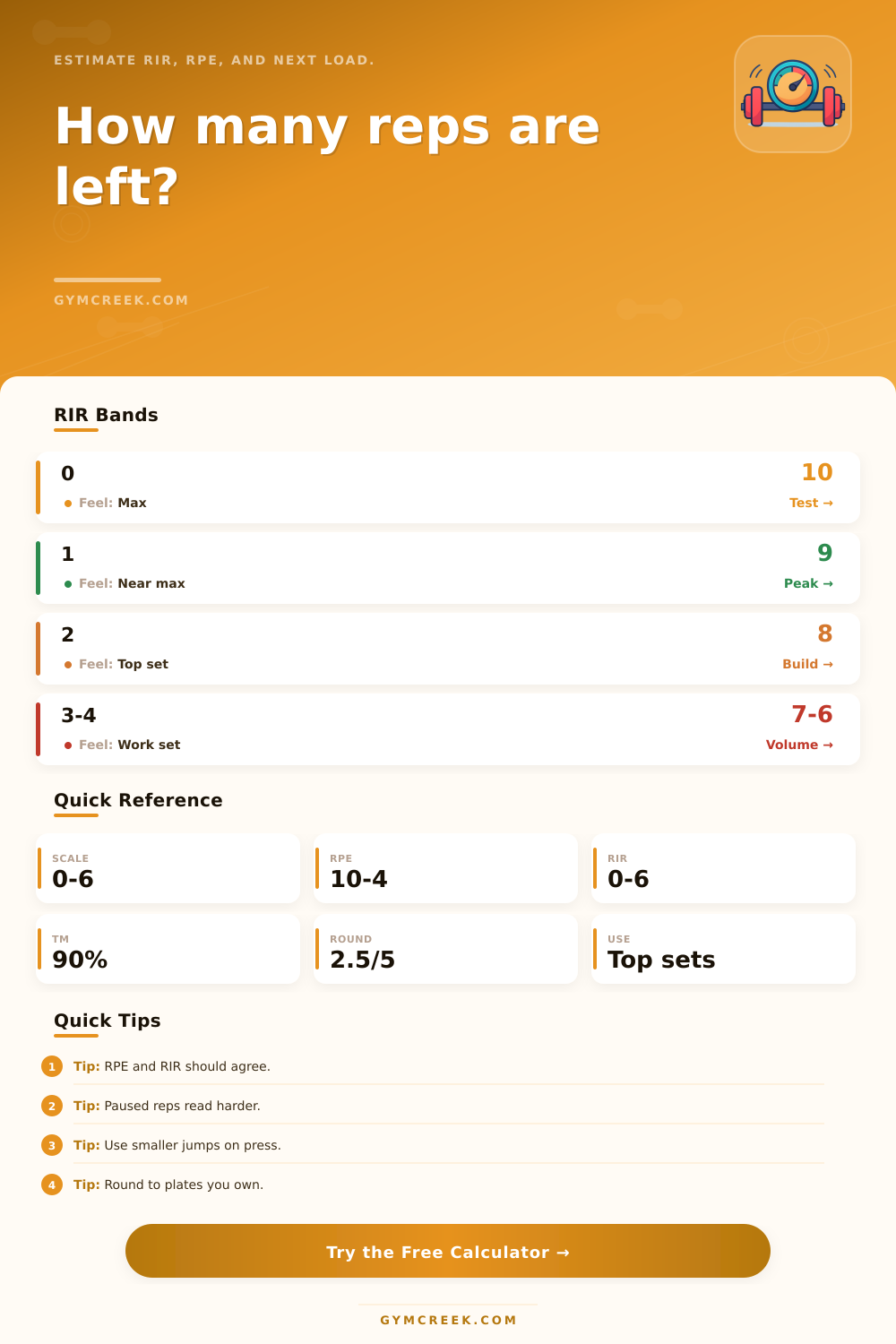
| RIR | RPE | Feel | Use |
|---|---|---|---|
| 0 | 10 | Max | Test |
| 1 | 9 | Near max | Peak |
| 2 | 8 | Top set | Build |
| 3-4 | 7-6 | Work set | Volume |
| Lift | Factor | RIR | Note |
|---|---|---|---|
| Squat | 30 | 0-3 | Steady |
| Bench | 28 | 0-2 | Micro |
| Press | 29 | 1-3 | Small |
| Deadlift | 32 | 0-2 | Hard |
| Style | Bias | Feel | Use |
|---|---|---|---|
| Standard | 0 | Clean | Baseline |
| Paused | -0.5 | Harder | Stricter |
| Tempo | -1 | Hardest | Slower |
| Cluster | +0.75 | Easier | Breaks |
💡Tips
Reps in reserve, or RIR, is a method of measuring the numbers of repetitions of an exercise that an individual can perform before reaching muscularly failure. Any repetitions that an individual could of performed in addition to the number of repetitions that are performed are referred to as reps in reserve. For instance, if an individual performed five repetitions of a bench press exercise, but believe that they could have performed two more repetitions before muscular failure was reached, then the set of bench press exercises performed have a value of 2 reps in reserve.
If an individual performs a set of exercises until they are unable to perform one more repetition, that set will have a value of 0 reps in reserve. Reps in reserve can be important in that it can help an individual to determine if they should increase the weight that they are performing the exercise with, or if they should perform more repetitions of that exercise to increase there strength. Reps in reserve is similar to the concept of Rate of Perceived Exertion (RPE).
What Reps in Reserve (RIR) Means
RPE is a measure of the effort that an individual feels that they are expending while performing a given exercise, and ranges from 10 for maximum effort to lower values for less effort. Both RIR and RPE is similar in that they relate to the physical limits of the individuals body, but RIR is more specific in that it relates to the number of repetitions remaining before the individual reach muscular failure. RIR has the benefit of being able to turn an individual’s subjective notion of effort and difficulty into a measurable concept of number of repetitions.
However, an individual must understand that RIR can differ according to the types of exercise that is performed. For instance, exercises like deadlifts may feel more difficult than exercises like squats when performing the same amount of effort. This may be due to the fact that deadlifts place more strain on the body and fatigue more quickly than squats.
The method in which an exercise is performed can also impact the RIR of that exercise. For instance, performing paused repetitions of an exercise may require more effort than performing explosive repetitions of the same exercise. Thus, if an individual performs a squat with a pause at the bottom of the squat, the RIR will be lower than if the individual performs the same number of sets of squat exercises without a pause.
The difficulty of the pause in the squat will reduce the reps in reserve for that exercise set. Conversely, because touch and go repetitions can allow a person to utilize the momentum created by each set, those repetitions can make an exercise more difficultly to complete with high RIR. A person must account for these styles because the style of the lift will dictate the number of repetitions a person have left in their tank.
Furthermore, a person’s training age and level of fatigue will also impact their calculation of their required RIR for a set. For instance, a person that is new to weight lifting may require a higher RIR for strength than an individual that has been lifting weights for many years as the novice may lose their form before they reach the point of muscular failure. Additionally, an individual may have a lower RIR for a deadlift that they perform later in the workout than at the beginning of the workout due to the fatigue that they have accumulated during that workout.
The compensation of RIR and plate rounding can help to account for these factor. In order to use RIR correctly, there are certain guidelines that an individual should follow based off their desired training goal. For instance, if an individual desires to test their maximum strength level, their RIR should be between 0 and 1.
However, if they are performing the lifts with the goal of building strength during their top sets, their RIR should be 2. Finally, if the goal is to perform volume training, an individual should aim for a RIR between 3 and 4. By using the RIR as a variable for each individuals goal, a person can ensure that they are lifting with the correct intensity.
Should an individual not follow these guidelines, they may either be lifting too hard or too light with respect to their strength and strength gains. Thus, measuring the RIR will help an individual to both maintain their desired intensity level and to ensure their training provide some form of progress.