Strength to Weight Ratio Calculator
Measure how your squat, bench press, deadlift, or strict overhead press stacks up against bodyweight, then see what it would take to climb to the next tier.
📌Presets
Each preset loads a real bodyweight-and-lift scenario, switches units when needed, and recalculates the ratio instantly.
⚙Calculator
Strength-to-weight snapshot
Enter bodyweight, lift load, and reps to score the ratio.
📊Bodyweight Benchmarks
📑Reference Tables
| Men | Novice | Advanced | Elite |
|---|---|---|---|
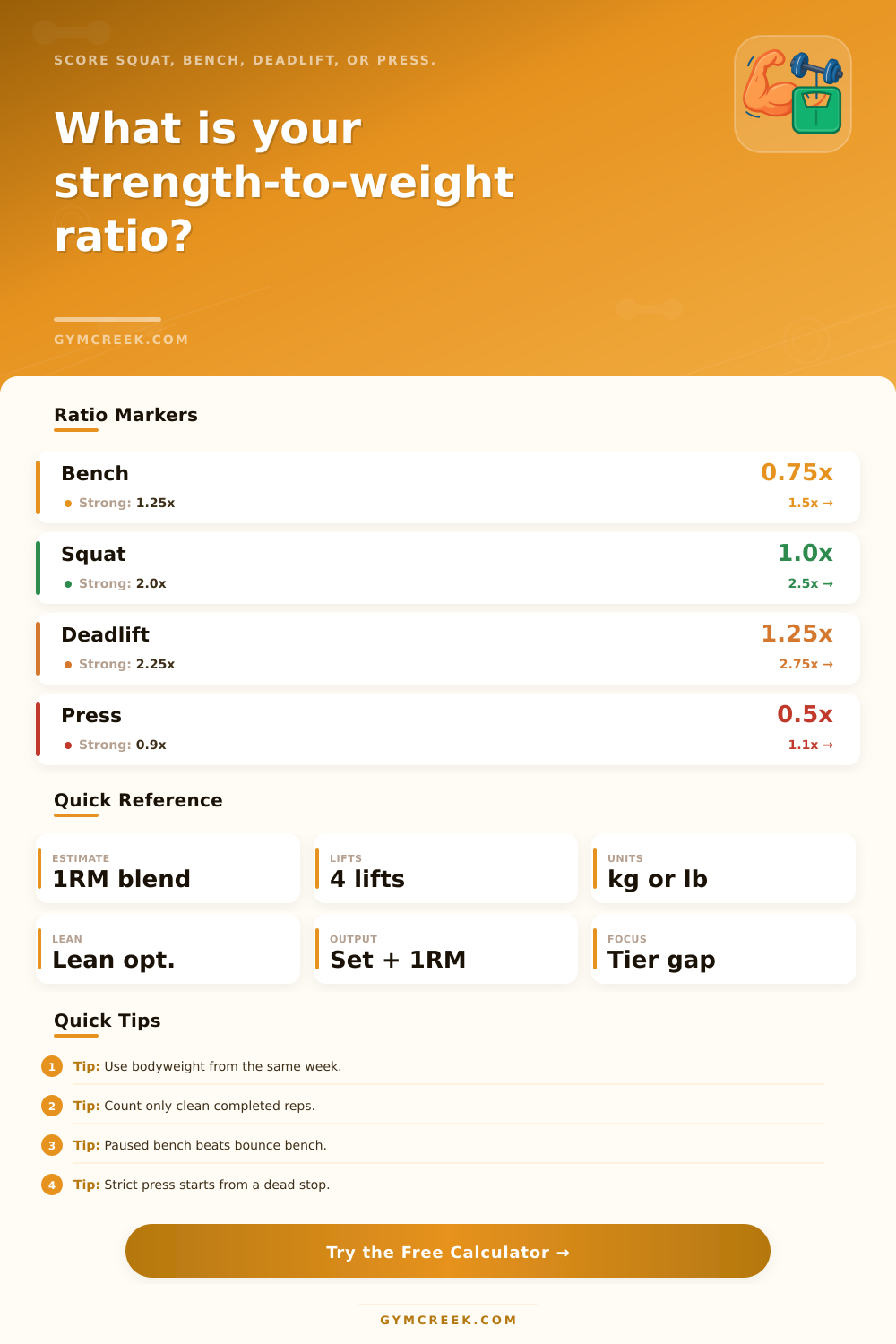
| Bench press | 0.75x | 1.25x | 1.50x |
| Back squat | 1.00x | 2.00x | 2.50x |
| Deadlift | 1.25x | 2.25x | 2.75x |
| Strict press | 0.50x | 0.90x | 1.10x |
| Women | Novice | Advanced | Elite |
|---|---|---|---|
| Bench press | 0.50x | 0.95x | 1.20x |
| Back squat | 0.80x | 1.50x | 1.90x |
| Deadlift | 1.00x | 1.80x | 2.20x |
| Strict press | 0.30x | 0.65x | 0.85x |
| Ratio | Read | Typical feel | Coaching cue |
|---|---|---|---|
| Under 1.0x | Base | Early skill | Own each rep |
| 1.0x-1.5x | Solid | Built pattern | Add small jumps |
| 1.5x-2.0x | Strong | Clear strength | Protect recovery |
| 2.0x+ | Rare | High ratio | Respect fatigue |
| Rep zone | Signal | Formula drift | Best use |
|---|---|---|---|
| 1-3 reps | Very clean | Low drift | Peak strength |
| 4-6 reps | Strong signal | Low-moderate | Most useful |
| 7-9 reps | More fatigue | Moderate | Volume blocks |
| 10-12 reps | Noisy read | Higher drift | Be cautious |
💡Tips
Strength-to-weight ratio are a measurement of the strength of an individual compared to there body weight. A persons strength can be measured in a variety of way, but using absolute weight measurements to represent strength dont take into account the weight that an individual are carrying. Strength-to-weight ratio allows for an individual to compare their lifting ability to individuals of different weight, as well as measuring the efficiency with which an individual can lift weight.
An individual who weighs 300 pound who can lift 300 pounds has a strength-to-weight ratio of 1.0, but an individual that weigh 150 pounds who can lift 300 pounds will have a strength-to-weight ratio of 2.0; indicating that they are relative stronger than the individual who weighs three time as much as the other individual. Strength-to-weight ratio is important to track to understand the change in an individuals body weight. If an individual gain weight, their body weight will increase, but the ratio will decrease, assuming that their lifting strength dont increase.
What is Strength-to-Weight Ratio?
Conversely, if an individual loses weight, their body weight will decrease, but the ratio will increase, again assuming that their lifting strength does not change. An individuals body weight can change over time, so it is important for an individual to use their most recent body weight measurement when calculating their strength-to-weight ratio. Strength-to-weight ratio measurement should use body weight measurement taken during the same week as their lifts.
Using a body weight measurement that is different than the time period during which an individual perform the lifts could result in inaccuracies in their body weight measurement. To calculate an individuals strength-to-weight ratio, it is recommended that the individual use their clean repetition when calculating their strength-to-weight ratio. Using repetition measurement that involve bouncing the weight or performing partial range of motion will create inaccuracies in their measurement of strength-to-weight ratio.
Many weight lifter recommend using a repetition range of four to six repetitions to calculate the strength-to-weight ratio of an individual. Lifts that involve repetition ranges of fewer than four repetition measure the strength of an individuals muscle compared to those that can perform a larger number of repetitions. Strength-to-weight ratio can vary significant from lift to lift.
For example, an individuals bench press strength-to-weight ratio will be lower than their deadlift ratio due to the need for stability in the upper body during a bench press exercise. Additionally, an individuals squat strength-to-weight ratio will be higher than their bench press ratio due to the ability to lift more weight during a squat exercise than during a bench press exercise. The technique used for lifting weights can also impact the strength-to-weight ratio of an individual.
For example, a ratio will be lower for a paused bench press than for a touch-and-go bench press due to the difficulty of perform a paused bench press. An individual can use their calculated strength-to-weight ratio to identify any imbalance within their physical strength. For example, if an individual has a high strength-to-weight ratio for squat exercise but a low strength-to-weight ratio for exercises like bench press, the individual may experience an imbalance between their lower and upper body strength.
By recognizing these imbalance, an individual can adjust their training routine to increase the strength-to-weight ratio for the lift with which they are struggling. Additionally, an individual can use their strength-to-weight ratio to track their strength and progress through different training tier. For example, an intermediate lifter may use their strength-to-weight ratio to determine the amount of weight they must lift to reach the strength of an elite lifter.
Finally, an individual should remain consistent in the way in which they track their strength-to-weight ratio. By tracking the same lifting exercise and the same body weight measurement over time and measuring the change in their strength-to-weight ratio, an individual can recognize if their strength is increasing at a faster rate than their body weight is increasing. This type of consistent measuring will allow for the strength-to-weight ratio to remain a useful measurement of an individual’s long-term strength progress.