🎯 Running Goal Pace Calculator
Enter your goal finish time to find your required race pace and full set of training paces
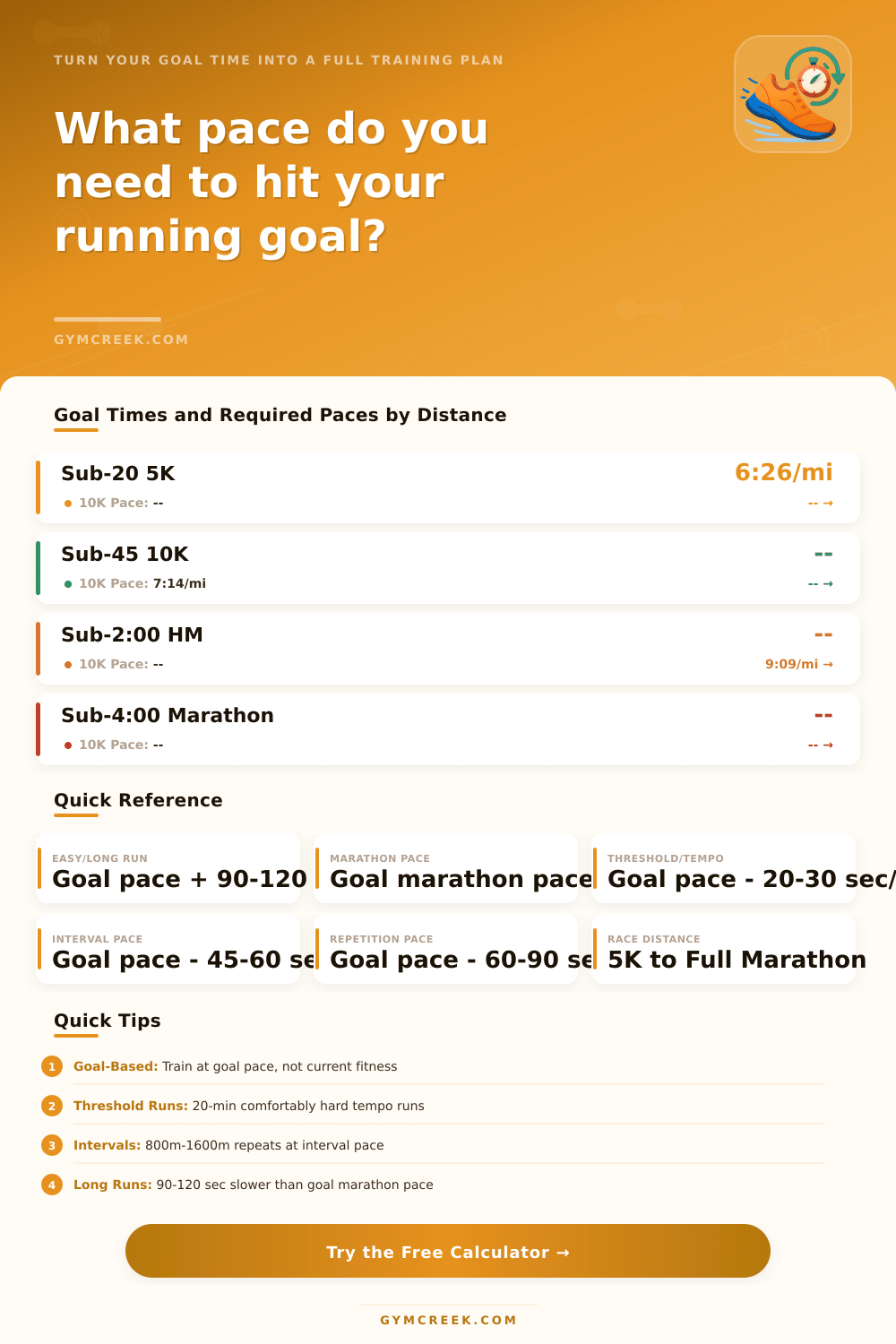
| Goal | Distance | Req. Pace/Mile | Req. Pace/KM | Level |
|---|---|---|---|---|
| Sub-18:00 | 5K | 5:47/mi | 3:36/km | Elite |
| Sub-20:00 | 5K | 6:26/mi | 4:00/km | Advanced |
| Sub-25:00 | 5K | 8:03/mi | 5:00/km | Intermediate |
| Sub-30:00 | 5K | 9:39/mi | 6:00/km | Beginner |
| Sub-40:00 | 10K | 6:26/mi | 4:00/km | Advanced |
| Sub-45:00 | 10K | 7:14/mi | 4:30/km | Intermediate |
| Sub-60:00 | 10K | 9:39/mi | 6:00/km | Beginner |
| Sub-1:30:00 | Half Marathon | 6:52/mi | 4:16/km | Elite |
| Sub-1:45:00 | Half Marathon | 8:00/mi | 4:58/km | Advanced |
| Sub-2:00:00 | Half Marathon | 9:09/mi | 5:41/km | Intermediate |
| Sub-2:30:00 | Half Marathon | 11:27/mi | 7:06/km | Beginner |
| Sub-3:00:00 | Marathon | 6:52/mi | 4:16/km | Elite |
| Sub-3:30:00 | Marathon | 8:00/mi | 4:58/km | Advanced |
| Sub-4:00:00 | Marathon | 9:09/mi | 5:41/km | Intermediate |
| Sub-5:00:00 | Marathon | 11:27/mi | 7:06/km | Beginner |
| Training Zone | Offset from Goal Pace | Purpose | Frequency |
|---|---|---|---|
| Easy / Recovery | +90 to +120 sec/mile | Aerobic base, recovery | 70-80% of runs |
| Long Run | +60 to +90 sec/mile | Endurance development | 1x per week |
| Marathon Pace | Goal marathon pace | Race-specific stamina | 1x per week |
| Threshold / Tempo | −20 to −30 sec/mile | Lactate threshold | 1x per week |
| Interval | −45 to −60 sec/mile | VO2 max development | 1x per week |
| Repetition / Speed | −60 to −90 sec/mile | Running economy | 1x per week |
Easy step shows, how many time you require for cover a distance. The main rule is easy: one shares the time by the distance. Like this, if you run 5 km.
In 30 minutes, your average step is 6 minutes each kilometer. Run one kilometer in 6 minutes, and that matches to 10 km./h. Running Pace use common runners for plan training and estimate results.
How to Find Your Running Pace
No need to have a fancy watch for control step. Simple usual clock works well. Just note the time at every mark of kilometer and do the math.
Although, on the net there are fast calculators that estimates step, time or distance, if you give two from those values. That tool works for any race length, whether 5 km., 10 km., half marathon, marathon or ultra marathon. A Running Pace calculator multiplies the step by distance for showing a guessed final time.
There is not one alone “ideal” easy step. What some reach in one week, maybe differ in the next. Step depends on age, sex, training level, weight and overall shape.
Below shows chart about easy step against old trends through time. For newcomers, start above 15 minutes each mile is entirely normal.
Easy run is that comfortable, talking rhythm, usually between 59 and 74 percent of VO2-maximum. The biggest part of training should happen in that tiny effort. The 80/20-rule offers to run 80 percent of the distances in slow easy step and 20 percent in more speed work.
Run in Running Pace of 5 km., and it becomes almost anaerobic; in 10 km. Step it stays steady middle until high aerobic work. Running Pace drops in the range of 4 until 5 on scale of effort.
Run easily after contest, and that helps too lower pain. Slow runs probably build endurance and help muscles rest after heavy work. Slow the finish also helps build distance.
Longer runs in slower step forms the base week after week.
New runners avoid growing step or distance to soon. Start with a mix of run and walk, that is good mode. For instance, run a quarter mile, walk half mile and repeat.
More matter to choose step like this slow, that you not breathe too hard, than care about pace early. Breathing becomes better during time. Deeper, long breaths instead of panting help.
Running Pace in contest is tricky. Start more slowly than you think and end more quickly, that is good advice. The mind commonly will cry “go quickly” at first, then runners tire in the final parts.
Learn that require discipline and experience. Fun runners usually are around 14 percent slower in self-paced time-attempt than when step is outside led. Think about training amount according to time instead of distance makes sense, because faster runner covers moreterritory in hour than slow.
Running Pace range is the simplest tool for estimate running strength, and they almost like this reliable as power, that one considers the golden standard. Run regular with balanced training, and you will receive improvements during time.