Ideal Body Weight Calculator by Age
Get your age-adjusted and frame-size corrected ideal body weight using Devine formula with healthy BMI ranges.
Quick Presets:
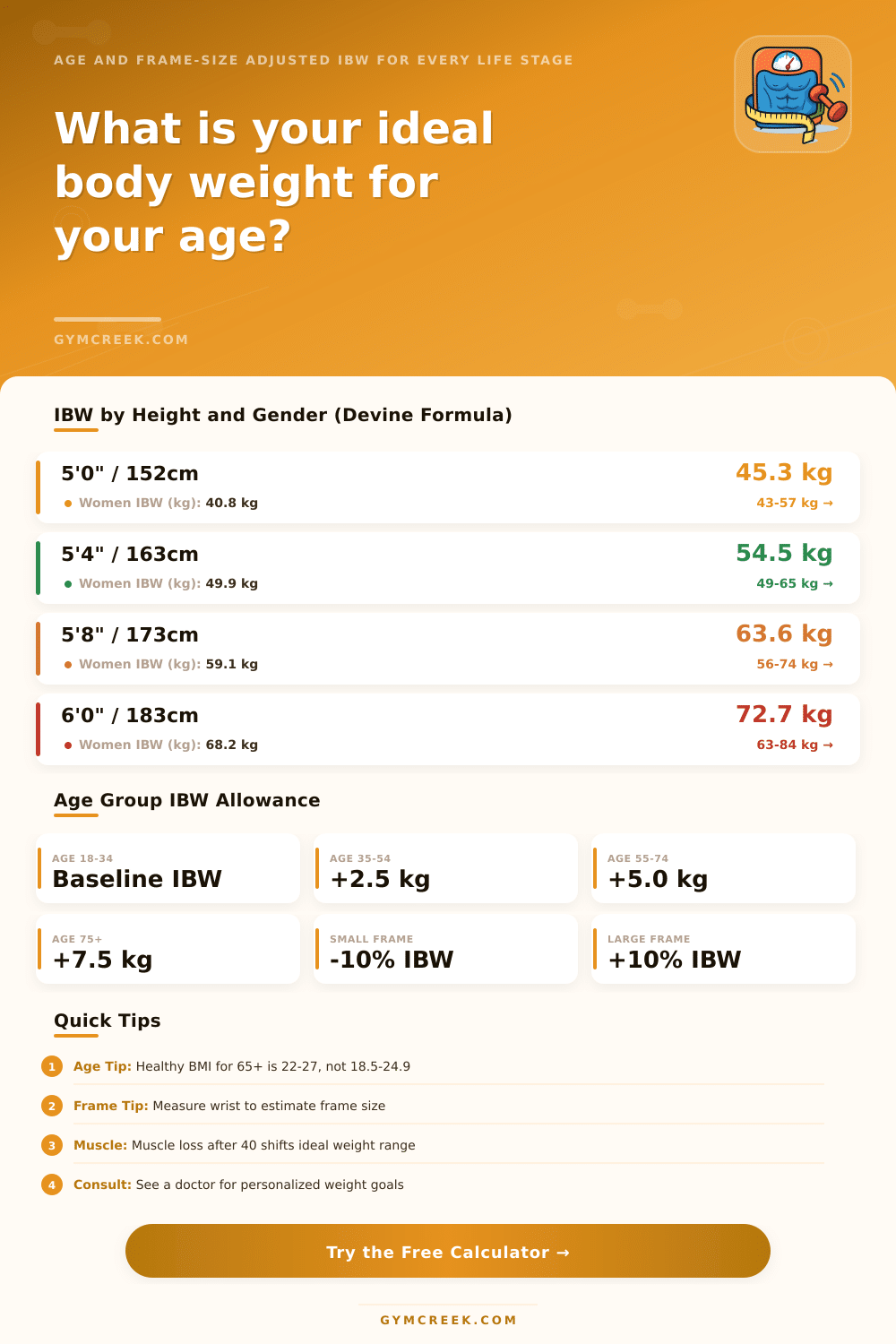
| Height | Men IBW (kg/lb) | Women IBW (kg/lb) | BMI 18.5–24.9 Range |
|---|---|---|---|
| 4'10" / 147cm | — | 38.2 / 84 lb | 40–53 kg |
| 5'0" / 152cm | 45.4 / 100 lb | 40.8 / 90 lb | 43–57 kg |
| 5'2" / 157cm | 50.0 / 110 lb | 45.4 / 100 lb | 46–61 kg |
| 5'4" / 163cm | 54.6 / 120 lb | 50.0 / 110 lb | 49–65 kg |
| 5'6" / 168cm | 59.1 / 130 lb | 54.5 / 120 lb | 52–69 kg |
| 5'8" / 173cm | 63.6 / 140 lb | 59.1 / 130 lb | 56–74 kg |
| 5'10" / 178cm | 68.2 / 150 lb | 63.6 / 140 lb | 59–79 kg |
| 6'0" / 183cm | 72.7 / 160 lb | 68.2 / 150 lb | 63–84 kg |
| 6'2" / 188cm | 77.3 / 170 lb | — | 67–89 kg |
| 6'4" / 193cm | 81.8 / 180 lb | — | 71–94 kg |
| Age Group | Recommended BMI | IBW Allowance | Notes |
|---|---|---|---|
| 18–34 years | 18.5–24.9 | Baseline | Standard guidelines apply |
| 35–54 years | 18.5–24.9 | +2.5 kg | Slight increase in healthy range |
| 55–74 years | 20.0–26.0 | +5.0 kg | Bone density considerations |
| 75+ years | 22.0–27.0 | +7.5 kg | Higher BMI may be protective |
do not exist magic number, that answer for every folk when deal about ideal Body Weight. The reality is much more complex than simply that. Height, sex, percentage of body fat, amount of muscle, that you bear, bone density.
Everything this plays important role. Hence any one formula can exactly set, as far as any should weigh. The notion of universal “ideal weight” simply does not count.
No one right weight for everyone
Various formulas evolved during years for estimate ideal Body Weight, and the formula of Devine rank between the most used. At men it starts at 50 kg. And adds 2,3 kg.
For every inch above 5 feet. For instance, folk high in 5 feet and 10 inches reach 50 plus 23, so 73 kg. Or around 161 pounds.
Exists other version, that uses 110 pounds as base for men and add 5 pounds for every inch above 5 feet. Also the formulas of Robinson, Miller and Hamwi enter in the mix. But here the main spot: those different methods commonly give entirely different results for the same individual, what genuinely frustraets.
BMI works as another tool for measure. It counts body fat only from height and weight. At adults one sorts it in groups, underweight, healthy weight, overweight and obesity.
Widely healthy BMI sits between 18,5 and 24,9. What is the problem? BMI does not consider muscle mass, bone density nor the real makeup of your body.
A person with a lot of muscles can weigh more than some average person and even so be perfectly healthy. Muscle is heavier then fat, at the end of everything.
Also the body type affects the cause. Thin folks have less thick frames, heavy folks more solid builds, medium folks stronger muscle skill. Every type reacts quite differently to management of weight.
Hence matter to focus on the percentage of body fat rather than obsess about the number on the scale. Most folks feel good and seem best in the range of 8 until 15 percentages.
At folks that practice training in CrossFit-style, dropping the body fat to around 15 percentages during building muscles help to better impact. Male athletes in CrossFit usually weigh in the group of 85 until 90 kg. Women in that branch commonly reach good results in around 65 until 70 kg.
The typical American woman weighs around 171 pounds, but that number alone almost nothing say. Age, height, composition of the body, everything this matters. Two people can have identical weight, yet seem entirely differently.
Simply look at one number on the scale does not capture the size of the frame, width of the shoulders, structure of the hips or size of the ribcage. Here the real essence ofthe details.
Every body is different. What feels well and seem good for one folk, could be entirely wrong for another.