📏 BMI & Waist Measurement Calculator
Calculate your Body Mass Index, waist-to-height ratio, and cardiovascular disease risk level
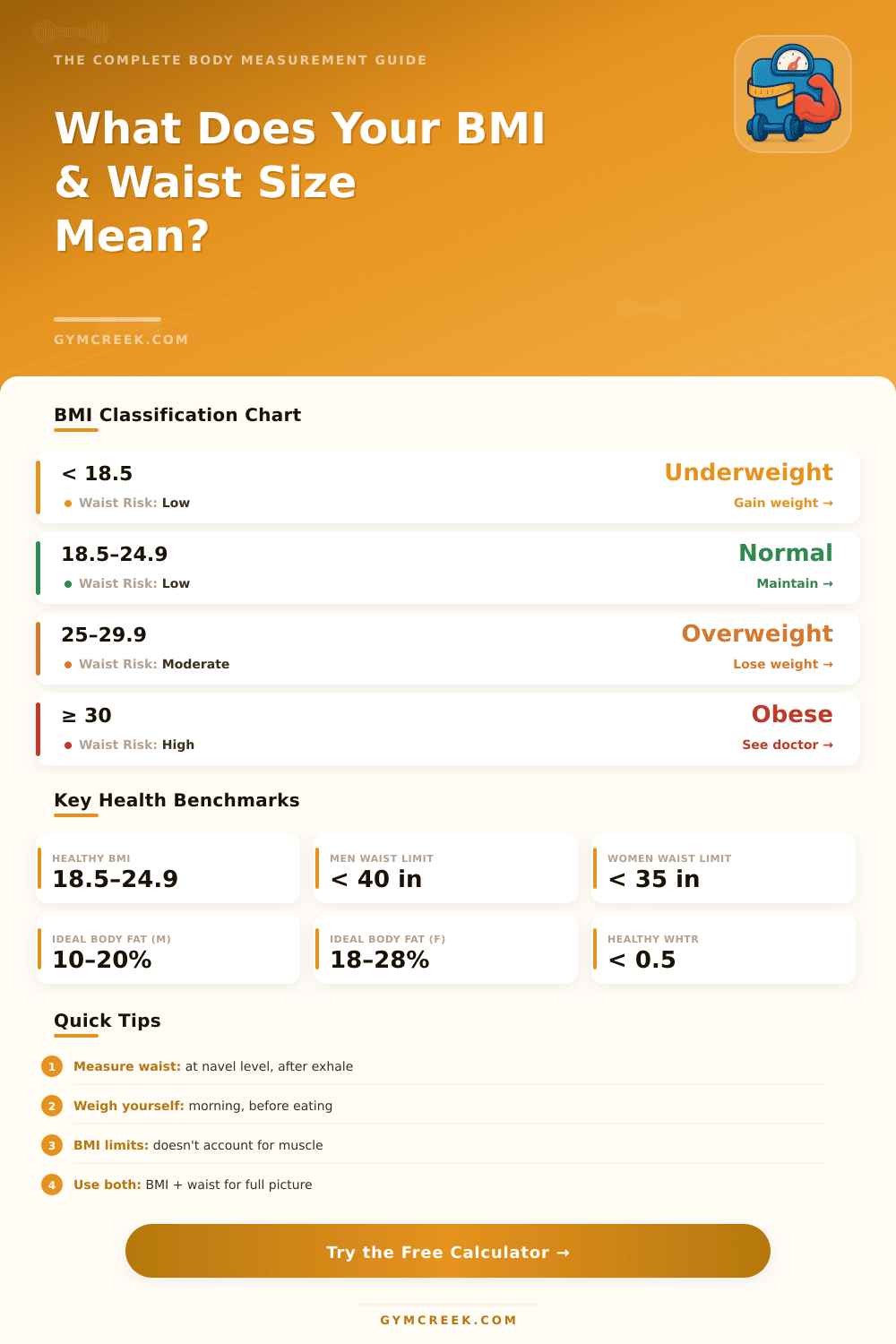
| BMI Range | Category | Health Risk | Recommended Action |
|---|---|---|---|
| Below 16.0 | Severely Underweight | Very High | Seek medical advice immediately |
| 16.0 – 18.4 | Underweight | Elevated | Increase caloric intake with guidance |
| 18.5 – 24.9 | Normal Weight | Low | Maintain current lifestyle |
| 25.0 – 29.9 | Overweight | Moderate | Lifestyle changes recommended |
| 30.0 – 34.9 | Obese Class I | High | Medical guidance advised |
| 35.0 – 39.9 | Obese Class II | Very High | Medical intervention recommended |
| 40.0 and above | Obese Class III | Extremely High | Urgent medical attention needed |
| Sex | Low Risk | Increased Risk | High Risk |
|---|---|---|---|
| Male | Below 37 in / 94 cm | 37–40 in / 94–102 cm | Above 40 in / 102 cm |
| Female | Below 31.5 in / 80 cm | 31.5–35 in / 80–88 cm | Above 35 in / 88 cm |
| WHtR Range | Category | Cardiovascular Risk | Notes |
|---|---|---|---|
| Below 0.40 | Very Slim | Low – may be underweight | Check nutritional status |
| 0.40 – 0.49 | Healthy | Low | Optimal range for most adults |
| 0.50 – 0.59 | Overweight | Moderate | Lifestyle improvement advised |
| 0.60 and above | Very High Risk | High | Medical assessment recommended |
| Category | Men (%) | Women (%) | Health Status |
|---|---|---|---|
| Essential Fat | 2 – 5% | 10 – 13% | Minimum required for function |
| Athletic | 6 – 13% | 14 – 20% | High performance range |
| Fitness | 14 – 17% | 21 – 24% | Above average health |
| Average | 18 – 24% | 25 – 31% | Acceptable range |
| Obese | 25% and above | 32% and above | Elevated health risk |
| Risk Level | Men (WHR) | Women (WHR) | Disease Risk |
|---|---|---|---|
| Low | Below 0.90 | Below 0.80 | Pear shape — lower cardiovascular risk |
| Moderate | 0.90 – 0.99 | 0.80 – 0.84 | Intermediate risk |
| High | 1.00 and above | 0.85 and above | Apple shape — higher cardiovascular risk |
Body Mass Index, or BMI, is a value that is calculated from the height and weight of people. It helps to check whether someone has weight in a healthy range. The calculation is easy: you divide the weight in kilos by the square of the height in metres.
That result shows in kg./m². It counts for adult men and women and it works as a first test to estimate the amount of fat in the body.
What is Body Mass Index (BMI)?
The values of BMI belong to various groups. If it is under 18.5, that points to an underweight state. From 18.5 to 24.9 one considers it normal or healthy.
Above that limit, some enter the group of heavy folks. When BMI reaches 30 or more, it shows obesity, which further splits into three levels. For children and youngsters between 2 and 18 years, the calculation also includes age and gender.
The name “Body Mass Index” spread after an article appearing in 1972 in the Journal of Chronic Diseases, written by Ancel Keys. In that study, they found that BMI is the best link between weight and height to estimate teh percentage of body fat. The growing attention to body fat came because of the increase of obesity in rich western lands.
The same formula comes from the 19th century, when one called it the Index of Quetelet.
BMI gives a good overview, but it has some limits. It does not detect the fat in the body itself. Also, it does not consider muscle volume, bone density or the spread of the fat.
Athletes and bodybuilders with a lot of muscles commonly end in the heavy or overweight group, although their fat is little. More then 25% of male athletes were classed as heavy or overweight according to BMI, but only less than 4% truly had too much body fat. In older adults, normal BMI can hide bigger fat amount because of loss of muscles.
BMI does not suit for pregnancy and breastfeeding, because the body structure changes a lot in those periods. It varies based on age and ethnic group. In African-Americans, BMI commonly underestimates obesity, when the high value comes from bigger muscle mass instead of excess fat.
The percentage of body fat estimates health more truly than only BMI. The ratio between height and Waist is suggested as a better marker. The safest way to check your state is a trip to the doctor for a full checkup.
High BMI however stays linked to bigger risk of death for most folks. It works well as a basic test, but not as a standalone diagnosis. Also diet, movement andfamily history play a role.