🏋 Bench Press Calories Burned Calculator
Estimate calories burned based on your weight, sets, reps, intensity & rest time
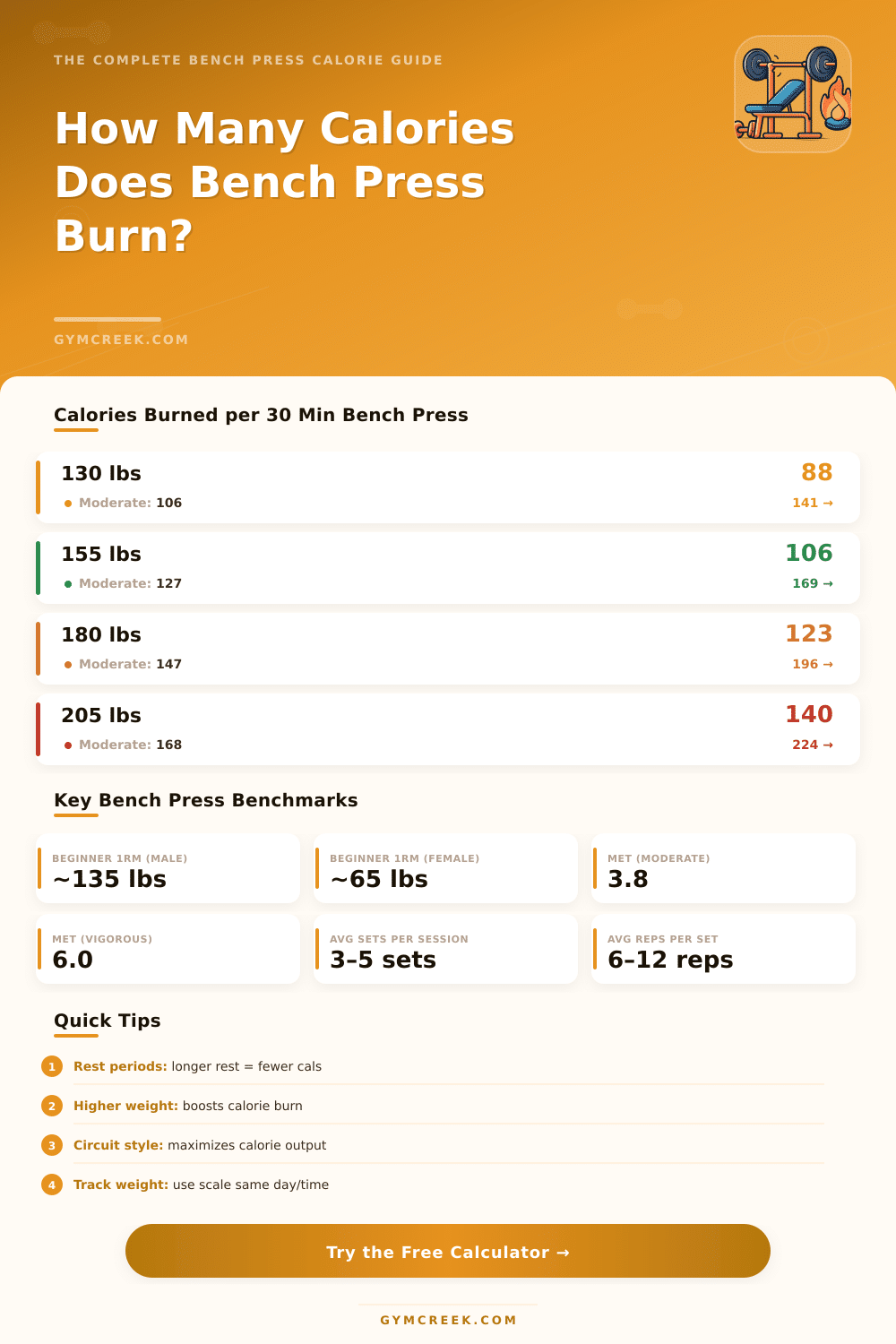
| Intensity Level | MET Value | Description | Typical 1RM % | Example Goal |
|---|---|---|---|---|
| Light | 3.0 | Very easy, warm-up weight | < 50% | Rehab / Warm-up |
| Moderate | 3.8 | Comfortable working weight | 50–70% | Hypertrophy / Endurance |
| Vigorous | 6.0 | Challenging, near failure | 70–85% | Strength / Size |
| Max Effort | 8.0 | Near maximal, powerlifting | > 85% | Powerlifting / 1RM Test |
| Body Weight | Light (MET 3.0) | Moderate (MET 3.8) | Vigorous (MET 6.0) | Max (MET 8.0) |
|---|---|---|---|---|
| 120 lbs (54 kg) | 81 | 103 | 162 | 216 |
| 140 lbs (64 kg) | 95 | 120 | 189 | 252 |
| 160 lbs (73 kg) | 109 | 137 | 216 | 288 |
| 180 lbs (82 kg) | 122 | 155 | 243 | 324 |
| 200 lbs (91 kg) | 136 | 172 | 270 | 360 |
| 220 lbs (100 kg) | 149 | 189 | 297 | 396 |
| 240 lbs (109 kg) | 163 | 206 | 324 | 432 |
| Level | Male (% Bodyweight) | Female (% Bodyweight) | Example (175 lb male) |
|---|---|---|---|
| Beginner | 0.5 × BW | 0.35 × BW | ~88 lbs |
| Novice | 0.75 × BW | 0.50 × BW | ~131 lbs |
| Intermediate | 1.0 × BW | 0.65 × BW | ~175 lbs |
| Advanced | 1.5 × BW | 1.0 × BW | ~263 lbs |
| Elite | 2.0+ × BW | 1.5 × BW | ~350 lbs |
| Rep Range | % of 1RM | Primary Goal | Sets Recommended | Rest Period |
|---|---|---|---|---|
| 1–3 reps | 93–100% | Max Strength / 1RM | 3–6 | 3–5 min |
| 4–6 reps | 85–92% | Strength | 4–6 | 2–4 min |
| 6–12 reps | 67–84% | Hypertrophy (muscle size) | 3–5 | 60–90 sec |
| 12–20 reps | 50–66% | Muscular Endurance | 2–4 | 30–60 sec |
| 20+ reps | < 50% | Endurance / Burn | 2–3 | 15–30 sec |
The Bench Press is an exercise with weights, where one pushes the weight upward while lying on a bench in a flat position. That move is combined, so it uses several muscles at once. The main muscles that work here are the big chest muscle, the front shoulder muscles and the triceps.
One lies on the bench and pushes the weight upward by means of a bar or pair of dumbbells. The weight one lowers until the level of the chest then pushes it upward while straightening the arms.
How to Do the Bench Press
The Bench Press ranks between the most useful exercises for building muscle and strength in the upper body. It mainly targets the chest, but also uses the shoulders, triceps and core. It uses more upper body muscle mass than any ohter exercise for that part.
The version with wide grip works the chest, front shoulders and arms together, what saves time instead of working everything by means of separate moves.
Various kinds of Bench Press target the muscles a bit differently. The flat bench forms the basic version. The incline press affects the upper parts of the chest muscles.
The decline version well helps for the chest growth in many folks. Combine different moves, as the incline barbell Bench Press and the decline dumbbell Bench Press, attack the chest from various angles and work several zones of the chest muscles, including upper, middle and bottom.
It is very common that one must use less weight for the incline Bench Press than four the flat. The weight that one can raise on flat bench, commonly also it is possible on decline, but the incline seems harder.
For good position, one starts with the bar directly above the eyes, if there is a spotter, or above the nose and mouth, if not. The feet stand flat, with the hips and upper back flat on the bench. The shoulders are pulled down and back.
The hands are straight, so that the joints line up well and the grip is stable. Bending the hands can cause injury. Big tension in the back, without relaxing at the finish of the move, is important.
Dumbbells well replace the bar, but the raised weight probably will be less, because dumbbells are less stable. Using dumbbells also trains both parts of the chest separately, what matters, because the bar can allow that one side works more than the other.
Doing the Bench Press twice weekly with different sets and high volume helps it grow. The frequency is key for improving the move. For getting whole muscle mass, sets with eight to twelve reps work well.
Ranging the routine of Bench Press by means of different sets, reps and weights is a good way to surprise the body and beat plateaus. If the sticking spot happens in the middle of the press, probably the shoulder muscles are weak. If it is at the chest, then the chest muscles or wide back is the problem.
Moves like skull-crushers and JM-presses give better carryover to the bench than tricep pushdowns. Controlling theweight matters more than using too heavy with bad form.