🏔️ Ultra Running Pace Calculator
Calculate finish times, splits & elevation-adjusted paces for 50K, 50M, 100K & 100M races
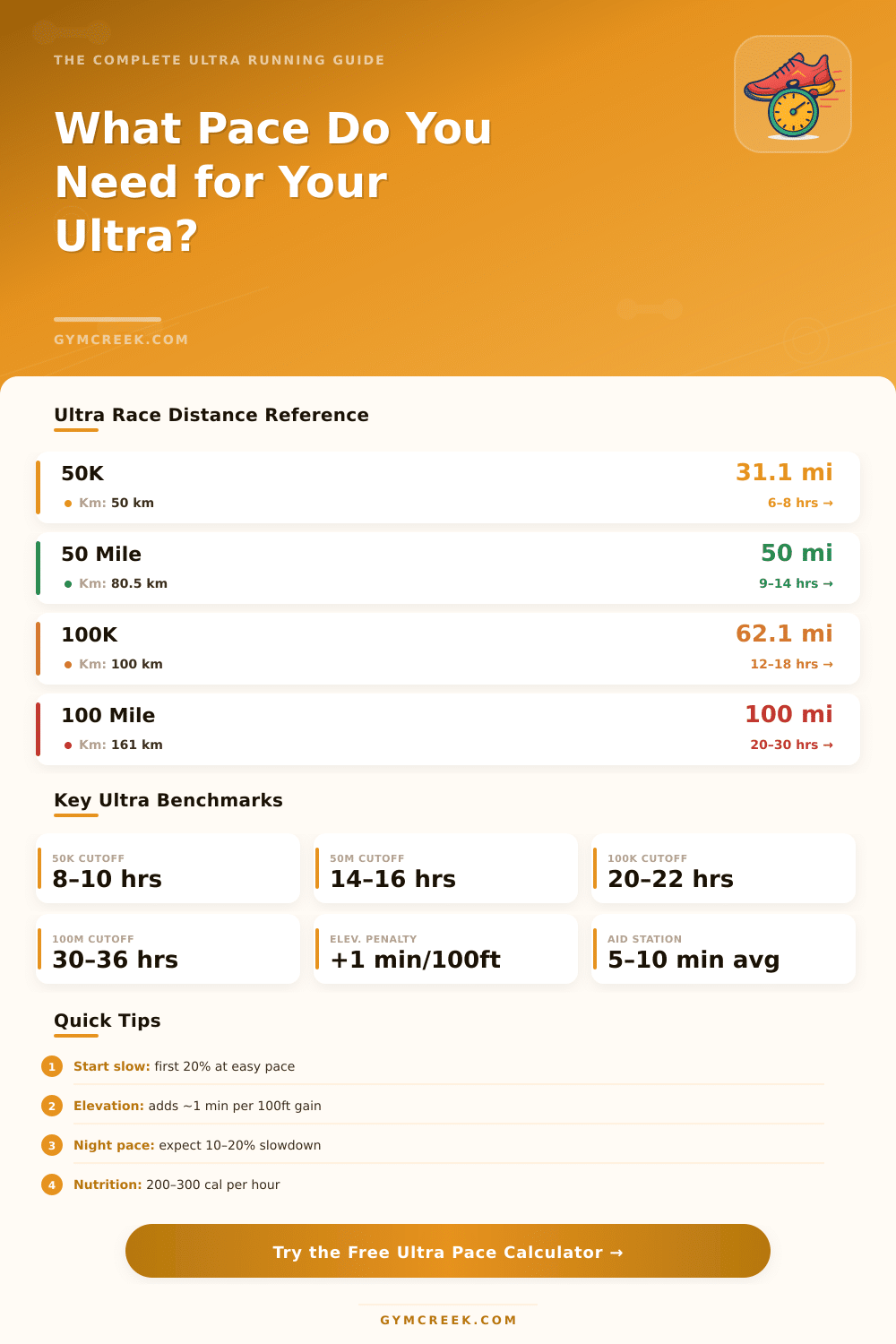
| Race | Miles | Kilometers | Avg Finish Time | Typical Cutoff |
|---|---|---|---|---|
| 50K | 31.1 mi | 50 km | 6–8 hrs | 8–10 hrs |
| 50 Mile | 50 mi | 80.5 km | 9–14 hrs | 14–16 hrs |
| 100K | 62.1 mi | 100 km | 12–18 hrs | 20–24 hrs |
| 100 Mile | 100 mi | 160.9 km | 20–30 hrs | 30–36 hrs |
| Elevation Gain | Pace Penalty | Course Type | Example Race |
|---|---|---|---|
| 0–2,000 ft | +1–2% | Flat / Road-like | Tunnel Hill 100 |
| 2,000–5,000 ft | +3–6% | Rolling Hills | Western States 100 |
| 5,000–10,000 ft | +7–12% | Mountainous | Leadville 100 |
| 10,000–20,000 ft | +13–20% | Alpine / Technical | UTMB 100 |
| 20,000+ ft | +20–35% | Extreme Mountain | Tor des Géants |
| Effort Zone | % of Marathon Pace | RPE (1-10) | Best For |
|---|---|---|---|
| Zone 1 — Easy | 130–160% of MP | 1–3 | 100M, long 50M sections |
| Zone 2 — Aerobic | 115–130% of MP | 3–5 | 50M, 100K, flat sections |
| Zone 3 — Moderate | 105–115% of MP | 5–6 | 50K, competitive 50M |
| Zone 4 — Threshold | 100–105% of MP | 7–8 | Elite 50K racing |
Terrain Matters: Trail pace is typically 1.2–2x slower than road pace depending on technicality. Rocky, rooty single-track adds significant time beyond simple elevation calculations.
Night Penalty: Running through the night typically slows pace by 10–20% even for experienced runners. Factor this into your 100M or long 100K plan.
Late-Race Fade: Most runners slow 15–30% in the final 25% of a 100M. Build buffer time into your plan from the start.
| Distance | Elite | Competitive | Midpack | Back of Pack |
|---|---|---|---|---|
| 50K | 3:00–3:30 | 4:00–5:00 | 5:00–7:00 | 7:00–10:00 |
| 50 Mile | 6:00–7:30 | 8:00–10:00 | 10:00–13:00 | 13:00–16:00 |
| 100K | 9:00–11:00 | 12:00–15:00 | 15:00–19:00 | 19:00–24:00 |
| 100 Mile | 14:00–18:00 | 20:00–24:00 | 24:00–30:00 | 30:00–36:00 |
The Running Pace in ultra-runs is not about running at high speed the whole time. Main targets are to minimize the slowdown that happens close to the finish of the race. The winner of an ultra is basically the runner that slows the least.
In such events the Running Pace changes a lot because of conditions of the course and because of tiredness.
How to Pace Yourself in an Ultra Race
A good example is the winner of the Ultra-Trail du Mont-Blanc in 2019 Pau Capell. Over 105 miles with 30,000 feet of climb he averaged 11.5-minute miles, included stops at aid stations. However his Running Pace ranged from 6.4-minute miles on flat and downhill sections to 20.5-minute miles on uphill parts.
Even for an elite runner that is an imprssive difference.
In a 100-mile race the Running Pace naturally will be slower than in a 50K because of bigger distance, more height and physical exhaustion. Most ultra-marathons happen on trails, so runners must deal with uneven ground, hills and changes in height. An average of 15 minutes per mile is considered good in a 100-mile race.
For races of 50 miles or longer, aim for a comfortable Running Pace that feels right for lasting the whole day. That speed probably will be at least two minutes slower per mile than marathon pace, especially for new ultra-runners. On flat ground a Running Pace a bit slower than marathon effort works well, similar too that of a 50K race.
In hilly or trail terrain walking can be needed to keep the right level of effort. Almost every run in ultra-training and in the race itself can happen at that easier pace.
Starting too fast is a very common mistake among runners. The advice is to start at a speed close to your long training Running Pace or even one to two minutes slower, especially during the first three to four hours. The mind often pushes you to go faster early, because the tiredness does not show yet.
It takes discipline and experience to hold back at the start. Starting toohard often ends with a death march to the finish line.
Research on Running Pace shows that the fastest runners keep their starting pace until around 50 kilometers before starting to slow. Slower runners drop to around 40 percent of the initial speed and often fade much earlier. Even average runners from the crowd slow only a bit.
In ultra-running the effort matters more than exact splits. Your personal record in a 50K does not help a lot, when the course ranges from rocky trails to flat soggy areas. It all comes down to effort instead of hitting a certain split on the clock.
The average Running Pace in ultra-marathons has actually slowed over the years. In 1996 it was 11:35 per mile. Now it is around 13:16 per mile, which shows a slowdown of around 15 percent.
Top ultra-runners fit a marathon personal record around 2:15, so their easy ultra Running Pace of 7 to 8 minute miles feels loose for them. The usual human walking speed is around 19 minutes per mile, and with little effort 18-minute miles are easily reached.