⚖️ Body Frame Size & Ideal Weight Calculator
Discover your body frame type and calculate your personalized healthy weight range
| Gender | Small Frame | Medium Frame | Large Frame |
|---|---|---|---|
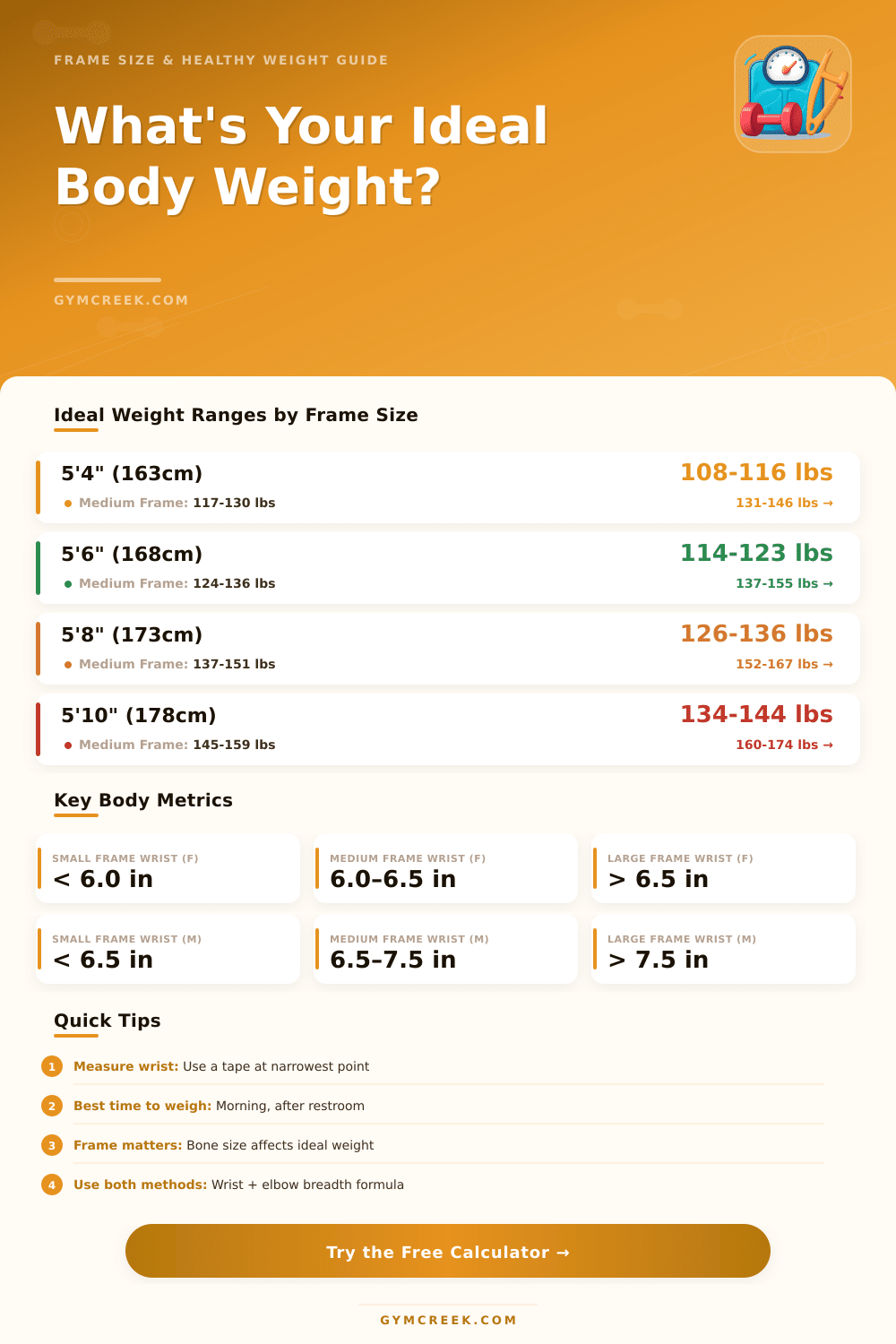
| Female (height < 5'2") | < 5.5 in / 14.0 cm | 5.5–5.75 in / 14.0–14.6 cm | > 5.75 in / 14.6 cm |
| Female (5'2"–5'5") | < 6.0 in / 15.2 cm | 6.0–6.25 in / 15.2–15.9 cm | > 6.25 in / 15.9 cm |
| Female (height > 5'5") | < 6.25 in / 15.9 cm | 6.25–6.5 in / 15.9–16.5 cm | > 6.5 in / 16.5 cm |
| Male (height < 5'5") | < 6.5 in / 16.5 cm | 6.5–7.5 in / 16.5–19.1 cm | > 7.5 in / 19.1 cm |
| Male (5'5"–5'11") | < 6.5 in / 16.5 cm | 6.5–7.5 in / 16.5–19.1 cm | > 7.5 in / 19.1 cm |
| Male (height > 5'11") | < 7.0 in / 17.8 cm | 7.0–8.0 in / 17.8–20.3 cm | > 8.0 in / 20.3 cm |
| Height Range | Gender | Small Frame | Medium Frame | Large Frame |
|---|---|---|---|---|
| 4'10"–4'11" | Female | < 2.25 in | 2.25–2.5 in | > 2.5 in |
| 5'0"–5'3" | Female | < 2.25 in | 2.25–2.5 in | > 2.5 in |
| 5'4"–5'7" | Female | < 2.375 in | 2.375–2.625 in | > 2.625 in |
| 5'8"–5'11" | Female | < 2.375 in | 2.375–2.625 in | > 2.625 in |
| 5'2"–5'3" | Male | < 2.5 in | 2.5–2.875 in | > 2.875 in |
| 5'4"–5'7" | Male | < 2.625 in | 2.625–2.875 in | > 2.875 in |
| 5'8"–5'11" | Male | < 2.75 in | 2.75–3.0 in | > 3.0 in |
| 6'0"–6'3" | Male | < 2.75 in | 2.75–3.125 in | > 3.125 in |
| Formula | Base Weight | Adjustment | Result (lbs) |
|---|---|---|---|
| Hamwi (1964) | 106 lbs | +6 lbs/inch over 5' | 148 lbs |
| Devine (1974) | 110 lbs | +5.06 lbs/inch over 5' | 145 lbs |
| Robinson (1983) | 114 lbs | +4.2 lbs/inch over 5' | 143 lbs |
| Miller (1983) | 124 lbs | +2.3 lbs/inch over 5' | 140 lbs |
| BMI Method (21.5) | — | BMI 18.5–24.9 range | 133–178 lbs |
| Frame Size | Hamwi Adjustment | Interpretation | BMI Modifier |
|---|---|---|---|
| Small Frame | −10% of IBW | Lighter bone structure, lower anchor | Target BMI ~19–22 |
| Medium Frame | No adjustment | Standard reference point | Target BMI ~21–24 |
| Large Frame | +10% of IBW | Heavier bone structure, higher anchor | Target BMI ~22–25 |
• Weigh yourself first thing in the morning after using the restroom, before eating or drinking.
• Wrist measurement: Use a flexible fabric tape for best accuracy. Plastic tape can give false readings.
• Elbow breadth (NHANES method) is considered more clinically accurate than wrist circumference alone.
• Ideal body weight formulas were originally developed for clinical/medication dosing — they are estimates, not targets.
The Body Frame relates to the bone structure of people, especially to the size and thickness of their bones. It almost does not change through the whole adult life although heavy changes happen. Consider it simply as a rough estimate, do the bones of any person naturally run narrow or broad.
The Body Frame one estimates comparing the wrist of a person with its height. Simply testing is made up of to wrap the thumb and the index finger around the thinnest part of the wrist. When the fingers overlap, that shows small Body Frame.
What Is Body Frame and Why It Matters
They barely touch one the other for medium Body Frame. A wrist measure of 7 inches commonly shows big Body Frame, depending on the height.
That matters, because many guidelines about physical weight, like BMI, do not consider levels of body fat. The Body Frame works as an informal adjustable factor for bone mass, when one looks at body shape. BMI becomes less important, when a lot of muscle builds on a small Body Frame.
People with natural broad bone structure, for instance big hips and braod shoulders, fit to carry 50 to 70 pounds more than some of same height with normal structure and same percentage of body fat.
In short, Body Frame is a nice word for bones and spots of muscle attachment. One can not change it, because it comes from genetics. Even so big Body Frame does not mean that some look thick.
It can give people a broad or narrow look, but real body fat stays an entirely other cause. Body fat one can change buy means of fat loss and muscle building, while the Body Frame stays fixed.
Having a small Body Frame brings its own quirks. People with small Body Frame can seem very small according to size, yet build body fat. Added weight shows more clearly on such a Body Frame.
On the other hand, people with big Body Frame commonly bear weight well and can have an hourglass figure even at higher weights. The Body Frame itself does not estimate, whether hips are narrow or broad, but only the overall state of the bones.
People are not made as clones. Real differences exist in hip bones, collarbones and rib cages. Body types described by means of frames, alike to somatotypes, truly happen, and the size with form of skeleton affects possible muscle mass and forces.
The mental side of somatotypes does not deserve trust, but the physical explanations count.
Online calculators for ideal weights can present body mass index, Body Frame size, waist-hip ratio and healthy body weight all together. Using Body Frame sizetogether with those other values delivers a more complete picture than depending on any alone measure.