🏋 Front Squat Max Calculator
Estimate your 1-Rep Max using any weight & rep combination. Includes training zones & strength standards.
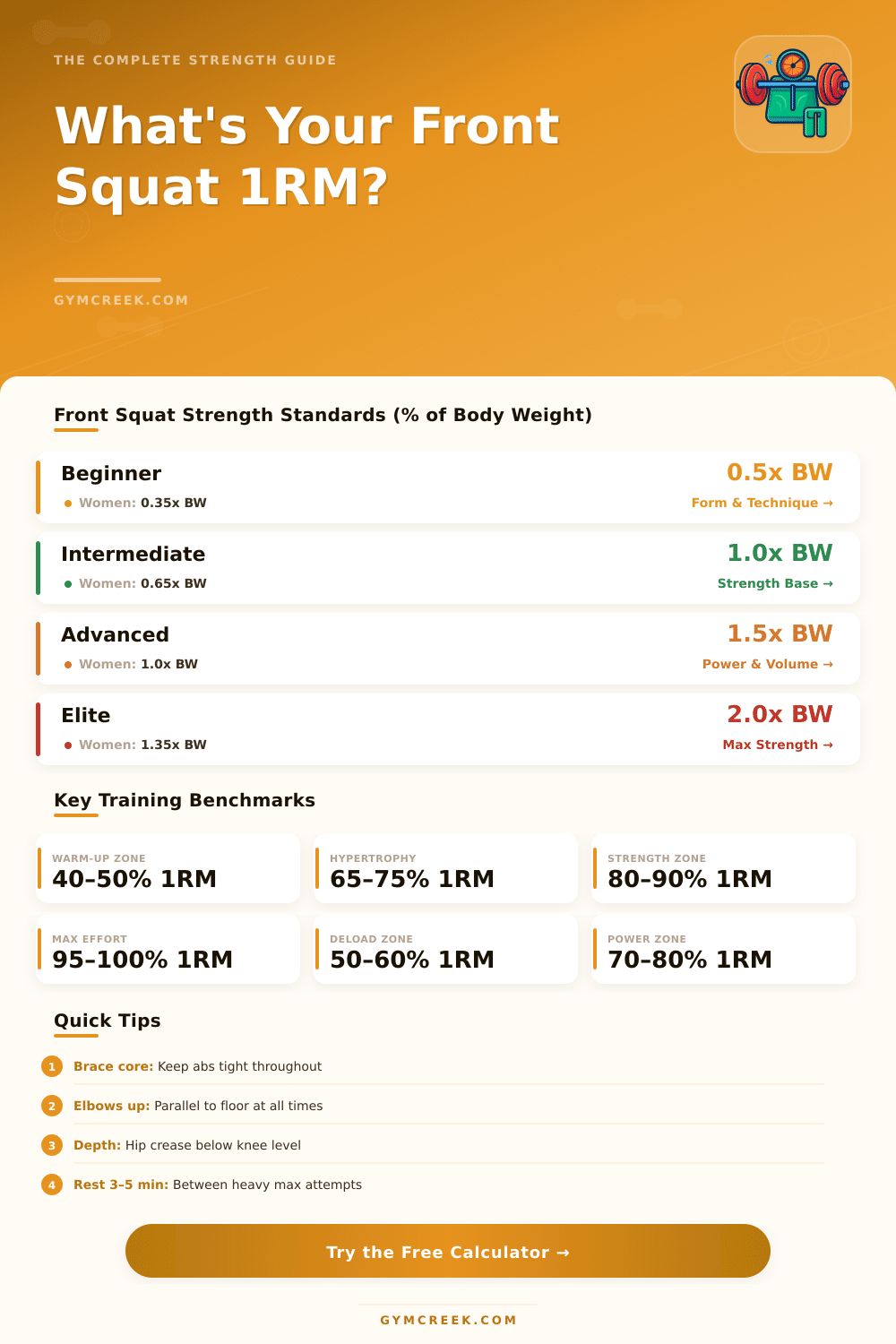
| Level | Men (x BW) | Men Example (80kg BW) | Women (x BW) | Women Example (60kg BW) |
|---|---|---|---|---|
| Beginner | 0.5x | 40 kg / 88 lbs | 0.35x | 21 kg / 46 lbs |
| Novice | 0.75x | 60 kg / 132 lbs | 0.5x | 30 kg / 66 lbs |
| Intermediate | 1.0x | 80 kg / 176 lbs | 0.65x | 39 kg / 86 lbs |
| Advanced | 1.5x | 120 kg / 264 lbs | 1.0x | 60 kg / 132 lbs |
| Elite | 2.0x | 160 kg / 352 lbs | 1.35x | 81 kg / 178 lbs |
| Formula | Best For | Accuracy (1-5 reps) | Accuracy (6-10 reps) |
|---|---|---|---|
| Epley | General use, most popular | ★★★★★ | ★★★★ |
| Brzycki | Lower rep ranges (1-10) | ★★★★★ | ★★★★ |
| Lander | Moderate rep ranges | ★★★★ | ★★★★ |
| Lombardi | Higher rep ranges (8-12) | ★★★ | ★★★★★ |
| Mayhew | Strength research reference | ★★★★ | ★★★ |
| Zone | % of 1RM | Rep Range | Primary Goal | Rest Period |
|---|---|---|---|---|
| Warm-Up | 40–50% | 10–15 reps | Motor pattern activation | 60–90 sec |
| Endurance | 50–60% | 15–20 reps | Muscular endurance | 60 sec |
| Hypertrophy | 65–75% | 8–12 reps | Muscle size & volume | 60–90 sec |
| Strength | 80–90% | 3–6 reps | Max force development | 3–5 min |
| Power | 70–80% | 2–5 reps (fast) | Explosive speed-strength | 2–4 min |
| Max Effort | 95–100% | 1–2 reps | Peak 1RM testing | 5–7 min |
| Metric | Front Squat | Back Squat | Notes |
|---|---|---|---|
| Avg 1RM Ratio | ~85% of Back Squat | 100% (baseline) | Varies by individual |
| Quad Activation | Higher | Moderate | Upright torso angle |
| Glute Activation | Moderate | Higher | More hip hinge involved |
| Core Demand | Very High | High | Bar position requires bracing |
| Spinal Load | Lower | Higher | Better for back issues |
| Mobility Required | Very High | Moderate | Wrist & thoracic flexibility |
If you truly care about building leg force, then your maximum Front Squat is one of those values that truly matters. According to the statistics, average male lifters reach around 105 kilos for one rep maximum, this gives good guidance. Even so, your own pattern can range a lot according to your experience in training and your body mass.
A good way to estimate your level is compare the Front Squat with the back squat. Usually, the Front Squat sits somewhere between 80 and 90 percent of the back squat. So, if you back squat 150 kg, probably your front maximum will be between 120 and 135 kg.
How to Find and Improve Your Front Squat
To be more precise, the typical ratio is 85 to 90 percent. Assume that you back squat 140 kg., then you could expect between 119 and 126 kg. For the front version.
What if you do not have a personal maximum yet? Here the math becomes fun. If you manage to do five good reps at maximum effort, that mathces around 87 percent of your real personal maximum.
So, assume that you reach 80 kg. For five reps (divide that by 0).87 and find a rough maximum of around 92 kg. There are also online calculators for that, if you want to skip the math.
When you use the Front Squat as your main exercise, the main target is reach heavy sets of 1 to 3 reps, above 90 percent intensity. Olympic lifters train Front Squats in the same range of 1 to 3 reps, although commonly without reaching the absolute maximum. Besides that, a good method is to switch exercises every three weeks, turning between squats, deadlifts, Front Squats and good mornings, staying in the 90 to 100 percent intensity zone with fewer reps.
For good relative force, aim for around 1.5 to 1.75 times your body weight, if you weigh between 82 and 104 kilos. Something reaching 2 to 2.25 times the body wait? This is truly impressive.
Here is the spot, better flexibility at ankles, shoulders and hip joints helps to close the difference between Front Squat and back squat. If the difference between them is big, it commonly shows limits of mobility instead of real strength gaps.
The Front Squats have their advantages compared with the back squats regarding muscle activity across the whole body, but with less pressure on the knees. This makes it truly a game changer for those that have knee problems like arthritis. Compared to the back squat, you will feel stronger work from the upper back and core.
It is one of the best exercises for building quadriceps. When you combine it with 2 to 3 other leg exercises, aim for 4 to 5 total sets. Heavy holds in front position at around 120 percent of your maximum, held for 30 seconds, alsoprove useful for building force.