🤱 Breastfeeding Calorie Deficit Calculator
Find your safe daily calorie target to lose weight while protecting your milk supply
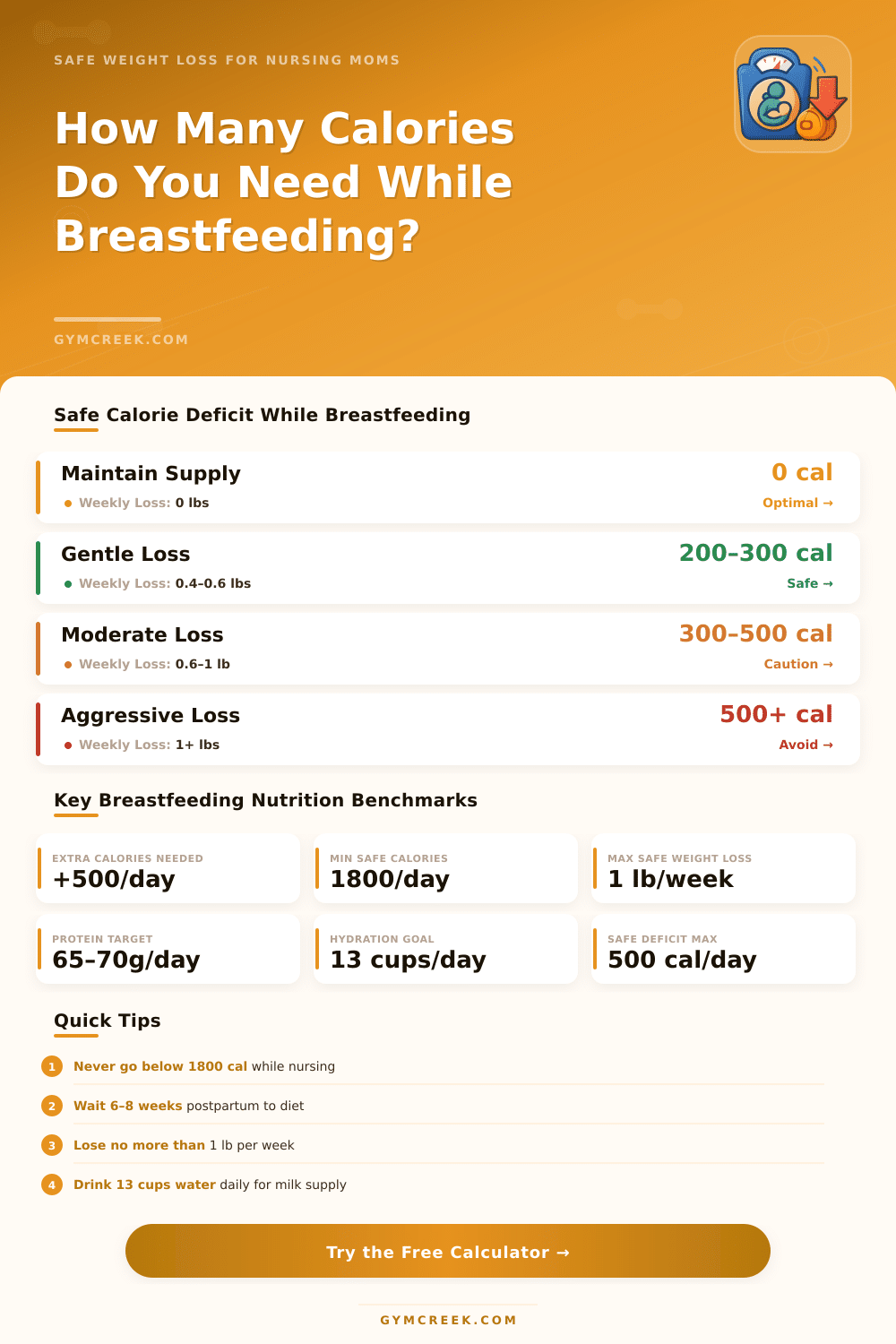
Most lactation experts recommend waiting at least 6–8 weeks postpartum before restricting calories. Your body needs time to establish milk supply. Never go below 1,800 calories/day while exclusively breastfeeding.
| Goal | Daily Deficit | Est. Weight Loss/Week | Safety for Milk Supply |
|---|---|---|---|
| Maintain Weight | 0 cal | 0 lbs | Optimal |
| Gentle Loss | 200–300 cal | ~0.4–0.5 lbs | Generally Safe |
| Moderate Loss | 300–500 cal | ~0.5–1 lb | Monitor Supply |
| Aggressive Loss | 500+ cal | 1+ lbs | Not Recommended |
| Nutrient | Non-Nursing Need | Breastfeeding Need | Key Food Sources |
|---|---|---|---|
| Calories | ~2,000 cal/day | ~2,300–2,500 cal/day | Whole foods, complex carbs |
| Protein | 46 g/day | 65–71 g/day | Eggs, chicken, legumes, fish |
| Calcium | 1,000 mg/day | 1,000 mg/day | Dairy, leafy greens, tofu |
| Iron | 18 mg/day | 9 mg/day | Red meat, spinach, lentils |
| Iodine | 150 mcg/day | 290 mcg/day | Seafood, dairy, iodised salt |
| Vitamin D | 600 IU/day | 600–800 IU/day | Salmon, fortified milk, sun |
| Fluid/Water | ~9 cups/day | ~13 cups/day | Water, milk, soups |
| Choline | 425 mg/day | 550 mg/day | Eggs, beef liver, salmon |
| Activity Level | Multiplier | Description | Example |
|---|---|---|---|
| Sedentary | 1.2 | Little or no exercise | Desk job, mostly resting |
| Lightly Active | 1.375 | Exercise 1–3 days/week | Short walks, light yoga |
| Moderately Active | 1.55 | Exercise 3–5 days/week | Regular gym, jogging |
| Very Active | 1.725 | Hard exercise 6–7 days/week | Daily workouts, active job |
| Extra Active | 1.9 | Very hard exercise + physical job | Athlete, construction worker |
| Weeks Postpartum | Expected Change | Recommendation | Deficit Status |
|---|---|---|---|
| 0–6 weeks | Natural fluid/blood loss (~10–14 lbs) | No calorie restriction | Avoid Deficit |
| 6–8 weeks | Milk supply stabilising | Establish supply first | Proceed Carefully |
| 8–12 weeks | Body adapting to new normal | Gentle deficit (200–300 cal) OK | Gentle Only |
| 3–6 months | 0.5–1 lb/week possible | Moderate deficit safe if supply strong | Moderate OK |
| 6+ months | Typical 1–1.5 lb/week | Standard approach with monitoring | Standard Safe |
Production of breast milk is truly an energy-hungry task. Your body spends between 400 and 700 calories daily to create it, but that amount adjusts according to your personal situation. It does not match for all women.
During exclusive Breastfeeding you probably require around 500 to 700 calories a day. Your weight, food and amount of milk that you truly make, everything affects where you ultimately stand.
Calories and Eating While Breastfeeding
Also, your basic Calorie needs grow by around 450 to 500 calories. So, if you eat more than before, that is entirely natural and even wanted. The most many sources suggest to add between 340 and 400 calories daily, although some reckon that more well are close to 500.
Constant starving in that period is not needed.
Here what is notable about breast milk: it averages around 171 calories for 250 milliliters. Sharing that, one finds about 65 calories for 100 milliliters. The makeup ranges through the day, fat, sugar, hormones, everything adjusts.
Since the fourth month babies usually drink between 24 and 30 ounces daily. To produce that amount you burn around 528 to 660 calories. Each ounce costs you around 20 calories from your energy.
Interestingly, after the 12-month limit the milk becomes denser and its Calorie content adjusts.
Nutrition during Breastfeeding matters more then many think. Eat and drink according to your feelings of hunger and thirst. A firm minimum sits between 1500 and 1800 calories daily, according to your separate case.
Under that it becomes too hard to get the nutrients that you truly require. Some guides warn to not go under 1800 calories during Breastfeeding. Fill your diet with fruits, vegetables and whole foods, while you reduce ready products, that is the good strategy.
Losing weight during Breastfeeding is possible, but it must happen cleverly. One pound each week is the ideal level for safety. If you eat at your usual level, that naturally creates a drop to remove fats.
But if you too roughly limit calories? Your milk supply will quickly drop. Many women notice that their supply falls when they are too harsh with restrictions.
Athletic nursing mums do not need to worry that training will affect their milk, quality and amount stays stable, and babies grow well. Even so, you must eat quite a lot of carbs for Breastfeeding and exercises. You still require those 400 to 500 extra calories plus around 16 cups of water daily.
Hydration and sleep also matter. Building muscles through strengthtraining beats simply cutting calories, because good nutrition keeps your milk, keeps energy high and boosts metabolism for future success.