🏃 VO2 Max Calculator for Runners
Estimate your aerobic capacity from your run performance – get your fitness category & training zones
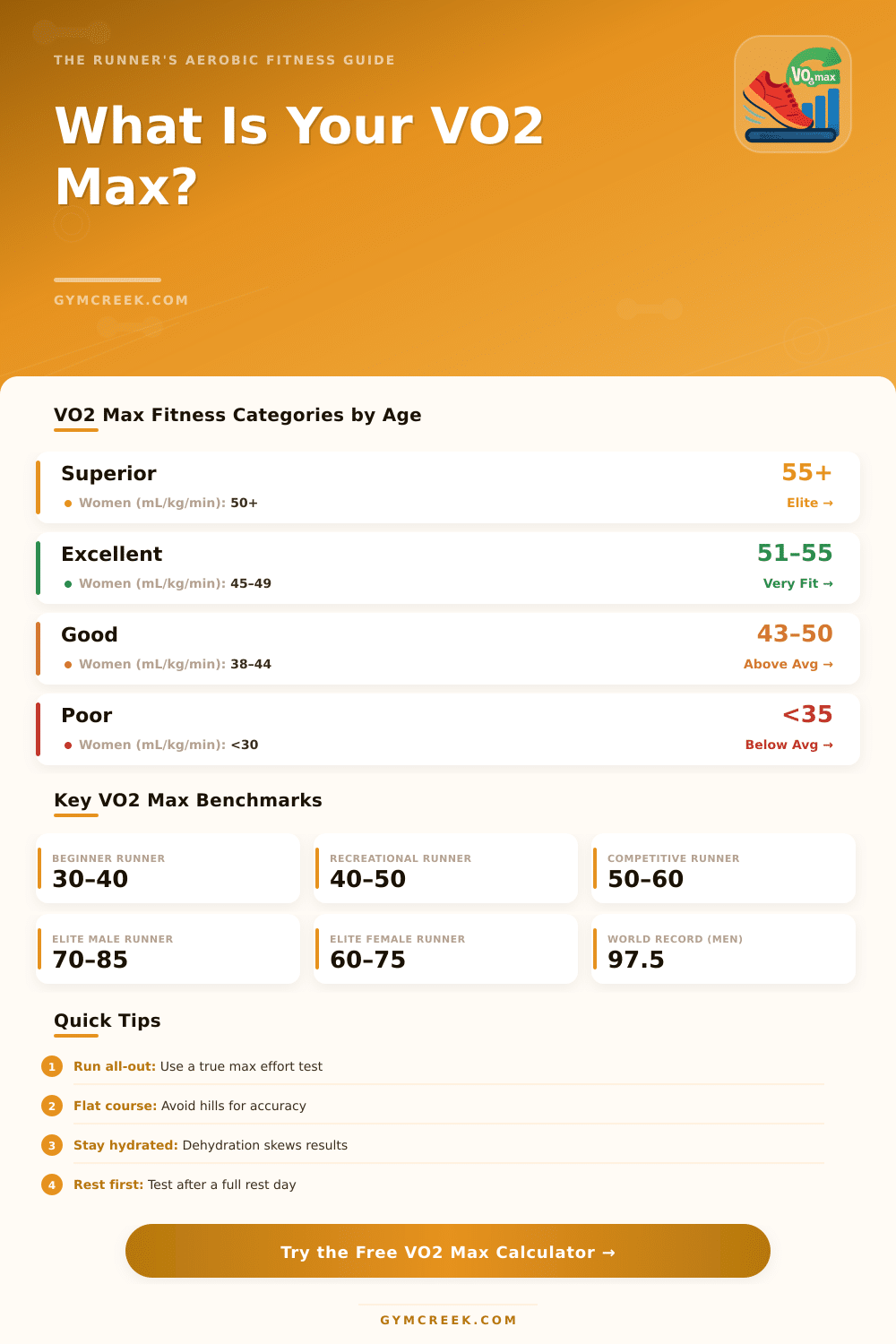
| Category | Men mL/kg/min | Women mL/kg/min | Description |
|---|---|---|---|
| Superior | ≥ 55 | ≥ 50 | Elite & competitive athlete |
| Excellent | 51 – 55 | 45 – 49 | Very fit, regular intense training |
| Good | 43 – 50 | 38 – 44 | Above average fitness |
| Fair | 35 – 42 | 31 – 37 | Average, moderate activity |
| Poor | 27 – 34 | 24 – 30 | Below average, sedentary |
| Very Poor | < 27 | < 24 | Highly deconditioned |
| Age Range | Men Avg (mL/kg/min) | Women Avg (mL/kg/min) | Typical Activity |
|---|---|---|---|
| 20 – 29 | 43 – 52 | 36 – 45 | Active young adult |
| 30 – 39 | 40 – 48 | 33 – 42 | Recreational runner |
| 40 – 49 | 36 – 44 | 30 – 38 | Moderate exercise |
| 50 – 59 | 32 – 40 | 27 – 34 | Regular walking/jogging |
| 60 – 69 | 27 – 35 | 23 – 30 | Light to moderate exercise |
| 70+ | 22 – 30 | 19 – 26 | Light activity |
| VO2 Max Range | 5K Finish Time | 10K Finish Time | Marathon Finish |
|---|---|---|---|
| 70 – 80+ | Sub 16:00 | Sub 33:00 | Sub 2:30 |
| 60 – 70 | 16:00 – 19:00 | 33:00 – 40:00 | 2:30 – 3:00 |
| 50 – 60 | 19:00 – 24:00 | 40:00 – 50:00 | 3:00 – 3:45 |
| 40 – 50 | 24:00 – 31:00 | 50:00 – 65:00 | 3:45 – 5:00 |
| 30 – 40 | 31:00 – 42:00 | 65:00 – 90:00 | 5:00 – 6:30 |
| Below 30 | 42:00+ | 90:00+ | 6:30+ |
| Zone | % Max HR | % VO2 Max | Purpose |
|---|---|---|---|
| Zone 1 – Recovery | 50 – 60% | ~40 – 50% | Active recovery, easy runs |
| Zone 2 – Aerobic Base | 60 – 70% | ~50 – 60% | Fat burning, endurance base |
| Zone 3 – Tempo | 70 – 80% | ~60 – 75% | Lactate threshold training |
| Zone 4 – Threshold | 80 – 90% | ~75 – 90% | Race pace, VO2 max work |
| Zone 5 – Max Effort | 90 – 100% | 90 – 100% | Intervals, speed work |
VO2 Max… It shows the upper limit of your body for oxygen use during strong physical work. The words are quite clear: V stands for volume, O2 for oxygen, and max for maximum.
It measures how much oxygen your body can take, move around and use during one minute. Most training trackers and tests show that in milliliters of oxygen for every kilo of body weight per minute.
VO2 Max: What It Is and How to Improve It
In the world of training, people see this measure as the gold flag for heart health and aerobic fitness. Here is the reasoning: the more oxygen you can use during hard work, the less heavy the same effort feels. If your VO2 Max is higher, your body simply becomes more efficient at pulling oxygen from the air and sending it to the muscles that need it.
Also, it ranks among the best measures that we have for guessing the lifespan of folks.
Swimmers, cyclists, runners and cross-country skiers; they all love the numbers of VO2 Max. That gives them a real way to track their fitness level. On the other hand, the practical value has limits based on the kind of sport. Body shape also matters.
Because VO2 Max is figured for every kilo of weight, losing fat while you keep your force does boost your result. Naturally, slimmer athletes tend too reach higher scores.
Several things decide the top of your VO2 Max: genetics, your age, the style of your training and your whole shape. Both men and women can boost theirs. Studies showed that mostly older adults that trained regularly for around nine to twelve months, managed to raise their VO2 Max by around twenty percent.
Women usually have a bit lower ability to transport oxygen… Because of less high levels of hemoglobin and slightly smaller hearts.
High-intensity interval training shows itself as one of the best ways to raise VO2 Max. Intervals that last from one to six minutes with equal rest periods between the strong efforts, is what coaches call VO2 Max work. Steady Running leaves its mark too. Training in zone 2 alone will not right away boost your VO2 Max, but it builds the basic aerobic base that you need for harder sessions.
Mixing zone 2 with interval sessions a few times weekly should move the needle. Real breakthroughneeds more training and raising the intensity.
Smart watches can guess VO2 Max, although they are not perfect. Only a lab test gives the real number. Those ratings from the watches rely on heart rhythm and speed data, not on actual study of breathing.
Sometimes the watch number differs from what the lab shows. VO2 Max does not always predict how you will race either.
Training through different levels helps with the gains. Supplements will not change much. The main profits come from better heart and breathing function, that both adapt through regular, hard aerobic work.